Last Updated
Key Takeaways
Generated from the text of customer reviews
Oracle Fusion Cloud ERP is a cloud-based platform for managing finance and business operations. Finance, procurement, and supply chain teams use it the most, with industrial manufacturing seeing the biggest benefit. Users praise its broad functionality and integrations, though setup and running costs draw criticism. Oracle expanded its AI agent tools in Release 26C on August 24, 2026.
Our Verdict
Oracle Fusion Cloud ERP works best for large, multi-entity organizations that need strong financial control and cross-functional visibility, especially in manufacturing and life sciences. Its depth in risk and compliance suits teams that handle complex approvals. While the functionality justifies the price, ongoing costs remain a common complaint. We recommend it for larger enterprises with solid IT support, not smaller or budget-conscious teams.
Oracle Fusion Cloud ERP Specifications
- Financial Management
- Inventory Management
- Supply Chain Management
- Project Management
What Is Oracle Fusion Cloud ERP?
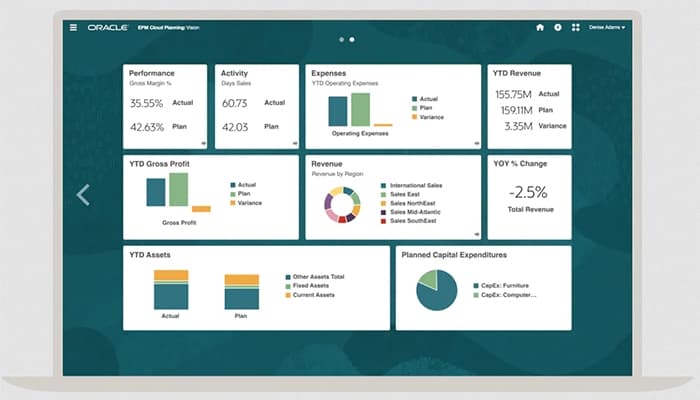
Oracle Fusion Cloud ERP is a cloud-based enterprise resource planning platform for organizations managing core financial and business operations. The platform brings together financial management, procurement, project management, risk management, and enterprise performance management in one connected environment. As a result, companies with complex processes or operations across multiple regions can easily access financial and operational data in one place. It is useful for multiple industries, such as manufacturing, retail, and e-commerce.
What Is Oracle Fusion Cloud ERP Best For?
It stands out for its AI-agent-driven financial management capabilities. AI agents take on repetitive finance tasks such as invoice matching, transaction checks, cash monitoring, and anomaly detection, flagging exceptions for human review. This adds AI automation to core accounting activities such as general ledger, accounts payable, accounts receivable, expenses, payments, and cash management. As a result, teams spend less time on manual checks and more time on decisions that require judgment.
How Much Does Oracle Fusion Cloud ERP Cost?
Oracle lists Fusion Cloud ERP at $625/user/month in its 2026 Global Price List. Since at least 10 users are required, expect a starting subscription cost of roughly $75,000/year.
Depending on the size of the rollout, buyers may also run into these expenses:
- Custom Integrations: $15,000–$100,000+ per integration, depending on complexity
- Implementation And Configuration: $400,000–$800,000+ for a core Finance deployment, with larger ERP projects costing more
- Training And Change Management: Typically 5–10% of the implementation budget for user training and adoption
- Post-Go-Live Services: $15,000–$80,000/month for ongoing technical support and application management
- Data Migration: $100,000–$250,000 for standard migrations, with complex projects costing significantly more
The software received mixed feedback on the cost. Several reviewers see good value in the platform’s extensive business functions and integrations. At the same time, high setup costs and expensive day-to-day running expenses come up repeatedly.
Disclaimer: The pricing is subject to change.
Oracle Fusion Cloud ERP Integrations
The software supports integration with multiple systems and platforms through Oracle Cloud ERP integration adapter, such as:
- QuickBooks
- PayPal Software
- SAP S/4HANA Cloud Public Edition
- Workday Enterprise Resource Planning (ERP) Tool
How Does Oracle Fusion Cloud ERP Work?
Follow these steps to get started with Oracle Fusion Cloud ERP:
- Sign in to Oracle Fusion Cloud ERP with your company credentials or single sign-on
- Navigate to the relevant application or work area from the main screen
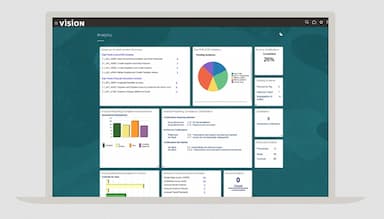
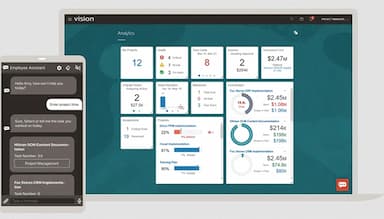
- Check dashboards for pending approvals, exceptions, alerts, and other items that need attention
- Add new business information or transactions when a process requires it
- Find existing records through search tools and filters when you need to review or update information
- Submit completed transactions for the required review
- Send the transaction for approval based on the rules set for your organization
- Authorize transactions assigned to you or send them back for correction
- Record approved financial activity in the appropriate ledger or accounting records
- Follow transaction progress and investigate items that remain pending or generate exceptions
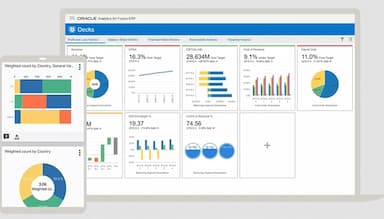
- Review reports and analytics to examine financial results and business activity
- Share information with connected Oracle or third-party systems through configured integrations
Who Is Oracle Fusion Cloud ERP For?
Oracle Fusion Cloud ERP is ideal for a wide range of industries and sectors, including:
- Retail
- Life sciences
- High technology
- Professional services
- Industrial manufacturing
Oracle Fusion Cloud ERP Use Cases
Our analysis of Oracle Fusion Cloud ERP features shows that it can support the following business scenarios:
Procurement Teams Conducting Cross-Brand Purchase Price Analysis
Oracle Fusion Cloud ERP places purchasing data from different brands or divisions into a shared environment for comparison. This helps procurement teams uncover situations where separate units pay different prices for the same item. It also exposes inconsistencies that would be difficult to spot across disconnected purchasing records.
Sales Teams Consolidating Customer Data Across Systems for Cross-Selling
Customer information scattered across separate applications makes it difficult for sales teams to understand purchasing activity across business lines. By bringing those records into a shared enterprise environment, Oracle Fusion Cloud ERP gives commercial teams a broader view of customer relationships. This helps them uncover relevant cross-selling opportunities.
Procurement Teams Detecting Enterprise-Wide Supplier Dependencies
Procurement teams can use Oracle Fusion Cloud ERP for visibility into sourcing patterns across the enterprise, making single-supplier dependencies easier to identify. That visibility addresses a common purchasing risk. A risk where businesses rely on a single source for critical products or materials and when that supplier cannot meet demand, the business becomes more exposed.
Hospitality Teams Managing Financials Across Multiple Properties
Oracle Fusion Cloud ERP brings financial and administrative activities such as invoicing and expense management into the enterprise environment used by hospitality organizations. This addresses the challenge of managing those functions across properties and departments to give hotel groups a broader financial view without the need to rely on isolated back-office records.
Is Oracle Fusion Cloud ERP Right For You?
Oracle Fusion Cloud ERP is a strong fit for organizations that need to monitor financial activity, user access, and ERP configurations. Its risk management capabilities cover separation-of-duties analysis, access certifications, transaction monitoring, and internal control assessments, with support for SOX and ICFR compliance. On top of these controls, embedded AI and more than 300 prebuilt algorithms can help flag suspicious activity, control violations, and higher-risk transactions for review.
AI is becoming a larger part of how Oracle handles enterprise processes. The company announced Fusion Agentic Applications for finance and supply chain on April 9, 2026. Rather than just generating recommendations, these specialized AI agents can make decisions and carry them out inside business processes. They operate within Oracle Fusion Cloud Applications and can access the data, policies, permissions, approval structures, and transaction details needed for those actions.
Release 26C, released on August 24, 2026, took the capabilities further. Oracle added hundreds of product updates and expanded its range of AI agents. The release also brought AI Studio Skill to AI Agent Studio. This gives developers a pro-code route for creating and modifying Fusion Agentic Applications, with support for development tools such as VS Code, Codex, and Claude Code.
Still doubtful if Oracle Fusion Cloud ERP is the right fit for you? Connect with us at (661) 384-7070 for further guidance.
Oracle Fusion Cloud ERP Features
Financial Planning And Forecasting
With this feature, companies can build budgets, create forecasts, test different financial scenarios, and examine how changing assumptions could affect results. Planning teams can compare projections, study financial trends, and model potential outcomes before committing resources. Predictive analytics can further support these activities by surfacing patterns in financial data so that planners spend less time on manual analysis and adjustments.
Accounts Reconciliation
Teams can use this functionality to manage account reconciliation, consolidation, journals, and other activities involved in closing the books. Finance staff can see outstanding close tasks, investigate account discrepancies, and review balances across entities from a shared environment, which cuts down on back and forth between systems. Automated tools can also flag unusual balances and transactions before the books are finalized.
Spend Management
Users can access this capability to manage sourcing, requisitions, purchasing, contracts, invoicing, and procure-to-pay activities. Guided buying directs employees toward approved products and purchasing channels, while automation handles routine purchasing transactions. Procurement teams can review spending patterns and purchasing activity from one system, giving them more time to assess costs and make sourcing decisions.
Supplier Management
The platform provides businesses with a way to manage supplier onboarding, qualification, profiles, certifications, evaluations, and performance information throughout the supplier relationship. Procurement teams can maintain supplier records and review performance from a shared source rather than tracking details across separate systems. Automated registration and information updates also reduce routine administrative work associated with supplier records.
Project Management
The software makes it possible to manage projects across planning, scheduling, budgeting, resource allocation, costing, billing, and revenue recognition. Project managers can compare actual spending with planned budgets and track financial performance as work progresses, which surfaces scope or cost changes early. Recurring project processes can also be automated to support consistent tracking of cost trends, resource considerations, and performance changes.
Asset And Lease Accounting
This functionality covers the financial lifecycle of fixed assets and leases, from acquisition and capitalization through depreciation, transfers, retirement, and reporting. Finance teams can also manage lease accounting requirements under standards such as IFRS 16 and ASC 842. Automated calculations handle recurring depreciation and lease entries, which supports consistent treatment even as asset and lease portfolios grow larger.
Supply Chain Management
Oracle Fusion Cloud ERP supports supply chain planning, inventory, manufacturing, order fulfillment, warehousing, and logistics. Teams can balance demand and supply, monitor stock across locations, coordinate production, and track shipments through transportation operations. Its logistics capabilities also cover freight management, delivery visibility, and global trade, helping teams respond to disruptions and fulfillment issues.
Pros And Cons of Oracle Fusion Cloud ERP
Pros
Flexible GL structures support varied accounting requirements
Broad OOTB functionality covers diverse finance requirements
Easy hierarchies simplify company and cost-center management
Cons
Quarterly updates may increase functional testing workload
Reporting feature needs improvement
Oracle Fusion Cloud ERP Reviews
Total 58 reviews
4.3
All reviews are from verified customers
Rating Distribution
5
Stars52%
4
Stars33%
3
Stars10%
2
Stars0%
1
Stars5%
Share your experience
Elizabeth H.
Retail, 51-100 employees
“Positive experience overall”
Pros
Using it mainly for company expenses has been a really positive experience. The system is quite simple overall and most parts of it are easy to figure out and use without much trouble.
Cons
Navigation can be annoying. It is not always clear how to go back or move between sections and I sometimes end up lost when trying to get to the expense area or find where to update my payment account settings.
Rating Distribution
Ease of use
10
Value for money
10
Customer Support
10
Functionality
10
Lettishia A.
Hospital & Health Care, 101-500 employees
“Complicated at first”
Pros
Keeping up with data was manageable thanks to correspondence features and regularly updated information. This product can offer quite a few valuable benefits overall.
Cons
It isn't very userfriendly when you're new to the system so getting around it can be challenging at first. That also makes it harder to learn yourself and more difficult to train new team members.
Rating Distribution
Ease of use
5
Value for money
6
Customer Support
6
Functionality
7
Frankie S.
Sports, 51-100 employees
“Cooperative support team”
Pros
Right from the start it has felt like a very user-friendly platform that delivers excellent value for the cost and fits small business needs really well. The customer support has also been excellent which makes a big difference when some team members need more time to get comfortable with the system and work through the learning curve.
Cons
At this point, I really haven't come across any actual downsides beyond a few personal preferences or minor pet peeves. Overall this app has been exactly what I needed when I needed it and I've been happy to recommend it to others looking for this kind of software.
Rating Distribution
Ease of use
10
Value for money
10
Customer Support
10
Functionality
10
Frequently Asked Questions
Does Oracle Fusion Cloud ERP provide an API?
Yes, it does offer API access.
What language does Oracle Fusion Cloud ERP support?
It supports Arabic, English, Dutch, Finnish, German, and many other languages.
What other apps does Oracle Fusion Cloud ERP integrate with?
Oracle Fusion Cloud ERP software Integrates with QuickBooks, PayPal, Software, SAP S/4HANA Cloud Public Edition, Workday.
Does Oracle Fusion Cloud ERP have a mobile app?
Yes, it does have a mobile app for iOS and Android.
What types of pricing plans does Oracle Fusion Cloud ERP offer?
Oracle Fusion Cloud ERP price starts at $625/user/month. The final cost varies depending on the requirements of businesses. Contact us to get a customized Oracle Fusion Cloud ERP cost estimate.
Who are the typical users of Oracle Fusion Cloud ERP?
It mainly caters to businesses operating in different industries and sectors, such as retail, life sciences, high technology, professional services, and industrial manufacturing.
What level of support does Oracle Fusion Cloud ERP offer?
It provides 24/7 support through live chat, phone, and ticketing system.