Last Updated

Key Takeaways

Generated from the text of customer reviews

ServiceBox streamlines field service operations by unifying scheduling, dispatching, and invoicing in a customizable platform. While initial setup requires process alignment, its flexible structure adapts to different workflows. It helps businesses systemize operations and enhance service delivery across fieldwork and billing functions. Recent updates include ServiceBox Version 8 inventory management system with stock tracking and reorder to improve job costing and workflow control.

Our Verdict

ServiceBox offers strong value for field service businesses needing an all-in-one platform for job management, scheduling, dispatching, invoicing, and customer management. It is appreciated for improving operational efficiency and reducing manual workload. Some users note concerns around pricing increases over time, especially during renewals or scaling. We recommend it for improving operations and end-to-end job visibility.

Overall Rating

Based on 152 users reviews

4.3

Rating Distribution

Positive

89%

Neutral

11%

Negative

0%

Starting Price
$75

per month
ServiceBox Specifications

  • Work Order Management
  • Scheduling & Dispatching
  • Mobile Access
  • Customer Relationship Management (CRM)
View All Specifications

What Is ServiceBox?

ServiceBox is a field service management software designed for field service businesses that need a more advanced solution. It offers extensive customization options, allowing users to adjust features to their specific requirements. Moreover, it helps companies manage schedules, invoices, and dispatches seamlessly. ServiceBox is a valuable solution that optimizes efficiency, reduces downtime, and improves customer experience for setups looking to streamline their operations.

What Is ServiceBox Best For? 

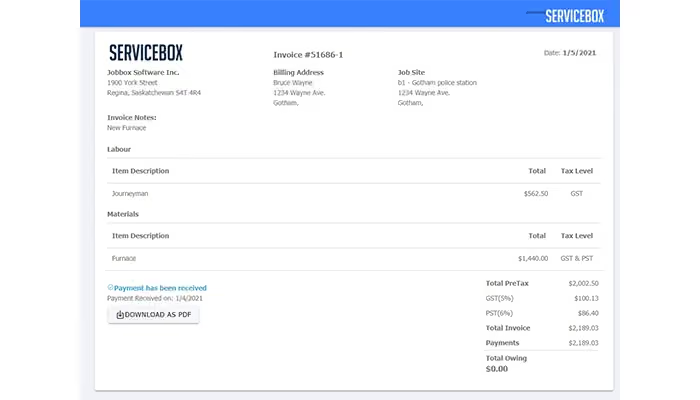
ServiceBox is best known for its ‘Invoicing’ feature which helps field service businesses create, send, and track invoices with minimal manual effort. Users can generate one-click invoices from quotes or work orders, automatically transfer job notes, photos, and signatures into invoices, and email customers directly with integrated payment links. With real-time invoice tracking, recurring billing automation, and on-site payment collection, it helps businesses reduce billing delays and get paid faster. 

How Much Does ServiceBox Cost?

ServiceBox price starts at $35/month for a standard user. The pricing plans it offers include: 

  • Starter: $75/month (For 2 Users)

  • Standard: $210/month (For Up To 50 Users) 

  • Premium: $330/month (For Unlimited Users) 

  • Enterprise: Custom Pricing 

In addition, organizations should keep the following additional costs in mind based on the industry benchmarks: 

  • Implementation And Onboarding: $500–$5,000 for small teams and $5,000–$20,000+ for mid-sized field service operations with workflow configuration, staff training, and setup of dispatching systems

  • Data Migration: $1,000–$10,000 depending on volume and complexity of historical service records and asset histories 

  • System Integrations: $2,000–$15,000+ depending on the number and complexity of integrations such as accounting software, ERP systems, or custom APIs 

  • Training And Change Management: $1,000–$8,000 for technician onboarding, dispatcher training, and administrative setup across teams 

Users generally view ServiceBox pricing as good value for money, particularly given its wide range of field service management features and operational efficiency benefits. Many reviewers highlight that it helps reduce manual work, improves job tracking, and streamlines invoicing and scheduling, making the cost worthwhile for service-based businesses. However, some users note concerns around pricing increases over time, especially during renewals or as businesses scale, which can lead to cost-related reconsideration despite the platform’s overall usefulness. 

Request a detailed analysis of the ServiceBox cost to pick a suitable package for your business.

Disclaimer: The pricing is subject to change. 

ServiceBox Integrations

ServiceBox offers integration with multiple third-party platforms, including: 

How Does ServiceBox Work? 

Log in to ServiceBox to access a cloud-based field service management platform for scheduling, dispatching, job tracking, invoicing, and customer management. Follow the steps below to use its core features: 

  • Set up your company profile, users, and customer database to centralize service operations in one system

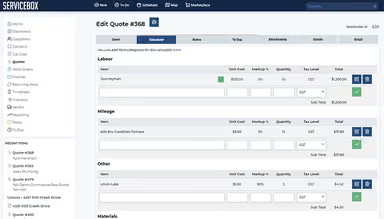
  • Create estimates and quotes for customers, then convert approved quotes into jobs or work orders with minimal manual effort

  • Schedule and dispatch technicians using the drag-and-drop calendar to assign jobs based on availability and location  

  • Give field staff mobile access to job details, customer information, notes, photos, forms, and checklists while on-site

  • Track labor, materials, expenses, and job progress in real time to maintain visibility across ongoing work

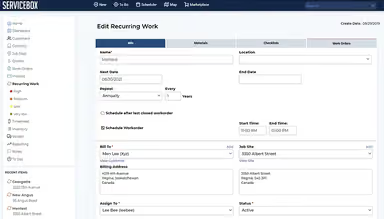
  • Manage recurring maintenance programs with automated work order generation, contract reminders, and maintenance checklists 

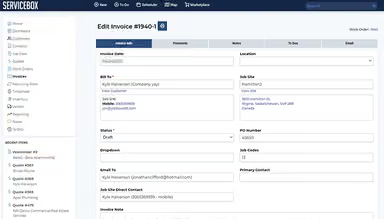
  • Generate invoices from completed jobs, collect payments, and sync financial data with supported accounting software 

  • Review reports, monitor business performance, and track customers, work orders, invoices, and recurring service activities from a centralized platform 

Book a free ServiceBox demo to learn more about its functionality and offerings.

Who Is ServiceBox For?

ServiceBox is suitable for different industries, such as:

  • Plumbing
  • Industrial maintenance
  • HVAC
  • Fire safety
  • Commercial service contracting

ServiceBox Use Cases 

Based on our analysis of ServiceBox’s features and product positioning, we have identified key scenarios where the platform is commonly used by field service businesses, contractors, and maintenance providers for job management, scheduling, invoicing, and workforce coordination: 

1. HVAC Companies Improving Customer Experience And Service Follow-Up 

HVAC companies frequently handle customer concerns related to missed appointments, communication gaps, recurring equipment issues, and service quality. Resolving these situations effectively requires quick access to customer history, previous work orders, technician notes, and ongoing maintenance records. ServiceBox helps HVAC businesses centralize customer information, track service activity, manage recurring maintenance programs, and improve communication between office staff and field technicians. This enables teams to respond to customer concerns with accurate information, maintain service consistency, and strengthen long-term customer relationships. 

2. Electrical Contractors Growing Their Customer Base And Managing Increased Service Demand 

Electrical businesses looking to expand their customer base often invest in marketing initiatives to generate more service requests, estimates, and project opportunities. As lead volume increases, managing customer information, scheduling appointments, dispatching technicians, and tracking job progress can become more complex. ServiceBox supports growing electrical contractors by centralizing customer records, streamlining scheduling and dispatching, managing quotes and work orders, and providing mobile access for field technicians. This helps businesses maintain operational efficiency as they scale while ensuring new customer inquiries and service requests are handled effectively. 

3. Plumbing Contractors Saving Time And Streamlining Job Management With The Software 

ServiceBox helps plumbing contractors significantly reduce the time spent on manual administrative tasks by centralizing job scheduling, customer management, quoting, invoicing, and field communication within a single platform. Instead of switching between spreadsheets, paper-based systems, or disconnected tools, plumbing businesses can create quotes, convert them into work orders, dispatch technicians, and generate invoices from one streamlined workflow. With mobile access for field staff, real-time job updates, automated documentation, and integrated billing processes, ServiceBox enables plumbing companies to complete jobs faster, reduce paperwork, and improve overall operational efficiency as service demand increases. 

4. Fire Safety Service Providers Scaling Operations And Managing Compliance-Driven Growth 

The platform is suitable for fire safety service providers that are expanding their operations and facing increased demand for inspections, maintenance contracts, and compliance documentation. As these businesses grow, they often struggle to manage recurring inspection schedules, track certification requirements, coordinate field technicians, and maintain accurate records for regulatory audits. ServiceBox helps address these challenges by centralizing customer and asset information, automating recurring inspection work orders, streamlining scheduling and dispatching, and enabling technicians to complete digital checklists and reports in the field. This ensures fire safety companies can scale their service delivery while maintaining compliance accuracy, improving operational efficiency, and reducing the risk of missed inspections or incomplete documentation. 

Is ServiceBox Right For You?

ServiceBox software is a reliable option for businesses seeking an all-in-one solution to systemize job management, scheduling, invoicing, and customer relations. Its robust features and mobile accessibility make it ideal for efficient operations and growth. For its seamless and intuitive functionalities, ServiceBox is a go-to choice for hundreds of businesses, such as Reliatech HVAC Inc. and One Degree HVAC.

Are you still unsure about ServiceBox? Contact us at (661) 384-7070 for further expert assistance regarding any questions.

ServiceBox Features

Job Management

This feature streamlines daily operations by converting quotes to work orders and invoices effortlessly. It tracks jobs, manages customer files, records billable hours, and ensures seamless communication between field staff and admins.

See How It Works
Scheduling And Dispatching

It enables users to manage staff efficiently using drag-and-drop scheduling, GPS tracking, and dispatch notifications. It minimizes confusion, optimizes tech time, and allows quick responses to emergencies.

See How It Works
Invoicing Software

The software helps businesses create paperless invoices instantly. It enables users to email invoices, track payments, and receive customer payments directly. All in all, it enhances cash flow and improves overall financial efficiency.

See How It Works
Customer Information Management

ServiceBox simplifies the process of managing customer history, tracking payments, prioritizing service agreements, and automating recurring work orders. Thus, it ensures a superior customer experience every time.

See How It Works
Mobile Connectivity

It facilitates ongoing connectivity for users through an application. ServiceBox mobile app provides seamless access to all its features, ensuring technicians and admins can collaborate effectively from any device at any time.

See How It Works
Preventive Maintenance

The feature assists businesses in managing ongoing maintenance contracts with automated reminders, recurring work orders, checklists, and intuitive reporting. Overall, it helps retain customers and grow repeat business effortlessly.

See How It Works
Time And Billing

It enables users to track employee work hours and record billable time directly against jobs and work orders. It simplifies timesheet logging, improves accuracy in labor tracking, and ensures time entries can be easily converted into invoices. Overall, it enhances billing accuracy and improves visibility into workforce productivity.

See How It Works
Inventory Management

It enables users to track parts, materials, and stock levels across jobs and warehouses in real time. It helps businesses manage inventory usage against work orders, reduce manual stock tracking, and avoid shortages or over-ordering. Overall, it improves operational efficiency and ensures technicians always have the right materials available for service work.

See How It Works
Payments Processing

ServiceBox enables users to accept and manage customer payments directly within the platform by integrating payment processing into invoices and work orders. It allows businesses to collect payments in the field or online, track payment status in real time, and reduce cash flow delays. This simplifies the payment process, helps service companies get paid faster, and improves financial visibility.

See How It Works

Pros And Cons of ServiceBox

Pros

  • Helps streamline time tracking by generating timesheets from completed work orders

  • Users appreciate the scheduling functionality, including the ability to incorporate holidays and other calendar events

  • The reporting tools assist businesses in reconciling invoices, reviewing work orders, and monitoring job activity

Cons

  • Several users mention that opening work orders on the mobile app often requires loading a webpage, which creates delays

  • Files attached during the work order stage may not be readily accessible when creating invoices

ServiceBox Pricing

Starter

eye

View Price

What's Included

  • 200 Customers

  • 300 Job Sites

  • 1 GB of Data

  • Access to All Standard Features

Standard

eye

View Price

What's Included

  • All features in the Starter plan, plus:

  • Unlimited Customers

  • Unlimited Job Sites

  • Unlimited Data

  • Quotes

  • Work Orders

  • Recurring Work Orders

  • Invoicing

  • Expenses

  • Payments

Premium

eye

View Price

What's Included

  • All features in the Standard plan, plus:

  • Inventory

  • Multi Location

  • Purchasing

Enterprise

eye

View Price

What's Included

  • All features in the Premium plan, plus:

  • 1-on-1 Product Support

  • Mobile App

  • Data Import

  • Equipment Tracking

  • Client Reporting

  • White Glove Onboarding

Disclaimer: The pricing details were last updated on May 15, 2026 from the vendor's website. Please contact us for a tailored pricing list.

ServiceBox Reviews

Total 152 reviews

4.3

All reviews are from verified customers

Rating Distribution

5

Stars

47%

4

Stars

42%

3

Stars

11%

2

Stars

1%

1

Stars

0%

Share your experience

SO

Stefanee O.

Electrical/ Electronic Manufacturing, 11-50 employees

4.0
November 2025

Easy to create progress invoices

Pros

Creating progress invoices was easy for me and I never had a problem accidentally charging twice for materials or labour. When I logged materials and labour on a job, the entries were always dated and timesheets were simple to manage.

Cons

I had a hard time using the online payment portal. Support was inconsistent and I rarely got a fast response. The reporting tools felt clunky and not easy to use. I wish there were more automation options for example, automatic invoice follow-ups would be really helpful.

Rating Distribution

Ease of use

8

Value for money

10

Customer Support

8

Functionality

9

NP

Nathan P.

Retail, 51-100 employees

5.0
October 2025

Easy to figure out

Pros

I picked it up really quickly because it's so user-friendly. There are almost no software glitches, it works across multiple devices and I can easily locate details like work orders, quotes or other records whenever I need them.

Cons

For me, the follow-up function still needs refinement because it's very hard to clear alerts. I've been struggling to figure out how to dismiss them for quite some time.

Rating Distribution

Ease of use

10

Value for money

10

Customer Support

10

Functionality

10

EH

Edvard H.

Security and Investigations, 11-50 employees

3.0
October 2025

Integrates well with Quickbooks

Pros

What I appreciate most is that it connects directly to QuickBooks. It's really convenient having so many of our business functions consolidated into a single platform.

Cons

What frustrates me is the absence of an appointment feature. For instance, we often split work orders among several technicians and it would be extremely helpful to be able to assign appointments to each tech so we can accurately track their hours, notes and any upsell opportunities.

Rating Distribution

Ease of use

8

Value for money

10

Customer Support

10

Functionality

9

Frequently Asked Questions

Does ServiceBox offer an API?

No, ServiceBox does not offer an API.

What language does ServiceBox support?

ServiceBox supports only the English language.

Who are the typical users of ServiceBox?

The typical users of ServiceBox are from different industries, such as HVAC, electrical, plumbing, commercial contracting, security, duct cleaning, industrial maintenance, refrigeration, and fire safety.

What level of support does ServiceBox offer?

ServiceBox offers support through phone, chatbot, email, and a knowledge base.

Does ServiceBox have a mobile app?

Yes, ServiceBox offers a mobile app for both Android and iOS devices.

What types of pricing plans does ServiceBox offer?

ServiceBox pricing starts at $35/month for a standard user. Other paid plans include Starter at $75/month, Standard at $210/month, Premium at $330/month, and Enterprise with custom pricing. Get a personalized ServiceBox price estimate now.

What other apps does ServiceBox integrate with?

ServiceBox integrates with Sage 50, Sage 300, Sage 100, QuickBooks Desktop, and QuickBooks Online.