Last Updated
Key Takeaways
Generated from the text of customer reviews
Kizen is an AI agent orchestration and application-building platform used by sales, marketing, and operations teams in insurance, financial services, and healthcare. Users cite its customization for different workflows as a strength, while initial difficulty navigating the platform remains a common concern. Recently, Kizen launched the Ultimate AI Assistant for Insurance Agents, which automates post-call documentation.
Our Verdict
Kizen is a strong fit for growing organizations managing regulated, document-heavy operations. Pricing tends to be steep for smaller teams, though larger organizations report it pays off through automation gains. We recommend it for mid-to-large organizations that need coordinated contracting, commission, and CRM workflows built around AI agents.
Kizen Specifications
- Contact Management
- Lead Management
- Opportunity Management
- Sales Forecasting
What Is Kizen?
Kizen is an AI platform focused on agent orchestration and workflow automation used by insurance, financial services, and healthcare organizations that need to automate document-heavy, multi-step processes. The platform provides tools to build and monitor AI workflows that adjust as processes change over time. It also includes an application builder that lets teams create custom internal tools with minimal custom coding. These features reduce manual processing work and can support operations for growing or multi-location organizations.
What Is Kizen Best For?
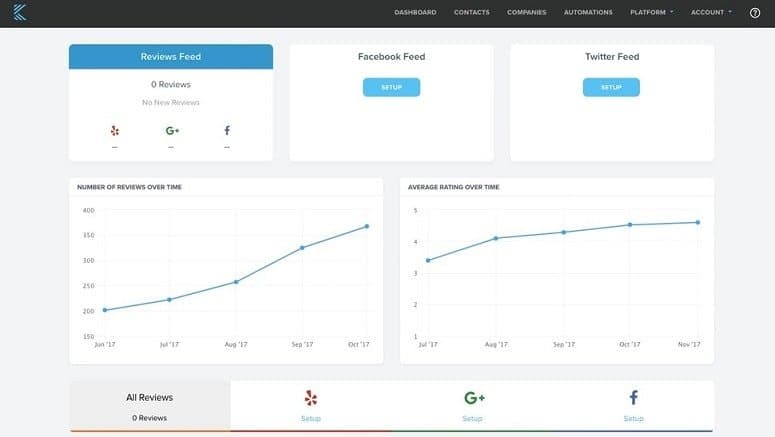
Kizen is best known for its AI-native CRM built for sales, marketing, and operations teams. It captures customer interactions and turns them into structured CRM records without manual logging. It also flags deals that may be at risk based on signs like missed follow-ups or unresolved commitments. The software is a strong fit for those handling growing transaction volumes, moving away from manual data entry and fragmented systems, or coordinating multi-location teams.
How Much Does Kizen Cost?
Kizen pricing is estimated to fall between $2,500 and $15,000+/month, based on industry benchmarks for comparable agentic AI orchestration and AI-native CRM platforms. This range gives a general sense of budget scale. What a specific organization pays will depend on factors like the number of users, how deeply AI agents are deployed, what industry-specific compliance is needed, and how much customization or app-builder work is involved.
In addition to the base subscription costs, organizations should account for the following expenses:
- Implementation: Usually priced between $5,000–$50,000 (one-time), covering Agentic OS setup, workflow configuration, and the initial environment setup, with costs varying based on the scope of the deployment
- Data Migration: Commonly priced in the range of $3,000–$25,000 (one-time), depending on how much CRM, contract, or policy data needs to be transferred and how the existing data is organized
- Training And Onboarding: Typically falls around $2,000–$15,000 (one-time), covering training for administrators and end users on building AI agents, using CRM features, and working with automated workflows
- Integrations: Often comes in between $2,500–$20,000 (one-time), depending on how many external systems need to be connected and how complex those connections are
- Customization And Configuration: Usually priced between $5,000–$40,000 (one-time), depending on the level of custom AI agent development, application configuration, and workflow setup needed
User reviews generally describe Kizen's pricing as high for small businesses and smaller teams. Many users find the cost justified given its automation capabilities and ROI, while smaller agencies and businesses with larger teams frequently flag affordability concerns as the price scales up.
Disclaimer: Pricing references are based on publicly available third-party information and industry benchmarks. Actual costs may vary.
Kizen Integrations
The software supports integration with multiple systems and platforms, such as:
- Twilio software
- Okta
- Google Calendar
How Does Kizen Work?
Log in to your Kizen software account and follow the given steps to benefit from its features:
- Set up workflows by defining the business processes and rules that AI agents will follow
- Connect existing systems and data sources so records and activities stay synced across the platform
- Build custom applications or CRM structures using the app builder, with minimal custom coding
- Automate document processing by having AI agents classify, extract, and route information from files
- Monitor agent activity by reviewing workflow performance, accuracy, and token usage
- Route exceptions to team members when items fall below a set confidence threshold, keeping human review in the loop
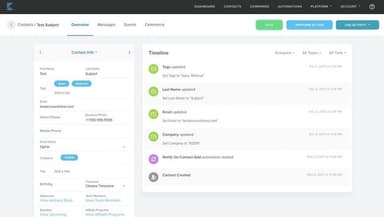
- Manage records and communications through the CRM, including customer interactions and pipeline updates
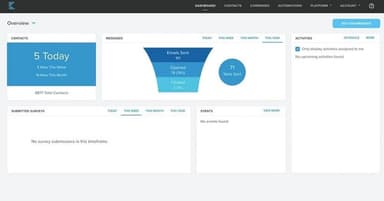
- Generate reports and dashboards to track operational metrics across teams
Who Is Kizen For?
Kizen is suitable for industries, sectors, and user types, including:
- Insurance
- Enterprise developers
- Healthcare
- Financial services
Kizen Use Cases
Based on our analysis of user reviews and Kizen's current capabilities, we have identified key scenarios where this software is a good fit for organizations across insurance, financial services, healthcare, e-commerce, and sales operations:
Insurance Agencies And FMOs Managing Contracting And Commissions
Insurance agencies and FMOs that oversee large networks of downline agents often end up tracking carrier contracting status and calculating commission overrides by hand, level by level. With multiple carriers involved, discrepancies are easy to miss during manual reconciliation. Kizen can help by monitoring contracting requests in real time and flagging commission calculations automatically for review.
Lenders And Financial Institutions Automating Document-Heavy Underwriting
Banks, credit unions, and mortgage lenders processing loan packages work through borrower financial statements and supporting documents that arrive in inconsistent formats. Classifying and entering this data by hand slows underwriting and raises the chance of error. Kizen could help lending teams that need loan documentation classified and extracted automatically, with low-confidence items sent to human reviewers.
Healthcare Organizations Reducing Administrative Workload
ACOs, providers, and payers managing patient intake and care coordination handle a high volume of administrative tasks that pull staff away from patient-facing work. Keeping documentation and onboarding steps consistent gets harder as patient volume grows. Kizen may help healthcare organizations that need administrative workflows automated so clinical and support staff spend less time on repetitive paperwork.
E-Commerce Brands Managing The Customer Lifecycle
Online retailers running onboarding, subscription renewals, and post-purchase outreach often need customer data pulled from their store platforms before campaigns can go out. Without that sync, marketing and service teams work from outdated or incomplete customer information. Kizen might suit e-commerce brands that need store data connected to automated campaigns to support onboarding, renewals, and customer success at scale.
Sales And Go-To-Market Teams Monitoring Deal Risk
Sales and go-to-market teams managing growing pipelines can lose track of deals that are quietly stalling, especially when follow-ups go unlogged or commitments made on calls are never recorded. Spotting these patterns manually takes time reps don't always have. Kizen may support sales teams that need at-risk deals flagged automatically based on patterns like missed follow-ups.
Is Kizen Right For You?
If you're an insurance agency, financial institution, or healthcare organization handling regulated, document-heavy workflows, Kizen could be a strong fit. Trusted by clients like Pinnacle Financial Services, AmeriLife, and Gordon Marketing, the platform supports millions of mission-critical business processes and provides production-ready AI assistants for business teams. It has been associated with significant productivity improvements and meets ISO 27001, SOC 2 Type II, HIPAA, and FedRAMP compliance standards.
Still unsure about Kizen? Connect with us at (661) 384-7070 for further guidance.
Kizen Features
Contracting CoPilot
This feature checks licensing details against carrier and state requirements before a contracting request moves forward. It tracks each request's status in real time and keeps agent data synced with Ready-to-Sell records and carrier rosters. Agent hierarchies are built automatically as agents are added, and exceptions are routed through configurable workflows rather than a manual queue.
Commissions CoPilot
Commission payments and overrides are calculated using contracting records, agent hierarchies, and policy data, with the correct rate logic applied at each level. The software generates commission statements, builds payment summaries, and flags transactions that show signs of a discrepancy. Commission structures update automatically when an agency's level changes.
Agent And Agency Portal
Agents and agencies access a single portal showing commissions, production metrics, licensing status, certifications, and contract requests. The portal also displays unpaid policies and Ready-to-Sell information, alongside dashboards that can be customized to show different views of operational activity.
Agent CRM
The CRM stores prospect and client records and logs interactions as they occur. It triggers follow-up activities based on that activity, drafts outreach emails, summarizes meetings, and manages automated sales sequences. Cross-sell opportunities are surfaced within the system, and customer records stay synced with connected tools.
Application Builder
Starting from a natural language prompt, the application builder generates business applications, customer portals, custom CRM systems, and workflow automations, along with the supporting code, APIs, and database structure. Built applications include role-based permissions and real-time synchronization and can be deployed to the cloud for enterprise use.
Pros And Cons of Kizen
Pros
Speeds up insurance contracting and commission processing
Makes business information easier to find and manage
Reduces delays caused by manual document handling
Gives teams greater visibility into operational performance
Helps sales teams respond before deals lose momentum
Cons
Interface can feel overwhelming during initial use
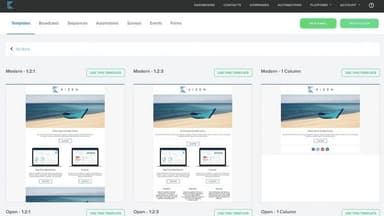
Setting up email templates could take up some time
Integration with some platforms can be challenging
Kizen Reviews
Total 37 reviews
4.4
All reviews are from verified customers
Rating Distribution
5
Stars46%
4
Stars43%
3
Stars11%
2
Stars0%
1
Stars0%
Share your experience
Saleem B.
Small Business, 11-50 employees
“very user-friendly”
Pros
Really easy for everyone to use. The interface just feels natural and user-friendly.
Cons
The marketing could be better. They need to reach a broader audience across different age groups.
Rating Distribution
Ease of use
9
Value for money
9
Customer Support
9
Functionality
9
Jatin Y.
Mid Market, 51-100 employees
“Automation tools create engaging email campaigns”
Pros
I appreciate the marketing automation features that let me set up email campaigns to keep customers engaged. The reporting and tracking capabilities give me solid sales insights and I love how customizable the workflows and business charts are for my specific needs. The integration tools make it easy to connect with my e-commerce platform too.
Cons
Integration process can be really tricky and causes problems when trying to connect with other software and platforms.
Rating Distribution
Ease of use
8
Value for money
8
Customer Support
8
Functionality
7
Steven W.
Small Business, 11-50 employees
“Improved our external communication”
Pros
The automation features and data tracking capabilities have really improved our external communications while maintaining consistent branding. Having that activity log creates accountability that's improved our overall quality.
Cons
Managing the automation features requires skills that are tough to handle internally and we still need help from our Kizen account manager to make adjustments.
Rating Distribution
Ease of use
10
Value for money
10
Customer Support
10
Functionality
8
Frequently Asked Questions
Does Kizen offer an API?
Yes, Kizen offers an API.
What language does Kizen support?
Kizen software primarily supports English.
What types of pricing plans does Kizen offer?
Kizen pricing is estimated to range between $2,500 and $15,000+/month, based on industry benchmarks for comparable agentic AI orchestration and AI-native CRM platforms. Get a detailed Kizen cost breakdown to make an informed decision.
What other apps does Kizen integrate with?
Kizen integrates with Okta, Google Calendar, and Twilio.
Who are the typical users of Kizen?
Kizen features are used by insurance agencies, financial institutions, healthcare organizations, enterprise developers, sales teams, and operations teams managing regulated and document-heavy workflows.
What level of support does Kizen offer?
Kizen offers support via a ticketing system and a knowledge base.
Does Kizen have a mobile app?
No, Kizen does not offer a dedicated mobile app.