


Foundation AI
Last Updated
Overview
Foundation AI automates document intake and routing for legal and insurance teams using pre-trained models. It classifies documents, extracts key details, and flags time-sensitive items for review. While firms with complex workflows may need customization, the platform supports document processing across high-volume operations.
Be the first one to leave a review!
No review found

Starting Price
Custom

Foundation AI Specifications
- Document Management
- Document Automation/Assembly
- Workflow Automation
- Compliance & Security Features
What Is Foundation AI?
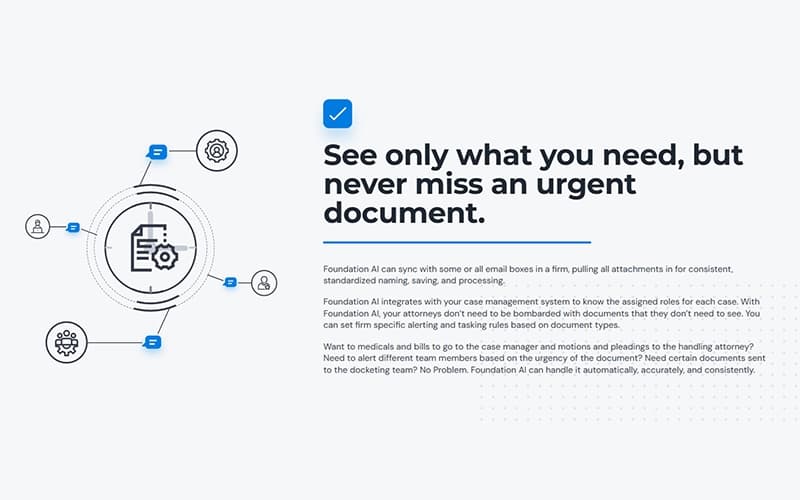
Foundation AI is a document operations platform for law firms and insurance claims departments that handle large volumes of incoming documents and correspondence. It captures documents, emails, and attachments from inboxes, e-fax, portals, and physical mail, then classifies them, matches them to the correct client matter or claim file, and routes them to the appropriate person or workflow.
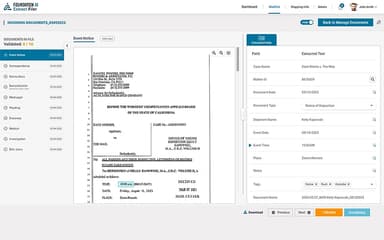
The platform uses fine-tuned large language models, retrieval-augmented generation (RAG), business logic, and jurisdiction-specific taxonomies to classify documents and extract key details. It also assigns confidence scores to classifications, file matches, and extracted fields, allowing uncertain results to be sent for human review instead of processed automatically.
Foundation AI offers two product lines: a document operations platform for law firms and Claims Operations for insurers, third-party administrators (TPAs), and claims departments.
What Is Foundation AI Best For?
The platform stands out for its 'Capture' feature which pulls every incoming document, including physical mail, e-fax, portal downloads, and email attachments, into one standardized workflow. Its 'Total Email Capture' function monitors designated email accounts, captures matter related TPAs and deduplicates copies sent to multiple recipients. The originating email is tagged in Outlook or Gmail, so staff can see the attachment has already been captured, saved, and processed downstream.
How Much Does Foundation AI Cost?
Foundation AI price is estimated to range between $2,100-$7,500/month based on industry benchmarks for enterprise intelligent document processing and legal technology platforms.
In addition to the base subscription costs, organizations should account for the following expenses as well:
- Implementation And Configuration: $5,000–$25,000 one-time, depending on workflow complexity, taxonomy configuration, and deployment requirements
- Practice Management And Claims System Integrations: $3,000–$15,000 per integration, depending on systems such as Clio, Filevine, CASEpeer, Litify, SmartAdvocate, Smokeball, or Salesforce
- Custom AI Taxonomy And Model Configuration: $5,000–$20,000 one-time, based on jurisdiction-specific classification, extraction rules, and matter or claim types
- High Volume Document Processing: $1,000–$10,000+/month in additional usage costs for organizations exceeding standard document processing volumes
- BI And Reporting Integrations: $2,000–$10,000 one-time for feeds and connections to platforms such as Domo or Power BI
Disclaimer: Pricing references are based on publicly available third-party information and industry benchmarks. Actual costs may vary.
Foundation AI Integrations
The software integrates with multiple third-party systems, including:
How Does Foundation AI Work?
Here's how you can access the platform and use its features:
- Log in to the Foundation AI platform with your firm credentials
- Connect your email inboxes, e-fax lines, scanned mail, and portals so incoming documents are captured automatically
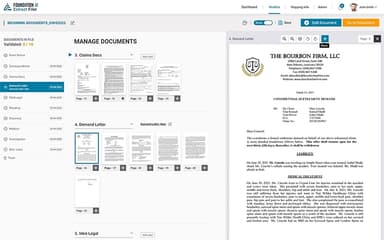
- Let Foundation AI classify each document and match it to the correct matter or claim file
- Review any documents or fields flagged with a low confidence score before they are filed
- Apply firm defined rules to route documents to the right person or team
- Set up tasks, deadlines, and escalations for time sensitive documents
- Track every document from capture through filing using built in dashboards and reports
Who Is Foundation AI For?
It is built for organizations processing high volumes of legal or claims correspondence, such as:
- Personal injury
- Insurance carriers
- Third-party administrators
- Insurance claims departments
Foundation AI Use Cases
Based on our analysis of Foundation AI's current tools and offerings, we have identified the following key business scenarios where it is well suited:
Personal Injury Firms Scaling Caseloads Without Adding Headcount
Personal injury firms face rising document volumes as their caseloads grow. Foundation AI automates document capture, classification, and routing, helping firms handle this increase without hiring more back-office staff. Nyman Turkish, one of the nation's largest injury firms, used the platform to increase document processing productivity by more than 12 times without expanding its back office.
Firms Turning A Full Day Of Mail Processing Into A Short Daily Task
Manual mail processing can take hours and delay time-sensitive documents. Foundation AI automates the sorting and distribution of physical mail and e-fax correspondence across different case types. Miller Dawson Sigal & Ward reduced daily mail processing from five to six hours to about 15 minutes. Documents also entered the system with consistent names and proper organization instead of waiting in a pile for staff review.
Insurance Defense Firms Shifting Time From Administrative Work To Billable Work
Manual document handling takes time away from billable legal work and can affect firm profitability. Foundation AI automates document intake, reducing the administrative workload for attorneys and support staff. Floyd Skeren Manukian Langevin achieved a 350% improvement in document processing efficiency and cut non-billable hours by 81% after implementing the platform.
Firms Replacing Temporary Staffing With Automated Intake During Volume Spikes
Sudden increases in document volume can force firms to hire temporary staff, adding costs and inconsistencies to document handling. Foundation AI helps firms manage these spikes through automated intake without relying as heavily on seasonal hires. Stockwell Harris, a California defense firm, processed documents five times faster, achieved processing accuracy of up to 98%, and saved $400,000 in temporary staffing costs.
Firms Consolidating Document Intake Into A Single Role
When multiple paralegals and legal assistants handle document intake, administrative work can take time away from casework. Foundation AI automates and consolidates this process, reducing the staff hours needed to manage incoming documents. Acumen Law cut weekly document processing time from approximately 120 hours to five hours, freeing up staff capacity for client work instead of manual handling.
Is Foundation AI Right For You?
Foundation AI is a strong choice for organizations handling high volumes of repetitive document intake and routing across legal and insurance workflows. Its classification, matching, and extraction tools use confidence scores to flag uncertain results for human review rather than filing them automatically.
The platform lists SOC 2 Type II, ISO 27001, and HIPPA compliance. It is used by firms and carriers including Nyman Turkish, Floyd Skeren Manukian Langevin, Acumen Law, Ghitterman & Feld, and RLI. Foundation AI also ranked 37th on Forbes’ America’s Best Startup Employers 2026 list.
As legal teams increasingly adopt AI to automate administrative work, Foundation AI supports this trend by streamlining document-heavy workflows while keeping human review for uncertain results. It is a better fit for high-volume litigation firms, insurance carriers, and claims departments that need specialized document workflows than for teams seeking a general-purpose document management platform.
Still doubtful if Foundation AI is right for your team? Contact us at (661) 384-7070 for further guidance.
Foundation AI Features
Document classification
Document classification runs through fine-tuned LLMs, RAG, business logic, jurisdiction specific taxonomies, and deterministic guardrails, evaluating each document from multiple angles. Results are reconciled into a confidence score for every field, so the platform can flag uncertainty rather than presenting a guess as a fact.
Matter And Claim Matching
The platform identifies the correct matter or claim file using signals including names, dates, addresses, and claim or policy numbers, drawing on custom models, RAG, and vector search. It also links the document to related contacts, providers, staff roles, and records in connected systems such as Filevine or Salesforce. This helps surface its best guesses for human confirmation when confidence is low rather than filing automatically.
Document Standardization
Foundation AI applies firm defined or built in rules covering practice areas. Including personal injury, workers compensation, SSDI, VA claims, property claims, bankruptcy, and immigration. For how documents are named, organized, routed, and tasked, applying the same rules consistently regardless of which inbox or channel a document came through.
Confidence Scoring And Validation
Every match, classification, and extraction is checked against a calibrated confidence threshold. Confident results move through automatically, while lower confidence results are flagged for review inside the platform's interface, which the vendor positions as a way to centralize clerical review with an operations team rather than eliminate human review entirely.
Workflow Automation
Every action taken on a document, from capture through classification, matching, validation, filing, routing, and delivery, is logged. Built in dashboards, custom reports, and feeds into BI tools such as Domo and Power BI show processing status and flag items needing attention.
Document Tracking And Reporting
Every action taken on a document, from capture through classification, matching, validation, filing, routing, and delivery, is logged. Built in dashboards, custom reports, and feeds into BI tools such as Domo and Power BI show processing status and flag items needing attention.
Pros And Cons of Foundation AI
Pros
Purpose built taxonomies and workflows for specific legal practice areas
Confidence scoring routes only uncertain results to human review instead of every document
Direct integrations with widely used legal practice management systems
Total Email Capture deduplicates attachments sent to multiple recipients
Downstream workflow execution such as tasking, deadlines, and escalations is built into the platform
Cons
Document review queue requires staff to resolve flagged items manually
Lacks connection to a firm's existing case or claims system
Limited coverage for practice areas outside its supported taxonomies
Foundation AI Reviews

No reviews yet!
Be the first to review this product
Frequently Asked Questions
What other apps does Foundation AI integrate with?
The software integrates with multiple third-party systems, including CASEpeer, Clio, Filevine, Litify, SmartAdvocate, and Smokeball.
What level of support does Foundation AI offer?
The vendor offers support via phone, email, resources, and contact form.
Who are the typical users of Foundation AI?
Foundation AI features are used by personal injury and other high volume litigation firms, firms handling workers compensation, SSDI, VA, immigration, bankruptcy, or property claims matters, insurance carriers, third party administrators, and insurance claims departments.
Does Foundation AI offer a mobile app?
No, Foundation AI software does not offer a dedicated mobile app.
Does Foundation AI offer an API?
Yes, Foundation AI offers an API.
What languages does Foundation AI support?
The software primarily supports the English language.
What type of pricing plan does Foundation AI offer?
Foundation AI pricing is estimated to fall between $2,100-$7,500/month, based on the industry benchmarks for similar platforms. Get a tailored Foundation AI cost estimate.