


Lexion
Last Updated
Key Takeaways
Generated from the text of customer reviews
Lexion, now part of DocuSign, is an AI-based contract management platform. It helps legal teams manage agreements and supports contract-related processes across different business functions. Some reviewers note that the platform offers limited document formatting flexibility. However, most users cite its ease of finding and reviewing important contract information. Lexion serves organizations across various industries with tools for contract creation, review, workflow, repository, management, approvals, signatures, and post-signature obligation tracking.
Our Verdict
The software is a suitable choice for companies managing a growing number of contracts and legal teams that need to handle recurring contract workflow. Users generally view its pricing as reasonable, although smaller organizations may find the cost harder to justify. We recommend Lexion for businesses where multiple departments regularly create, review, and manage contracts.
Lexion Specifications
- Document Management
- e-Signature
- Document Automation/Assembly
- Workflow Automation
What Is Lexion?
Lexion is a contract management platform for organizations where business units regularly rely on in-house legal counsel to review, approve, and manage agreements. It gives teams a structured way to initiate and progress contract requests while keeping the legal team involved where its review is needed. This could help reduce delays caused by incomplete requests, approval bottlenecks, and repeated follow-ups on contract status.
Once agreements are executed, the software also makes information within them relatively easier to retrieve, including terms, key dates, and obligations. Its AI can extract contract dates, parties, clauses, and other key terms, helping lower the amount of manual searching needed to answer contract questions or monitor commitments. For organizations whose contract volume is straining legal capacity, Lexion can help teams take on more agreements, potentially decreasing the need to route every contract request through legal staff.
What Is Lexion Best For?
The platform stands out with Easy Intake, which lets business stakeholders submit contract requests through tools they already use, including email and CRM systems. Instead of requiring employees to learn a separate request process, Lexion can capture the request, collect the details needed for review, and direct the next steps based on that information. Moreover, custom intake forms can show relevant questions as needed, helping reduce incomplete requests before they reach the legal function. The software also supports self-service generation of legal-approved documents for repeat agreements such as Non-Disclosure Agreements (NDAs), allowing users to generate predefined documents for routine agreements.
How Much Does Lexion Cost?
Lexion's starting price is estimated at $2,100/month. Actual pricing is based on a custom quote and might vary depending on each company's requirements and deployment scope.
Organizations should also consider these potential additional costs when estimating their total investment:
- Small/Mid-Market Deployment: $30,000-$50,000/year
- Larger Enterprise Deployment: $60,000-$150,000+/year
- Implementation And Onboarding: $5,000-$25,000+
- Data Migration/Legacy Contract Import: $3,000-$15,000
- Custom Integrations/API: $5,000-$20,000+
- Advanced Workflow Configuration: $3,000-$15,000+
- Training: $2,000-$10,000
- Premium support: $2,000-$10,000+/year
Users generally view Lexion as offering good value for money, with reviewers describing the pricing as reasonable relative to the functionality and contract management capabilities provided. Others mention that the cost may be harder to justify for smaller organizations, suggesting that value for money can depend on company size and contract management needs.
Disclaimer: Pricing references are based on publicly available third-party information and industry benchmarks. Actual costs may vary.
Lexion Integrations
The software supports integrations with multiple third-party systems including:
- Salesforce CRM
- HubSpot CRM Software
- Slack Software
- Coupa
- Microsoft Teams
- Box Sign
- Google Drive
- Dropbox
How Does Lexion Work?
Here’s how you can get started with Lexion software and use its key functionalities:
- Log in to the software with your account credentials
- Create a contract request through Lexion, email, or a connected business tool, then provide the details needed to process it
- Configure the request by using intake forms that capture relevant details and apply the appropriate routing or approval steps
- Manage the request from the central dashboard, where you can review its status, conversations, approvals, and related contract activity
- Generate or update the required contract using an approved template, then route it for review and approval
- Send the finalized agreement for signature and track its signing status within the platform
- Track executed contracts, key dates, terms, and obligations in the repository using search, alerts, and extracted contract data
Who Is Lexion For?
The platform is suitable for companies across various industries and sectors, including:
- Healthcare
- Biotech
- Pharmaceutical
- Healthcare
- Consumer goods
Lexion Use Cases
Based on our analysis of Lexion’s existing features and user reviews, we have identified several situations where the platform can be a good fit:
1. Legal Teams Managing Incomplete Contract Requests
When contract submissions arrive with missing information, legal staff may need to spend time going back to the submitting employee before review can begin. Lexion’s Easy Intake can address this at the intake stage by using customizable forms to collect the details needed for a particular type of contract. Requests can also come through email or existing business tools, so employees might not necessarily have to learn a separate submission process.
2. Sales Teams Handling Recurring Agreements During Active Deal Cycles
Sales teams handling recurring agreements such as NDAs may need to prepare and send documents without waiting for counsel to handle each routine agreement. Lexion’s templated document generation allows approved templates to be used for these agreements, including from within a CRM. This could give sales representatives a way to produce standard documents while keeping the legal team’s approved language in place.
3. Procurement Teams Managing Vendor Renewals And Obligations
Missed renewal dates, termination windows, or vendor obligations could create avoidable spending and compliance issues, particularly when agreements are spread across a large supplier base. Lexion’s AI-powered contract repository extracts and organizes terms, dates, and obligations across contracts, while reminders can surface upcoming deadlines. Procurement and legal can therefore work from a consolidated view when reviewing vendor commitments and upcoming contractual events.
4. Legal Teams Reviewing Contracts During An Acquisition Or Fundraising Round
Fundraising and Merger and Acquisition (M&A) activity often requires teams to find specific contract terms and prepare disclosures without spending weeks manually reviewing the entire contract portfolio. Lexion’s AI-powered search and reporting can identify extracted clauses and terms across the repository, helping teams assemble the information needed for due diligence and disclosure schedules. It allows transaction teams to work from existing contract data, so they may not have to review each agreement separately.
5. HR Preparing Employee Agreements During Periods Of Rapid Hiring
High-volume hiring can create an ongoing need to prepare offers and other employee agreements while still applying approved contractual language. Lexion’s employee document generation can populate legal-approved templates based on the relevant hiring information, allowing HR to produce recurring agreements without requiring counsel to draft each one individually. This can be particularly useful when hiring involves many similar agreements as well as exceptions that might still need legal review.
Is Lexion Right For You?
Lexion could be a suitable fit for organizations managing a growing contract volume across legal and business teams, particularly where legal capacity needs to scale with demand. It can help standardize contract handling without requiring legal to oversee every agreement.
The platform is SOC 2 Type II and ISO/IEC 27001 certified. It uses AES-256 encryption for data at rest, TLS encryption for connections, access controls, audit trails, regular security testing, and third-party audits.
Lexion was acquired by DocuSign in 2024, making it worth considering for companies already using DocuSign or evaluating it alongside contract management software.
Firms with low contract volumes or relatively simple agreement requirements may have less need for a platform with Lexion's broader contract management capabilities.
Still not sure if Lexion is right for you? Get in touch with us at (661) 384-7070, and we will help you make the best decision.
Lexion Features
No-Code Workflow Automation
No-Code Automation enables teams to build contract processes by setting triggers, conditions, and actions without coding or IT support. Based on details such as contract value, task status, or region, it can automatically assign owners, add stakeholders, generate templated documents, route agreements for approval, and send them for signature. Teams can combine these steps into end-to-end processes and apply different rules to different contract scenarios. It could help reduce manual back-and-forth between teams and ensure the right approvals and stakeholders are included.
Workflow
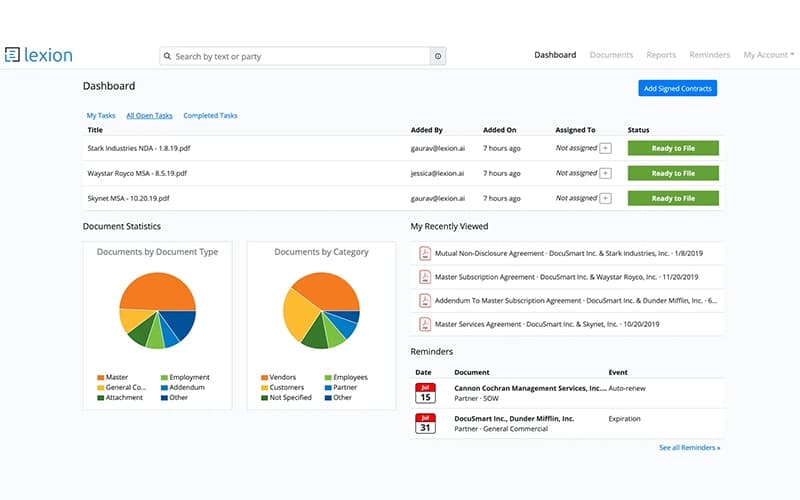
The Workflow functionality allows teams to use custom intake forms to collect the details needed for a contract task and assign it to the appropriate people for handling and approval. They can also collect approvals by email, manage contract versions, keep discussions and deal history together, and track task status from a central dashboard. Once an agreement is signed, the completed contract can be filed in the Repository while remaining linked to its workflow history. KPI reports also allow teams to track measures such as contract volume and review time. This feature assists legal teams in keeping contract reviews organized and helps reduce the need to switch between emails and separate documents.
Repository
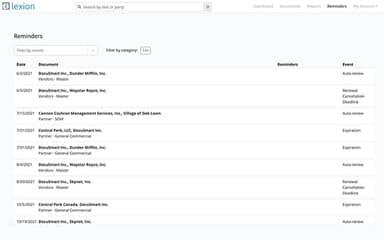
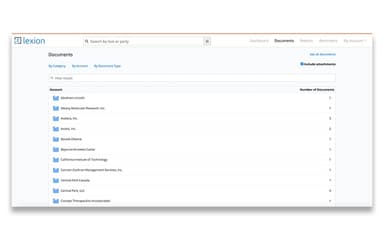
The platform stores contracts in a centralized repository and uses AI to extract key information such as parties, clauses, dates, and other contract terms. Teams can search agreements using details such as party names or clause types. It also lets them organize documents into folders and create reports that update as contract data changes. The repository uses AI to identify important dates, such as renewal and expiration deadlines, and can send reminders for upcoming events. Existing contracts can be added and organized alongside new agreements, giving teams a consolidated view of their contract records.
Lexion Sign
Using Lexion Sign, teams can prepare documents for electronic signature, add required fields, and send them to the relevant parties directly from the platform. It enables users to track who has viewed or signed a document, follow its signature status, and access the completed agreement in Lexion after signing. It also maintains an audit trail of the signing activity and supports e-signatures that comply with ESIGN, UETA, and eIDAS requirements. Lexion Sign helps teams avoid moving documents between separate signing and contract management systems.
AI Contract Assist
Lexion’s AI Contract Assist works inside Microsoft Word to support contract review, redlining, and drafting. It lets teams create playbooks that define preferred contract positions, which the AI then uses to compare agreements and flag language that may need review. Users can select a clause and describe the change they want, after which Lexion suggests redlines or alternative wording. It can also generate new wording from a plain-language instruction, giving teams a starting point when drafting contract provisions. Through this feature, legal teams can apply consistent contract standards and spend potentially less time reviewing and drafting routine agreements.
Pros And Cons of Lexion
Pros
Users find the interface easy to navigate, making it simpler for business teams to use
AI-based contract extraction can help reduce the time spent searching for key terms across multiple agreements
Centralized contract records make it easier for teams to find agreements and related information when needed
Users find the implementation process relatively straightforward, with less effort needed to get started
Reporting gives teams clearer visibility into their contract portfolio and its key details
Cons
Some users find that notifications do not always make the next required action clear
There may be limited control over who can upload signed contracts to the repository
Some users report limited flexibility in how documents are formatted and ordered for signing
Lexion Reviews
Total 16 reviews
4.6
All reviews are from verified customers
Rating Distribution
5
Stars69%
4
Stars25%
3
Stars6%
2
Stars0%
1
Stars0%
Share your experience
Mid Market, 500+ employees
“Makes complex workflows simpler”
Pros
The user interface is pretty great as it is so simple that I feel like even people with minimal technical knowledge can easily navigate it.
Cons
Well the price is a bit too high for smaller organizations like ours.
Rating Distribution
Ease of use
9
Value for money
6
Customer Support
9
Functionality
9
Information Technology and Services, 500+ employees
“Good one”
Pros
Lexion AI's ability to pull data is simply the best. It really saves me time and reduces the hassle of manual data entry. Plus the flexibility to adjust repository data and add fields when needed is awesome.
Cons
As with anything new it takes a bit of time to get the hang of things. Also it would be helpful for us if there were ways to reduce the number of emails the system generates.
Rating Distribution
Ease of use
7
Value for money
7
Customer Support
8
Functionality
7
Mid Market, 500+ employees
“User-friendly and packed with great yet new features”
Pros
Moving from a fully manual CMS to Lexion was a huge leap forward. The AI is really user-friendly and one of my favorite parts is the customer service team. They are always available to help and have taken on a lot of our team's suggestions for system improvements.
Cons
It is an amazing software overall but the automations and workflows took a bit of our time getting used to.
Rating Distribution
Ease of use
9
Value for money
9
Customer Support
10
Functionality
9
Frequently Asked Questions
Who are the typical users of Lexion?
The software is primarily used by legal teams, with sales, procurement, HR, finance, and IT teams also involved in contract-related processes.
Does Lexion offer an API?
Yes, the software offers an API for custom integrations with business systems.
What level of support does Lexion offer?
Lexion provides a Help Center with FAQs, product demos, and guidance, along with customer support and implementation assistance. The level of support can vary based on the purchased package.
Does Lexion have a mobile app?
No, Lexion does not have a mobile app.
What types of pricing plans does Lexion offer?
Lexion's price starts at approximately $2,100/month. Contact us to get a custom Lexion price quote.
What other apps does Lexion integrate with?
It integrates with various third-party applications such as HubSpot CRM, Salesforce CRM, Microsoft Word, Microsoft Teams, Google Drive, and more.
What language does Lexion support?
The platform supports the English language.