


Last Updated
Overview
SAP Manufacturing provides essential tools for digitalization, bridging the gap between ERP and the shop floor. While the implementation may require extensive planning, it offers AI-guided performance tracking and closed-loop resource orchestration. Overall, SAP's strategic benefits make it a compelling choice for optimizing and controlling production operations.
Be the first one to leave a review!
No review found

Starting Price
Custom
SAP Manufacturing Specifications
- Production Planning
- Inventory Management
- Quality Control
- Supply Chain Management
What Is SAP Manufacturing?
SAP Manufacturing is a sophisticated Manufacturing Operations Management (MOM) platform engineered to support agile, risk-resilient, and sustainable production processes for both discrete and process industries. It centralizes essential operations, offering granular visibility across all departments using key performance indicators (KPIs) and embedded analytics. This comprehensive solution is specifically designed to help mid-sized and large enterprises minimize risk, control costs, and achieve operational excellence by ensuring efficient execution of production plans.
SAP Manufacturing Pricing
SAP Manufacturing pricing offers two pricing plans:
- SAP Supply Chain Base: $291.00/month/user
- SAP Supply Chain Premium: $408.00 /month/user
Disclaimer: The pricing is subject to change.
SAP Manufacturing Integrations
Who Is SAP Manufacturing For?
SAP Manufacturing software is ideal for a wide range of industries and sectors, including:
- Discrete manufacturing
- Process manufacturing
- Food and beverage
- Pharmaceuticals
- Chemical manufacturing
- Small and mid-sized businesses
- Large enterprises
Is SAP Manufacturing Right For You?
This platform stands out as an exceptional fit for businesses seeking a unified, end-to-end solution for their complex production environments. It was named Leader in the Worldwide Manufacturing Execution Systems 2024–2025 Vendor Assessment by IDC MarketScape, confirming its robust capability to enhance shop floor performance and execution. Its ability to manage multiple production scenarios—including repetitive, discrete, and process manufacturing—within a single application makes it highly versatile. It is the best choice for organizations dedicated to digital transformation and aiming for resource-efficient, high-quality production across all locations.
Still doubtful if SAP Manufacturing is the right fit for you? Contact our customer support staff at (661) 384-7070 for further guidance.
SAP Manufacturing Features
Real-Time Insights
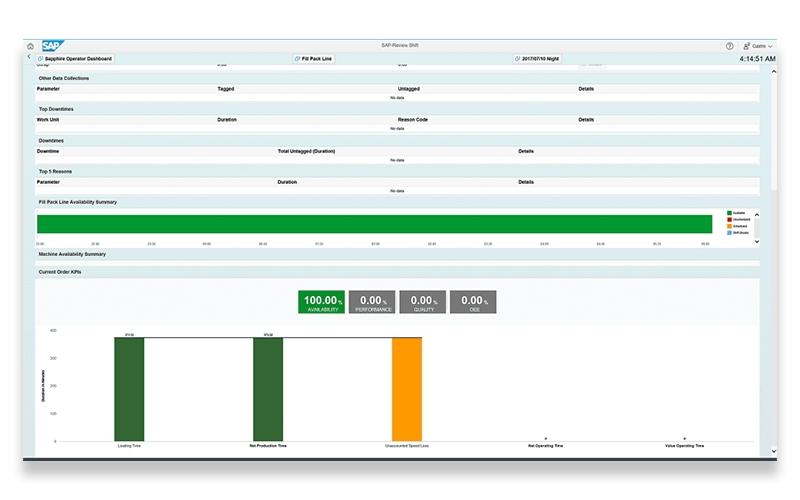
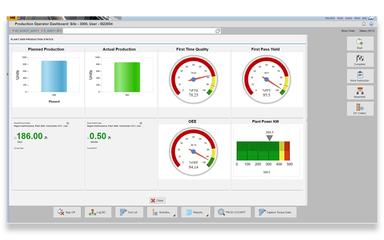
This feature provides customized, real-time data analysis, extending from the top floor down to the shop floor and across all operational areas. Users can leverage predefined, configurable KPIs embedded in various user interfaces for self-service reporting and performance collaboration via the integrated SAP Analytics Cloud solution.
Resource Orchestration
The system enables closed loop planning within the enterprise to dynamically adjust production based on evolving needs, facilitating a digital response to unexpected events. This includes dispatching and monitoring operations, allocating labor based on required skills, and automatically balancing production in coordination with the supply chain.
Production Execution
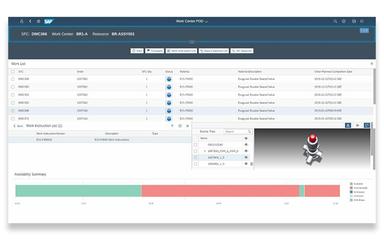
This functionality ensures continuous alignment between business systems and operations, integrating with planning, logistics, and quality functions. It supports hybrid manufacturing, handling various production types like repetitive and process scenarios in one application, and standardizes work instructions while tracking both direct and indirect labor.
Process Automation
Users can graphically define process workflows to coordinate actions among people, internal processes, and automation systems using simple user interfaces. This allows for the design of task automations based on individual worker actions, synchronously communicating with diverse technical systems while adhering to the latest industrial standards.
Structured Issue Resolution
A built-in collaboration space helps prevent and address problems by involving both internal and external stakeholders in a structured process. It allows for uploading visual content from any device to report quality control issues, grouping them logically, and utilizing AI to auto-generate standardized problem-solving processes based on historical approaches.
Pros And Cons of SAP Manufacturing
Pros
Users appreciate real-time visibility offered by SAP Manufacturing
Significantly reduces errors
Optimizes response time increasing efficiency
Cons
Software update may result in untimely lags in responsiveness
Some users require technical support for more advanced features
SAP Manufacturing Reviews

No reviews yet!
Be the first to review this product
Frequently Asked Questions
Who are the typical users of SAP Manufacturing?
Typical users are in discrete manufacturing, process manufacturing, food and beverage, pharmaceuticals, chemical manufacturing, small and mid-sized businesses, and large enterprises.
Does SAP Manufacturing have a mobile app?
Yes, SAP Manufacturing offers a dedicated app for Android and iOS users.
What types of pricing plans does SAP Manufacturing offer?
SAP offers subscription-based pricing with two main tiers: SAP Supply Chain Base at $291/month/user and SAP Supply Chain Premium at $408/month/user. Get a detailed SAP Manufacturing cost breakdown tailored to your specific requirements.
What level of support does SAP Manufacturing offer?
SAP Manufacturing offers support via telephone, e-mail, or live chat.
What other apps does SAP Manufacturing integrate with?
Information about third-party integrations has not been specified by the vendor.
What language does SAP Manufacturing support?
SAP Manufacturing software primarily supports English Language.
Does SAP Manufacturing offer an API?
Yes, SAP Manufacturing offers an API.