
Article
CV Resume Parsing Software For HR And Talent Acquisition Teams
6 mins read
Last Updated


By Laiba Laeeq and


Article
6 mins read
Last Updated
By Laiba Laeeq and

Are you still manually copying information from cluttered PDFs into your ATS?
When recruiters are manually pasting candidate information on resumes into your applicant's tracking system, they are wasting precious time on administrative work rather than hiring. When you are going through hundreds of applications per position, even five minutes per resume is hours of administrative time.
CV resume parsing software removes such inefficiencies by automatically extracting and structuring candidate data. This guide outlines the basic resume parser features and functionalities, things to take into consideration before implementation, and the most popular platforms available. For teams evaluating broader AI-driven hiring capabilities, it can also help to explore top AI recruitment software for hiring as part of the technology stack.
CV parser software automatically extracts selected candidate information from the resumes and converts it into structured data fields in your ATS, CRM, or HR platform. Instead of going through the resume line by line, the software uses natural language processing (NLP) and machine learning to identify and categorize important information, such as:
The result is organized candidate information that can be easily searched, filtered, ranked, and analyzed. For HR leaders and talent acquisition teams, this goes beyond convenience. It’s a core infrastructure.
Not all resume parsers deliver the same level of performance. For HR leaders and recruitment technology buyers, the depth of features has a direct impact on data integrity, compliance readiness, and long-term scalability.
The key requirements include capabilities commonly found in leading resume parsing solutions and enterprise hiring platforms.
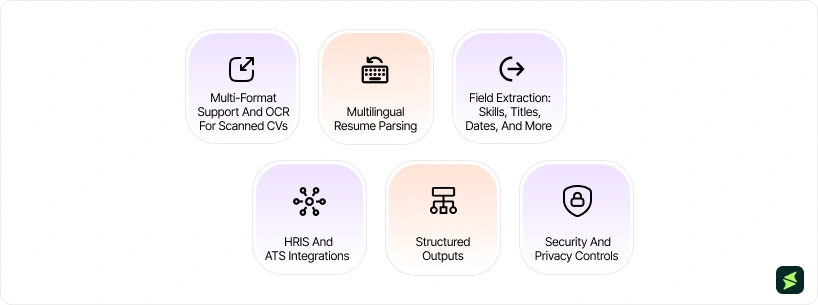
Resumes are usually submitted in various formats, including PDF, DOCX, Rich Text Format (RTF), HTML, and even scanned images files (JPEG, PNG, TIFF). Resume parsers extract text directly from structured formats like DOCX, RTF, and HTML, while standard PDFs are processed using layout-aware text extraction.
When the resumes are scanned or sent in a form of image PDFs, advanced platforms employ Optical Character Recognition (OCR) to decode the images into readable text before parsing begins. Once the text layer is extracted, the parser applies natural language processing to identify fields such as names, skills, work history, and education.
At its foundation, resume parsing software must precisely identify and classify structured data. Leading systems retrieve critical data like candidate name and contact details, job titles, skills and competencies, education history, and more. For HR leaders, extraction accuracy directly influences:
If the extraction is inaccurate, hiring analytics becomes unreliable.
Organizations hiring globally need multilingual parsing capabilities. Enterprise-level parsers typically support dozens of languages. This assists with supporting broader global talent reach, consistent structured cross-regional data, and reduced risk of translation-related bias.
Resume parsing software is not merely a software to retrieve information; it creates formatted outputs that are compatible with your existing systems. The formats of outputs offered by most major vendors include JSON, which is perfect in API-based integrations, XML, which is often used in enterprise HR systems, and CSV, which may be effective in bulk processing.
Resume parsing software should connect directly with the existing ATS, CRMs, HRIS, and job boards. Leading vendors offer REST APIs and pre-built integrations for leading ATS platforms. This guarantees that the data is populated automatically, leading to improved candidate searchability and faster recruiter workflows.
Resume data is personally identifiable information (PII), so security and compliance are non-negotiable with enterprise buyers. Strong security controls help protect candidate data from unauthorized access, while clearly defined data processing and deletion policies ensure that information is stored, handled, and removed in accordance with regulations such as GDPR and internal data governance standards.
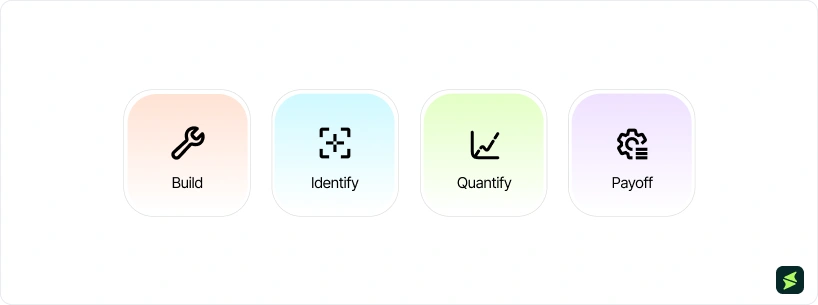
Now that you know the basic functionality of a resume parser, you can continue by assessing the accuracy of those functions in the field. It is important to ensure that you test and validate parsing accuracy with your own candidate data before rolling out any solution in your ATS or HR systems. The following are some of the steps to be taken to ensure the accuracy of resume parsing:
Begin by developing a test pool of resumes that your team gets. Add clean DOCX files, thick PDFs with advanced formatting as well as multiple scanned resumes. Test all your candidate parsers on this dataset and compare the fields extracted to a ground-truth spreadsheet that you prepare by hand. This reveals the performance of a parser under practical circumstances rather than ideal conditions.
Certain problem areas tend to surface quickly. Dates are a classic example. Formats like ‘Jan 20 – Dec 22’ can confuse systems and distort employment timelines. Nonstandard job titles, hyphenated skills, and bullet lists often create inconsistencies. Industry-specific terms such as ‘C++’ or phrases like 'R&D leadership’ may get split apart or misclassified.
When comparing solutions, examine how accurately each parser handles these edge cases. Platforms that correctly interpret varied date formats, technical terminology, and unconventional resume structures are more likely to produce reliable candidate data and reduce manual corrections for recruiters.
Evaluate field-level accuracy and recall of important categories like name, contact details, work history, education, and skills through the comparison of automated data with your validated data. Normalization consistency must also be observed. There should be only one standard form of date, and the job titles must map appropriately to the projected taxonomies.
Once you’ve selected a parser and confirmed its accuracy, the operational impact becomes clear. Tasks that once demanded extensive manual input and correction turn into automated, structured information that flows into your ATS, HRIS, or analytics environment. This assists recruiters to automate the candidate information pipeline and shortens time-to-shortlist, ensuring hiring teams have confidence in the data driving their decisions.

Once you’ve defined the features you need and established how you’ll validate accuracy, the next step is identifying vendors whose technology aligns with your business objectives, hiring volume, integration, and geographic reach. Below is an overview of established resume parsing providers and ATS platforms with built-in parsing capabilities:
1. Rchilli – AI-driven resume parsing API with deep-learning accuracy across complex fields and strong multilingual extraction
2. Textkernel – High-accuracy skill normalization with LLM parser and multilingual language support
3. Affinda – Easy API integration for automated candidate data normalization
4. Recruit CRM – All-in-one ATS with built-in resume parsing
5. DaXtra Parser – High-precision resume parsing with multilingual support
6. HireAbility – Semantic resume parsing with deep expertise in accuracy and structured data extraction for complex candidate profiles
7. Skima AI – AI-first resume parser with flexible API integration for fast, accurate candidate information extraction
8. TurboHire – Unified recruitment automation with integrated resume parsing and intelligent candidate matching
9. Bullhorn ATS – Built-in resume parsing that accelerates candidate intake and syncing directly within the Bullhorn ecosystem
10. Zoho Recruit – Context-aware resume parsing with seamless ATS integration for streamlined sourcing and data organization
11. HireEZ – Intelligent resume parsing paired with talent discovery tools for enriched candidate profiles
Selecting the right CV resume parsing software is more than a technical upgrade. It influences recruiter efficiency, data reliability, compliance, and your ability to scale hiring over time.
When you need to compare and short-list vendors, or think through an ATS upgrade, expert advice can help you navigate expensive integration issues and make sure the solution you pick is better suited to your volume of hiring, geographic scope, and system architecture.
Connect with us for expert support in identifying the right resume parsing platform for your organization. You can also request demos from the vendors listed above to evaluate parsing accuracy using your own candidate data.