




Healthcare providers manage patient records, clinical workflows, and compliance requirements digitally with the help of Electronic Health Record (EHR) software.
When it comes to pricing, it varies significantly based on practice size, specialty, and deployment model.
For example, entry-level EHR solutions for solo practitioners typically start around $300/month, while larger practices and health systems can expect to pay considerably more for advanced, enterprise-grade platforms.
Consequently, buyers often face difficulty picking out software with a price suitable for their needs.
This guide creates a transparent view of common pricing models, key cost drivers, and hidden cost breakdowns of EHR software.
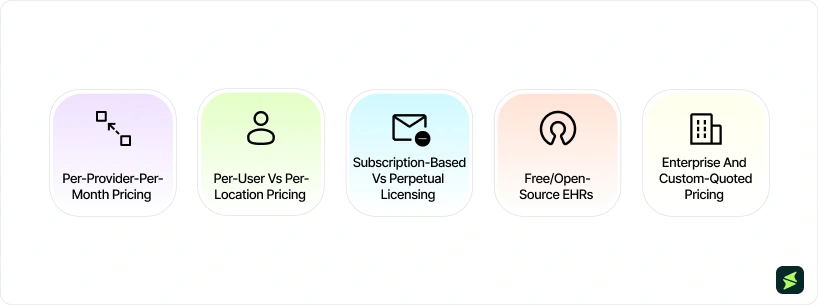
As mentioned above, the cost of EHR software is highly dynamic, ranging from open-source platforms to enterprise systems with six- and seven-figure implementations. The following provides an overview of a few popular EHR pricing models to help you figure out the most suitable strategy based on your practice size, financial capacity, and future expansion.
Per-Provider-Per-Month Pricing
This is a typical model of cloud-based EHR systems, which are priced depending on the number of clinicians utilizing the software. As an instance, eClinicalWorks bills its EHR-only option at about $449/provider/month, which comprises core charting, patient portal access, hosting, maintenance, and customer support.
Disclaimer: The pricing is subject to change.
Per-User Vs Per-Location Pricing
Several vendors charge based on the number of staff users, whereas others are priced on a facility or practice location basis. Industry estimates of the cost of per-user pricing are approximately $1,200/user/year, but location-based subscriptions may cost from $1,000/facility/month to $10,000/facility/month, depending on size or functionality.
Disclaimer: Pricing references are based on publicly available third-party information and industry benchmarks. Actual costs may vary.
Subscription-Based Vs Perpetual Licensing
Subscription-based (SaaS) EHRs have their costs distributed over monthly/annual payments, as most of the small-practice systems fall between $100/provider/month and $600/provider/month. The initial investment required by perpetual licensing is very high. In addition, the cost of software purchase and implementation, according to the public estimates, is between $15,000/provider and $70,000/provider.
Disclaimer: Pricing references are based on publicly available third-party information and industry benchmarks. Actual costs may vary.
Free/Open-Source EHRs
Open-source EHRs do not have licensing fees, but they include infrastructure and support expenses. As an example, the estimated cost of OpenEMR hosting published by cloud vendors is between about $5/month to over $100/month. Meanwhile, optional paid services can be an added cost of $50 and above/month.
Disclaimer: Pricing references are based on publicly available third-party information and industry benchmarks. Actual costs may vary.
Enterprise And Custom-Quoted Pricing
Large healthcare organizations negotiate specific pricing of EHR systems depending on the scope and modules of the system, integrations, and model of deployment. There have been widely reported estimates on Epic EMR implementations, with self-hosted entry points starting from $1,200 and average clinic or hospital implementations as high as $500,000 or more.
Disclaimer: Pricing references are based on publicly available third-party information and industry benchmarks. Actual costs may vary.
The price of EHR depends mostly on its scope and complexity. Solo practices typically require simpler configurations, while multi-specialty groups and businesses need more accessibility, customization, and integration. Cost is also influenced by medical specialty because, in this case, specialty-specific workflows may also demand custom templates and device or registry links.
Moreover, the deployment model also matters – cloud-based EHRs are based on recurring subscriptions, whereas on-premises systems are highly associated with increased infrastructure and Information Technology (IT) expenses. The depth of the features, compatibility with lab and billing software, and compliance technologies (ONC certification and CMS reporting, including MIPS) also affect the overall pricing.
Other than base pricing, there are additional or unanticipated costs in EHRs. Such can include implementation, onboarding fee, data migration, chart conversion, training, and premium-level support. In addition to that, practices can also pay extra for custom templates, specialty modules, e-prescribing, clearinghouse access, or patient portals. Auto-renewals and annual price escalations are a few of the contract conditions that can significantly raise the long-term cost if they are not reviewed with due consideration.
To assist with setting a realistic budget when picking an EHR system, the following table breaks down pricing ranges by practice size and usage scenario:
Practice Type | Typical EHR Cost Range | Best-Fit Pricing Model | What’s Usually Included | Common Cost Risks |
Solo provider | $300-$900/provider/month | Free / low-cost SaaS or per-provider pricing | Basic charting, scheduling, limited e-prescribing | Ads, limited support, poor scalability |
Small practice (2–5 providers) | $250-$800/provider/month | Per-provider-per-month SaaS | Core EHR, patient portal, basic reporting | Data migration, paid integrations |
Mid-sized practice (6–20 providers) | $200-$700/provider/month | Per-provider or per-user pricing | Specialty templates, billing integrations, compliance tools | Training, interface fees, contract lock-ins |
Large group / multi-location | $150-$600/provider/month | Per-location or hybrid (users + facilities) | Advanced analytics, interoperability, admin controls | Implementation overruns, customization costs |
Hospital / enterprise system | $50,000-$500,000+/year | Custom-quoted enterprise licensing | Full clinical suite, population health, custom workflows | Multi-year contracts, upgrade costs |
Pricing note: Ranges reflect common US market benchmarks and vary by specialty, deployment model, and service scope.
Disclaimer: Pricing references are based on publicly available third-party information and industry benchmarks. Actual costs may vary.
Free or low-cost EHRs may be useful to individual providers or a small practice with simple documentation requirements. Nevertheless, there usually are trade-offs, including limited support, fewer integrations, advertising, or restricted reporting. The lack of scalability might demand the transition to a paid system as the practices multiply, adding more expenses in the long run.
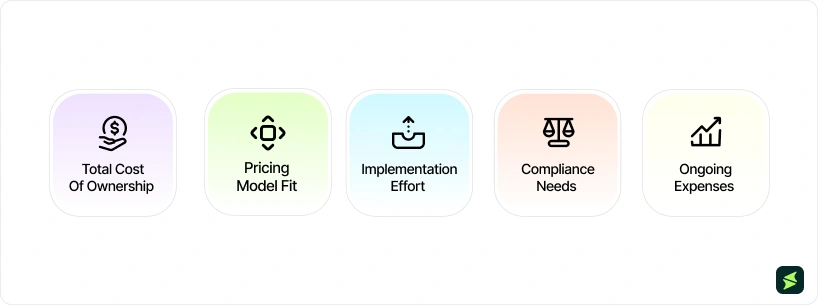
Choose an EHR in accordance with existing and expected growth. This way, you can demand a complete cost analysis in terms of licenses, implementation, integrations, and support, with multi-year estimates. Moreover, paying close attention to core processes and regulatory needs can help avoid comparing base pricing alone instead of the total cost of ownership.
The following cost-related factors should be considered when evaluating options:
- Total Cost Of Ownership: Licenses, implementation, training, and support
- Pricing Model Fit: Per-provider, per-user, or per-location scalability
- Implementation Effort: Custom workflows increase upfront costs
- Compliance Needs: Regulatory features without add-on fees
- Integration Costs: Labs, billing, devices, and registries
- Ongoing Expenses: Updates, support tiers, and future modules
Evaluating these factors together helps ensure the EHR you choose remains affordable not just at purchase, but throughout its entire lifecycle.