Article
How ModMed Scribe 2.0 Is Reshaping Clinical Documentation Workflows And Reducing Physician Burnout
7 mins read
Last Updated


By Rumman Masood and


Article
7 mins read
Last Updated
By Rumman Masood and

Clinical documentation takes up a significant portion of a physician’s workday, consuming time that could otherwise be dedicated to patient care. This workload is a documented concern across many healthcare practices. Research shows that for every hour of direct patient care, physicians spend two hours on EHR documentation.
Tools like ModMed Scribe 2.0 are designed to close this gap. These tools listen to patient-physician conversations in real time, transcribe them automatically, and generate structured clinical notes, freeing physicians from the documentation load that drives burnout. A 2025 study published in JAMA Network Open found that AI scribe adoption drove a 21.2% reduction in burnout prevalence at Mass General Brigham within 84 days.
The question many practices are now evaluating is not whether AI-assisted documentation can support clinical workflows, but whether the benefits justify adoption within their own environment.
The administrative burden on physicians has become increasingly difficult to manage. Christine A. Sinsky, Vice President of Professional Satisfaction at the AMA, says, ‘Across all physician specialties in the outpatient setting, physicians spend nearly six hours on the electronic health record for every eight hours of patient scheduled time.’
A significant portion of that time extends beyond clinic hours. A 2024 study published in the Journal of the American Medical Informatics Association found 52.8% of physicians identified after-hours documentation as the most burdensome aspect of EHR use. While EHRs have improved access to patient information, they have also expanded administrative demands, pulling physicians away from clinical decision-making and patient interaction. Among family medicine residents alone, around 33% reported spending three or more hours per night working on the EHR. Growing compliance, coding, and reporting obligations compound the load further.
Conventional fixes are only partially addressing the problem. Templates reduce the time spent on notes but still require extensive manual editing. Dictation eliminates typing without eliminating review. Human scribes ease documentation demands but remain costly and difficult to scale. These limitations have accelerated interest in AI medical scribe tools that aim to address longstanding documentation challenges. ModMed Scribe 2.0 represents one approach to this shift, applying AI to assist with clinical documentation during patient visits.
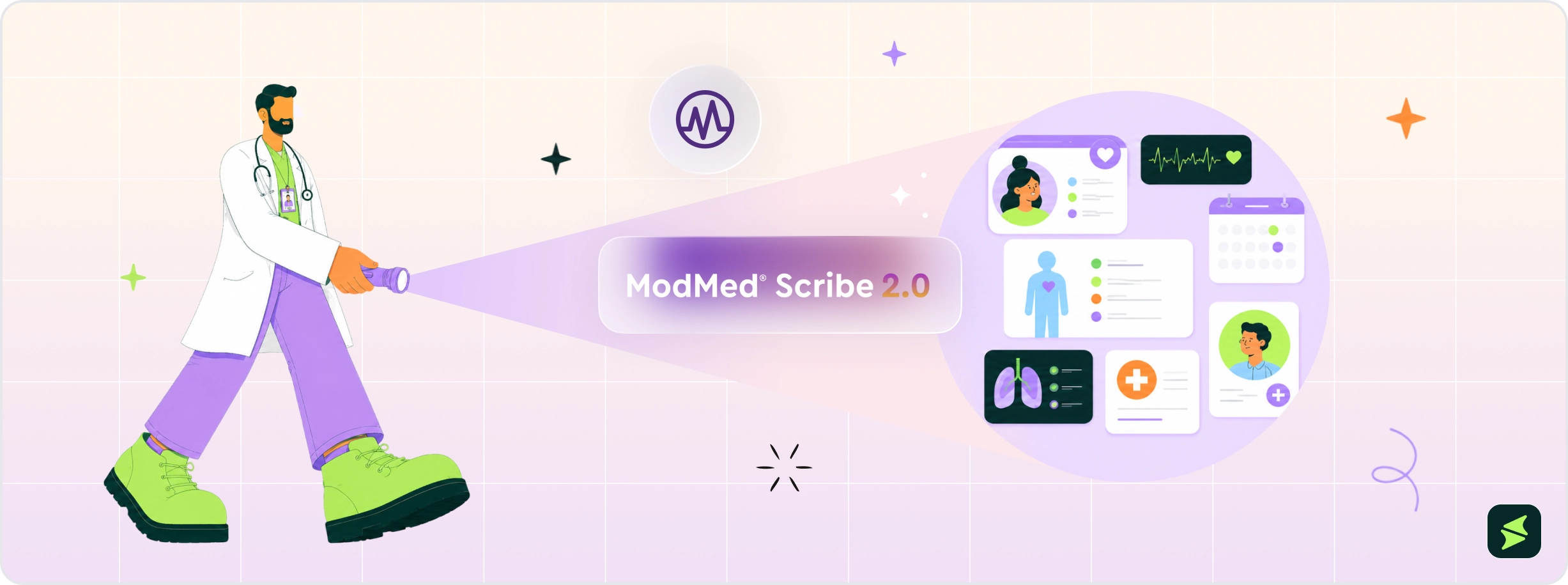
ModMed Scribe 2.0 is an AI-powered clinical documentation solution built within ModMed's EMA EHR. It captures natural patient-provider conversations and suggests structured clinical notes and billing codes. The platform also supports downstream workflows, such as prescriptions, lab orders, and patient education. AI Scribe ModMed 2.0 uses proprietary, specialty-trained models that allow providers to speak naturally during patient visits. This helps reduce the need for awkward pauses, direct commands, or robotic phrasing often associated with traditional voice-driven documentation tools.
ModMed Scribe is designed to integrate into the clinical visit without disrupting its natural flow. The provider first informs the patient that the visit is being recorded and then starts the recording. From there, the conversation proceeds naturally. As it unfolds, ModMed Scribe 2.0 captures relevant information in real time, processing it to suggest visit notes along with E&M, ICD, and CPT billing codes throughout the encounter. Unlike some documentation tools, it usually does not require providers to use scripted language or issue structured commands to function.
When the visit concludes, data is prepopulated into the relevant sections of the visit note, including chief complaint, history of present illness, exam findings, impressions, and treatment plans. The provider reviews, makes any adjustments, and approves. Because ModMed Scribe is built natively within ModMed EMA EHR, downstream actions, including prescriptions, lab orders, and patient education materials, can be initiated within the same platform. Note finalization can often be completed in minutes (depending on visit complexity), rather than extending into post-clinic hours.
In addition to the documentation workflow described earlier, ModMed Scribe 2.0 also offers the following capabilities.
Features | What It Does |
Specialty-Specific AI Models | Trained on data sampled across specialties, including dermatology, ophthalmology, orthopedics, and more |
Intelligent Note Reconciliation | Offers Smart Merge that identifies existing note content, flags duplicates, and suggests how to resolve conflicts while preserving clinical accuracy |
Device Flexibility | Available on Apple iPad and iPhone, with Android support planned for the second half of 2026 |
Automated Body Location | AI-captured body locations and laterality are automatically included as part of the visit note suggestion, significantly reducing manual clicks during documentation |
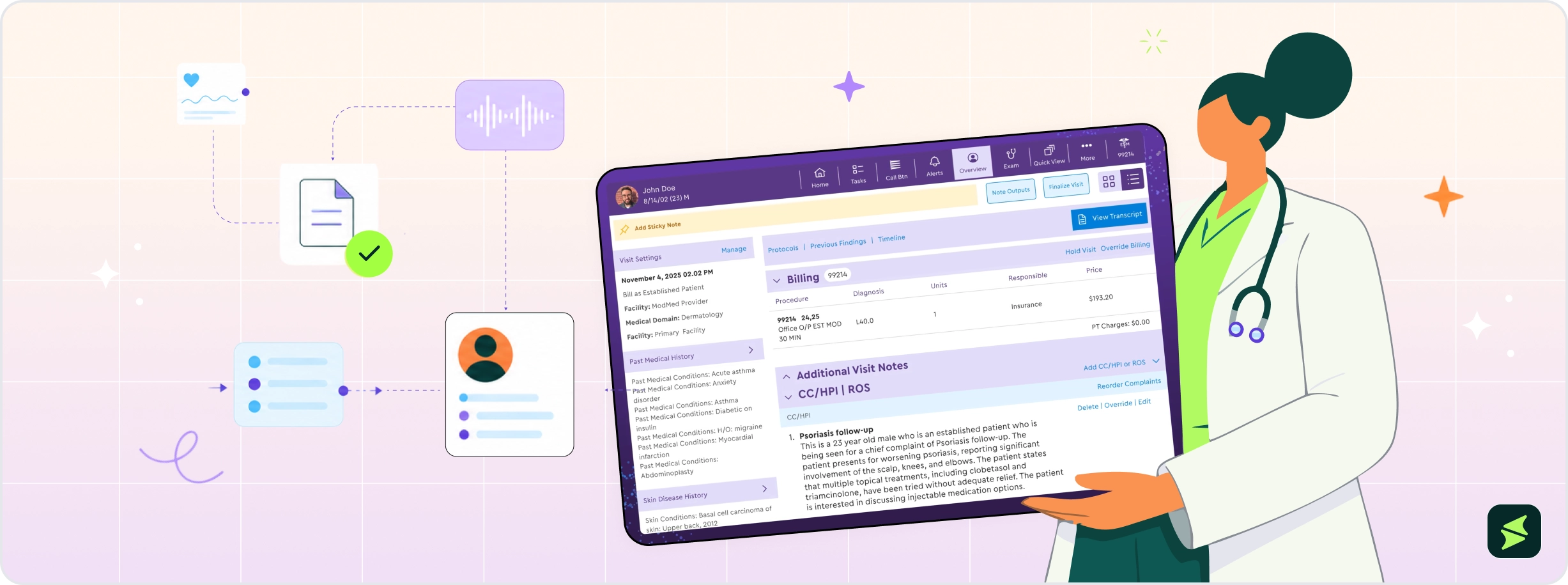
Documentation inefficiency does not always stem from a single problem; it usually accumulates across every stage of the clinical day. From the moment a physician enters an exam room to the final note submitted hours later, traditional workflows often create friction at each step. ModMed Scribe 2.0 helps address this friction by changing not just how notes are created but also how the documentation process moves from conversation to clinical record to billing.
Before adopting ModMed Scribe 2.0, practices like Halcyon Dermatology relied on generic AI documentation tools that lacked direct EHR integration, a setup that created fragmented workflows and often added manual steps across multiple stages.
The table below illustrates how that experience compares with the workflow supported by ModMed Scribe 2.0:
Scenario | Generic AI | ModMed Scribe AI 2.0 |
Documentation Clicks | Manual clicks are required throughout the documentation | Reduced documentation clicks with AI-captured clinical data |
Staff Onboarding | New hires require months of EHR and note-taking training | Staff reach working proficiency in weeks, learning alongside Scribe |
Daily Chart Finalization | Hours spent finishing notes after appointments | Chart finalization time was reduced by 50% |
The efficiency gains from ModMed Scribe 2.0 add up throughout the day. By generating notes in real time, it can reduce the end-of-day documentation backlog. Physicians can close encounters faster, helping create more breathing room between appointments. These improvements have also been reflected in real-world specialty practices.
Parallel ENT & Allergy, a management service organization with 100+ providers, previously carried unfinished notes beyond clinic hours. After adopting ModMed, most practices moved to finalizing charts within 15 to 30 minutes, with notes completed twice as fast across the organization.
A similar outcome was observed at University Urology, which faced time-consuming charting and manual documentation challenges. After adopting ModMed's urology-specific EHR and ModMed Scribe, the practice cut charting time in half.
An important shift that AI Scribe ModMed introduces is the connection between clinical conversation and billing. In traditional workflows, coding often happens after documentation is complete, which can introduce gaps where details are missed. With Scribe 2.0, billing code suggestions are generated alongside the clinical note and drawn from the patient-provider conversation. Diagnoses are linked to treatments, and ICD-10, CPT, and modifier codes are proposed for physician review before the note is finalized. This may help reduce the risk of missed charges and claim rejections that result from documentation gaps between the clinical encounter and the billing process.
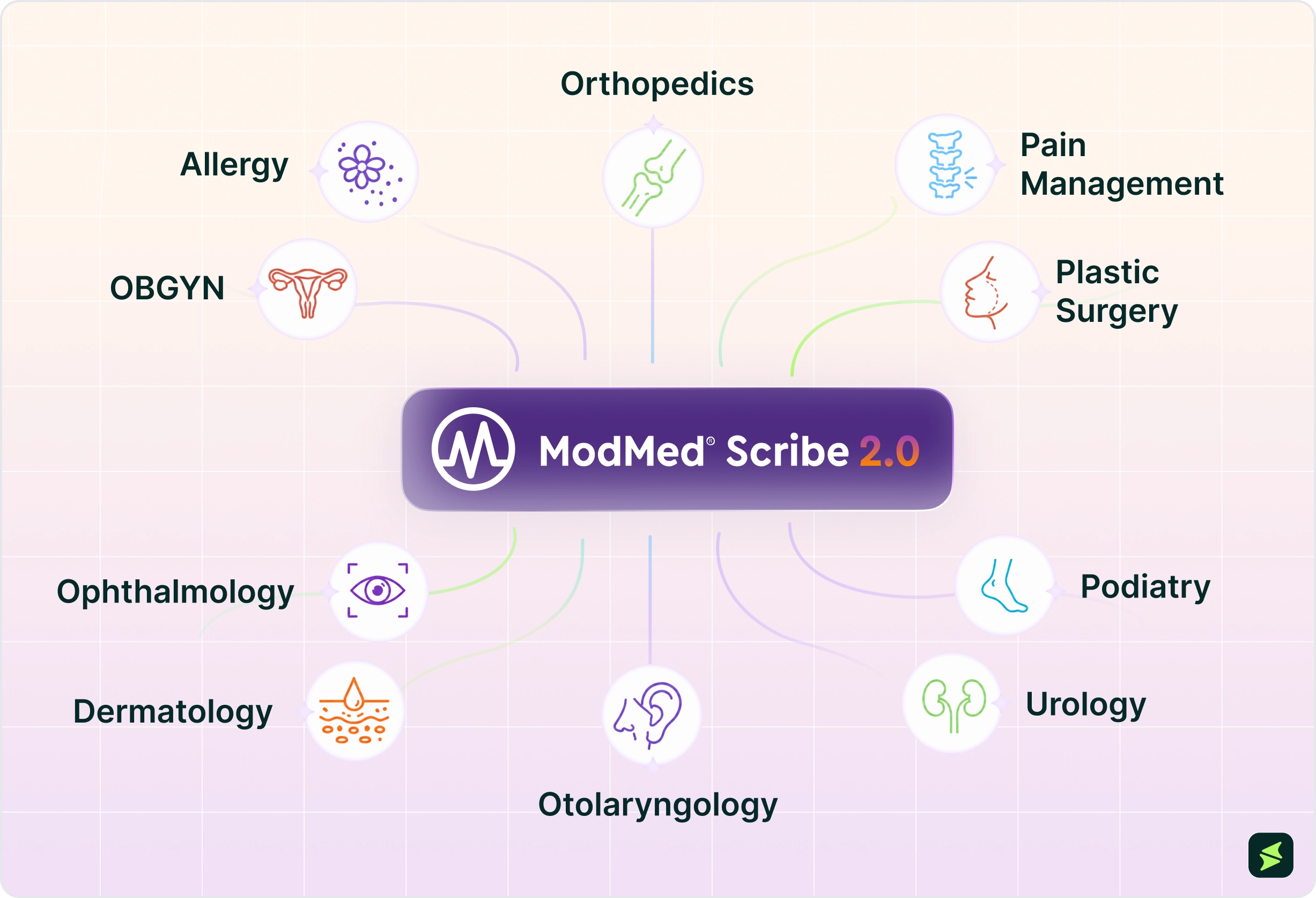
ModMed Scribe 2.0 is built with specialty medicine in mind rather than just general-purpose clinical workflows. Its AI models are developed in collaboration with on-staff physicians and trained on real-world clinical data from over 750 million patient encounters across specialties. Each specialty gets documentation that reflects its own clinical vocabulary, diagnostic language, and workflow patterns. This specialty-specific approach helps reduce the need for manual editing compared to generic documentation tools.
ModMed Scribe 2.0 currently supports the following specialties:
Allergy
Orthopedics
Podiatry
Urology
Otolaryngology
OBGYN
Ophthalmology

For many physicians, the documentation burden can be as draining as the administrative responsibilities that surround patient care. ModMed Scribe 2.0 addresses this by reducing documentation demands rather than just redistributing the work.
The AI Scribe ModMed captures and structures clinical notes in real time during a patient's visit, so physicians can leave the clinic with documentation already complete. This helps reduce both after-hours charting and the cognitive strain often associated with carrying a documentation backlog through a full schedule. Without the need to mentally track what still needs to be charted, physicians move through their day with more focus and less accumulated pressure.
At Parallel ENT and Allergy, this change was measurable across 100+ providers. Melissa Poe, Director of Clinical Process Improvement, described the results:
‘The time to finalize charts has significantly improved, with most practices now finalizing notes in 15 to 30 minutes, a major shift from after-hours charting. This improvement has also streamlined staffing, allowing most providers to drop from two clinical support staff to just one.’
The impact can extend beyond chart finalization. ModMed Scribe 2.0 automatically populates the relevant EMA note section and generates prescriptions and lab requisitions, often without additional input. Dr. Tory Sullivan, MD, described the difference as:
'One key benefit of using ModMed Scribe is its integration with EMA. It accurately places information into the appropriate sections of my notes, generates scripts ready to be sent, and creates lab requisitions.'
ModMed Scribe 2.0 listens passively during the encounter, so physicians don’t have to split their focus between the conversation and the screen. This usually has a direct impact on how physicians may experience their clinical day.
At Halcyon Dermatology, restoring patient focus was one of Dr. Lee's primary goals in adopting Scribe 2.0. With notes often requiring minimal editing during encounters, she was able to stay present with patients rather than managing documentation alongside them. For many physicians, that reclaimed attention can be redirected towards patient interactions, which may lead to a better clinical experience.
Because notes are suggested and finalized closer to each encounter, practitioners leave the clinic with their charts complete rather than carrying documentation responsibilities into the evening, directly reducing a persistent contributor to physician burnout.
Disclaimer: All case studies and outcomes referenced in this article are sourced from success stories published on ModMed’s official website.
While ModMed Scribe 2.0 addresses real workflow challenges for many practices, it's not universally suited to every clinical environment. Understanding where the tool may introduce friction is essential before adoption.
One limitation reported by some users is the consent workflow. The platform requires documented patient consent for each encounter in which the AI records and transcribes. For some practices, this consent process may not be ideal.
A user mentioned, ‘I use ModMed but haven't tried the AI scribe, though I signed up for it when it was announced. There was a requirement to get signed consent for each encounter, and that wasn't going to work with our patient flow.’
This limitation is worth evaluating based on a practice's patient volume and scheduling model. High-volume practices with rapid appointment cycles may find that the consent step introduces additional administrative overhead. On the other hand, practices with existing consent workflows may integrate it more fluidly.

Ultimately, ModMed Scribe 2.0 can support practices of all sizes, though it is likely to deliver the greatest value for dermatology, ophthalmology, and other outpatient specialties already operating within the ModMed EMA ecosystem.
If your clinicians spend hours on documentation and want a specialty-specific AI scribe built directly into their EHR workflow, it could be a worthwhile investment.
That said, smaller practices or those using other EHRs may find the cost and implementation effort harder to justify.