


Secoda
Last Updated
Overview
Secoda helps organizations turn complex metadata into actionable insights through AI-powered search, lineage tracking, and automation. While some users experience occasional syncing delays, its centralized catalog and enterprise-grade security make it suitable for data-driven teams managing large, distributed datasets.
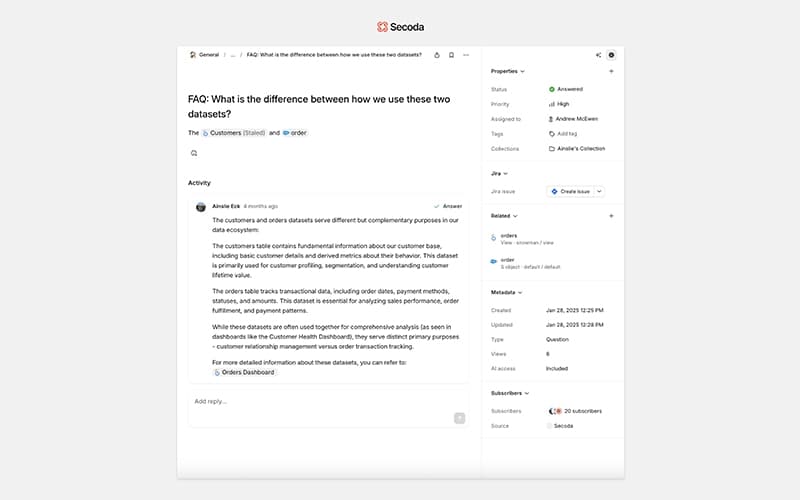
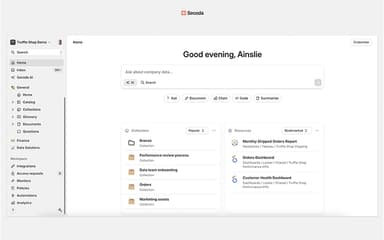
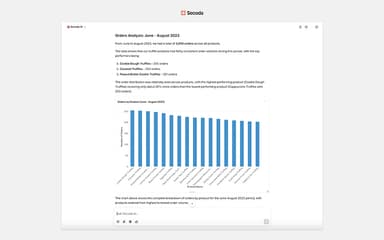
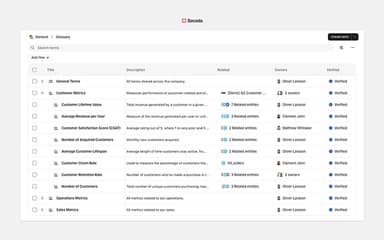
Secoda Specifications
- Natural Language Dialogue
- Smart Data Discovery
- Self-Service Dashboards
- Automation
What Is Secoda?
Secoda is a cloud-based AI platform designed to centralize data discovery, governance, and documentation for modern data teams. By serving as a unified data catalog, it allows businesses to scale their data operations without increasing manual overhead. The software features AI-powered search and automated data lineage, which enable users to instantly locate assets and understand data dependencies. These capabilities help organizations reduce technical debt and ensure data consistency, providing a reliable foundation for making informed, data-driven business decisions.
Secoda Pricing
Secoda pricing is estimated to start at $50.00/month. The vendor offers the following customizable pricing plans:
- Core
- Premium
- Enterprise
In addition to the subscription fee, organizations adopting Secoda should expect industry standard implementation costs typical for cloud-based AI-driven data governance platforms. Based on benchmarks data migration and configuration typically range from $5,000 to $25,000, training and onboarding from $3,000 to $15,000, and add on services such as professional services, self-hosted deployment support, advanced security configurations, and additional integrations may add $5,000 to $30,000, with total costs varying based on number of users, data sources, custom workflows, and security requirements.
Disclaimer: Pricing references are based on publicly available third-party information and industry benchmarks. Actual costs may vary.
Secoda Integrations
The software supports integration with multiple systems and platforms, such as:
Who Is Secoda For?
Secoda software is ideal for a wide range of industries and sectors, including:
- E-commerce
- Financial services
- Real estate
- Retail
- Hospitality
- Healthcare
- Energy
Is Secoda Right For You?
If you are searching for a unified way to turn complex metadata into clear business intelligence, Secoda is the ultimate choice for your data team. This platform addresses the common pain points of fragmented documentation and tangled lineage, allowing companies to automate discovery and governance.
The software ensures enterprise-grade security with SOC 2 Type II compliance. Trusted by industry leaders like Panasonic, Remitly, and Vanta, Secoda offers a scalable, secure environment with advanced encryption and flexible self-hosting options.
Still doubtful if Secoda is the right fit for you? Connect with our customer support staff at (661) 384-7070 for further guidance.
Secoda Features
SECODA AI
The Secoda AI platform powers discovery, documentation, governance, and analysis across the data stack. This feature allows organizations to leverage context-aware AI outputs, enhancing productivity, reducing manual effort, and accelerating data-driven decision-making at scale.
Analysis Agent
The analysis agent transforms raw data into actionable business insights, enabling teams to quickly understand complex datasets. This feature helps organizations make informed, data-driven decisions while reducing manual analysis time and improving operational efficiency.
Automation Agent
The automation agent automatically enriches data assets with critical metadata, streamlining documentation and governance processes. This feature ensures that datasets remain accurate, discoverable, and compliant while freeing teams from repetitive manual tasks across the organization.
Search Agent
The search agent instantly locates the exact data assets and insights users need. By leveraging AI, this feature accelerates data discovery, improves accessibility, and reduces time spent searching across complex, distributed datasets.
Memory Agent
The Secoda memory agent retains contextual knowledge to deliver smarter data insights over time. This feature enhances AI responses, enabling teams to benefit from accumulated understanding and improving the accuracy and relevance of analysis.
Pros And Cons of Secoda
Pros
Strong AI features improve data discovery efficiency
Centralizes metadata across various diverse data platforms
Seamless lineage tracking facilitates thorough impact analysis
Cons
Customer support response time may vary
Limited granular access controls for some users
Secoda Reviews
Total 4 reviews
4.5
All reviews are from verified customers
Rating Distribution
5
Stars50%
4
Stars50%
3
Stars0%
2
Stars0%
1
Stars0%
Share your experience
Enterprise, 500+ employees
“friendly setup”
Pros
Working with this tool feels very user friendly and it takes a lot of the repetitive infrastructure work off my plate. It also supports different languages and making changes to cookbooks is easy when updates are needed.
Cons
when something fails it can be difficult to understand what went wrong and troubleshoot the issue.
Rating Distribution
Ease of use
8
Value for money
10
Customer Support
10
Functionality
9
Mid-Market, 500+ employees
“promising metadata and ai direction”
Pros
We've been relying on it to connect metadata and lineage across our data stack and documentation tools and it's brought a lot more structure to our assets. Discovery has become much simpler for the data team and it's also beginning to support other business units through the Data Champions we have in each BU. The AI capabilities look very promising too. It gives you a way to link company metadata across multiple tools back to the underlying data, then use AI to surface insights or help diagnose issues. It's still early but it definitely feels like it's moving in a very promising direction.
Cons
Snowflake lineage detection doesn't always get picked up or refreshed correctly although it usually fixes itself after some time. It would also be helpful to have more detailed and flexible access controls for both users and groups.
Rating Distribution
Ease of use
9
Value for money
8
Customer Support
7
Functionality
8
Not Specified, N/A employees
“helpful questions & lineage”
Pros
The IT questions feature and the data lineage feature have been the most useful parts for us. Questions makes it easier for teams to share knowledge with each other while also keeping a record of the conversation. One detail I especially appreciate is that the person who asked the question can mark an answer as "accepted."
Cons
At the moment, I'm having a hard time understanding the settings for integrations that were already configured.
Rating Distribution
Ease of use
10
Value for money
10
Customer Support
10
Functionality
8
Frequently Asked Questions
What types of pricing plans does Secoda offer?
Secoda offers a Basic plan at $50.00/month, along with customizable Core, Premium, and Enterprise tiers. Get in touch for a personalized Secoda cost estimate.
What language does Secoda support?
The software is available in English.
Does Secoda offer an API?
Yes, Secoda offers an API.
What other apps does Secoda integrate with?
Secoda integrates with Slack, Github, Confluence, Jira, Sigma Computing, Tableau, and Snowflake.
What level of support does Secoda offer?
Secoda provides support through a contact form.
Does Secoda have a mobile app?
No, Secoda does not currently offer a mobile app.
Who are the typical users of Secoda?
Secoda features benefit teams in e-commerce, financial services, real estate, retail, hospitality, healthcare, and energy sectors.