Last Updated

Key Takeaways

Generated from the text of customer reviews

Kami is a learning solution for K-12 classroom instruction and assignments. It is used by teachers, schools, education programs, and language-learning teams. Several users appreciate the platform for the way it brings classroom work together for review, though some note that aligning text can sometimes be frustrating. Its recent update includes new admin and teacher controls for student embed access.

Our Verdict

Kami focuses on managing digital classroom instructions and assignments. It suits K-12 teachers and school teams moving from paper-based to digital teaching materials. The platform’s pricing is considered fair by several users, although some feel that having the full version may stretch smaller school budgets. We recommend Kami for K-12 schools looking forward to a practical digital learning environment.

Kami Specifications

  • File Sharing & Management
  • Document Management
  • Integration with Other Tools
  • Feedback Management

What Is Kami?

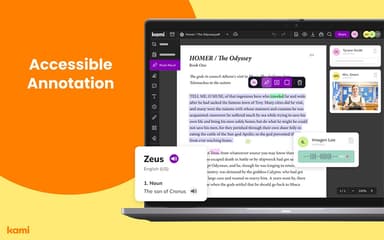
Kami is a digital learning platform that turns existing classroom resources into interactive assignments. It allows teachers to annotate materials, add questions, and use accessibility tools to support different learning needs. The platform also provides student progress information through features such as Class View. It gives educators a shared space to deliver lessons, review student work, and identify areas where learners need additional support from their teachers.

What Is Kami Best For?

The software is renowned for its Class View capability, which brings all class assignment copies into one review space. It allows teachers to view the submissions of all their students in a single location. The software further lets educators track progress, review answers, and grade multiple submissions. It also gives access to assignment-level insights that make it easy for teachers to compare student performance and highlight areas that require more attention.

How Much Does Kami Cost?

The platform’s starting price is $149. This package, known as the Teacher Plan, includes several features, such as Google Classroom integration and free onboarding and training. Additional Kami pricing tiers are as follows:

  • Basic Plan: Free
  • School Or District Plan: Custom pricing
Several users view the platform’s pricing as fair and affordable while noting that it can help reduce printing costs, though some feel the full version might be slightly expensive for schools with tighter budgets. Get a custom Kami cost quote today.

Disclaimer: The pricing is subject to change.

Kami Integrations

The platform integrates with multiple systems, such as:

How Does Kami Work?

Here's how you can manage classroom activities upon logging into the system:

  • Open the dashboard to access assignments and recent files
  • Select your profile settings to confirm the school role
  • Choose an existing document or create an assignment from the available files
  • Edit the document by adding annotations, questions, or multimedia responses
  • Assign the completed activity by sharing it using a Kami link
  • Open Class View to monitor submissions, add feedback, and enter grades
  • Select Insights to review class averages and score distribution
  • Use the Edit Assignment option to update student copies when changes are required
You can also schedule a free Kami demo to learn about the platform’s capabilities in detail.

Who Is Kami For?

The software is used by the following professionals:

  • Teachers
  • Technology leaders
  • Multilingual learner specialists
  • Assistive technology specialists
  • Supports and services leaders
  • Academic leaders

Kami Use Cases

Based on Kami’s existing capabilities, we have identified several situations where the platform can be a practical fit for K-12 schools and education teams:

Teachers That Need To Convert Existing Classroom Materials Into Digital Assignments

Teachers who already depend on PDFs and scanned worksheets need to work extra hours to turn lessons into digital classrooms. Recreating those resources can also make it harder to preserve familiar teaching materials. Kami provides a way to bring existing resources into digital lessons and add interactive elements without rebuilding the material from the ground up. This makes it particularly relevant for teachers shifting between paper-based and digital instruction.

School Leaders Standardizing Digital Instruction Across Multiple Campuses

Kami can serve districts that need a common approach to digital instruction across several schools. Academic leaders can use the platform as part of a district-wide strategy rather than leaving individual teachers to select separate classroom tools. Its use across districts of different sizes also makes it relevant when leaders are planning broader adoption and want greater consistency in classroom delivery.

Technology Teams Consolidating Classroom Applications

Technology departments often manage a growing collection of classroom applications, which can create additional concerns around access, security, and administration. Kami is suited to schools looking to reduce the number of separate systems used for digital teaching. Its support for Google, Microsoft, and Clever sign-in, along with security and privacy controls, gives technology leaders a basis for evaluating it as part of their district application environment.

Academic Institutions Supporting Students With Different Accessibility Needs

Kami helps schools that provide students with different learning requirements, as standard digital assignments, in such cases, do not provide enough ways to respond to each lesson’s content. The software allows teachers to adapt classroom materials so that the students have alternative ways to read content and communicate their understanding. This makes the platform particularly relevant for special education teams and schools working toward more accessible digital instruction.

Learning Programs That Support English Language Learners

English language learners need extra support when classroom materials include unfamiliar vocabulary and rely on written responses. Kami can fit this setting by giving teachers ways to adapt existing coursework while allowing students to respond through different media. Its language support and Read Aloud capabilities are particularly relevant for programs where comprehension and language development need to be addressed alongside the main curriculum.

Is Kami Right For You?

If you run a school that needs to turn existing PDFs and slides into interactive assignments, then Kami might be the ideal solution for you. It aligns with SOC 2 Type 2 and is GDPR-compliant to secure confidential data.

Additionally, the software has received the ISTE Seal of Alignment recognition from the International Society for Technology in Education. Trusted by several educational institutions, such as Moreno Valley Unified School District and Denver Public Schools, the platform is capable of meeting the needs of growing organizations.

Want to learn more about the Kami software? Contact us at (661) 384-7070 for further details.

Kami Features

Assessments And Grading

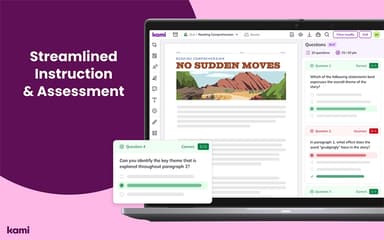
Kami features several assessments and grading tools to allow teachers to turn existing PDFs or templates into interactive assessments, select pages, and adjust questions, along with setting difficulty by grade level. The platform’s Questions AI capability lets users generate new questions from text or diagrams. Additionally, its Auto-grading handles eligible responses after submission, and LMS connections let educators distribute assignments and review class progress.

See How It Works
Feedback And Insights

The platform lets teachers track student submissions and review answers together. They can also filter assessments and enter grades using the same review area while providing personalized feedback to each student. Additionally, the system provides educators with an insights dashboard that presents the entire class’s overall average and score distribution. These views help teachers identify challenging questions and adjust their instruction accordingly while an assignment is still in progress.

See How It Works
Collaborative Learning

Kami software allows students to work on group projects using shared templates, whiteboards, and project copies. It also lets students respond with text or audio. The system allows educators to use video or screen captures to assess participation. During group work, teachers can monitor contributions and control which tools students can access for security purposes. They can also remove unwanted annotations and review annotation summaries.

See How It Works
Literacy And Numeracy

The system combines annotation with voice recording and Read Aloud for literacy. Additionally, it includes multimedia responses to support reading instructions and interventions. The software lets teachers use audio feedback and voice notes when students need another way to communicate rather than writing individual notes on each assignment or assessment. For numeracy, Kami allows learners to annotate problem-solving steps and explain mathematical thinking through different response formats. It gives teachers a place to track progress and highlight any learning gaps that require additional instruction.

See How It Works
In-Class And Blended Learning

The platform allows teachers to present lessons from classroom or remote devices and convert PDFs into interactive documents. It lets them add annotations, questions, and multimedia. The software lets students collaborate live or separately. Additionally, its feature control capability lets teachers manage available tools. Kami can place question types inside documents and provide auto-grading for eligible responses. It also provides read-aloud and dictionary functionalities, which educators and students can access during lessons, with captions available for each lesson delivery.

See How It Works

Pros And Cons of Kami

Pros

  • Makes assignments more interactive and engaging for students

  • Speeds up teacher feedback and review

  • Helps students better understand and work with learning materials

  • Saves time by simplifying digital document completion

  • Reduces the risk of losing work by storing documents online

Cons

  • Editing and font options are somewhat limited

  • Limited margins can make commenting difficult

  • Changes and annotations may not always save reliably

Kami Pricing

Basic Plan

eye

View Price

What's Included

  • Unlimited collaborators

  • Google Drive integration

  • Access to 10+ essential tools

  • Access to 1,000+ templates

  • OneDrive integration

Teacher Plan

eye

View Price

What's Included

  • Everything in the Basic Plan, plus:

  • Dedicated Account Manager

  • Free onboarding and training

  • Access to all 40+ tools and features

  • Domain-wide deployment

  • Schoology integration

  • Google Classroom integration

  • Microsoft Teams integration

  • Canvas integration

  • Priority support

School Or District Plan

eye

View Price

What's Included

  • Everything in the Teacher Plan, plus:

  • Google Classroom integration

  • Access to all 40+ tools and features

  • Canvas integration

  • Schoology integration

  • Free onboarding and training

  • Microsoft Teams integration

  • Priority support

Disclaimer: The pricing details were last updated on Aug 10, 2026 from the vendor's website. Please contact us for a tailored pricing list.

Kami Reviews

Total 22 reviews

4.6

All reviews are from verified customers

Rating Distribution

5

Stars

77%

4

Stars

5%

3

Stars

18%

2

Stars

0%

1

Stars

0%

Share your experience

HC

Hannah C.

Health, Wellness and Fitness, 101-500 employees

More than a year

3.0
February 2026

needs better text recognition and stationary edit

Pros

What really stood out to me was how you can throw almost any image or document at it and start messing with it right away. No fuss.

Cons

I really wish the text recognition worked better. Also once you upload a document you should be able to edit things that are just sitting there on the page like headers or other fixed items but you can't.

Rating Distribution

Ease of use

7

Value for money

7

Customer Support

7

Functionality

5

GP

Giovanni P.

Hospitality, 101-500 employees

More than a year

3.0
January 2026

Limited fonts and file quality

Pros

The PDF editing part doesn't cost anything which is nice. You get all the basic stuff like adding your own words, dropping in shapes, setting up fields however you want and then sharing it out or saving it straight to whatever cloud service you use.

Cons

You don't get a ton of editing options and the font selection is pretty limited. On top of that the file quality coming out the other end isn't exactly top notch.

Rating Distribution

Ease of use

5

Value for money

7

Customer Support

5

Functionality

5

JH

Julianna H.

Arts and Crafts, 1-10 employees

More than a year

3.0
July 2025

works well with google tools but less simpler than adobe

Pros

It plays really nicely with Google docs and other tools I already have. You can grab pretty much any document and start tweaking it without jumping through hoops.

Cons

Honestly I don't find Kami as easy to figure out as Adobe. With Adobe it's usually pretty obvious where you're supposed to type or where to drop your signature. With Kami you kind of have to jump through more steps just to finish up and save the thing.

Rating Distribution

Ease of use

7

Value for money

9

Customer Support

9

Functionality

5

Frequently Asked Questions

What language does Kami support?

Kami supports several languages, including English and Spanish.

Does Kami have a mobile app?

No, Kami does not have a mobile app.

Does Kami offer an API?

Yes, Kami offers an API.

What type of pricing plans does Kami offer?

The starting cost of the platform is $149 for its Teacher Plan. Additional pricing tiers include: Basic Plan (free) and School Or District Plan (custom pricing). Get a flexible Kami price quote today.

What level of support does Kami offer?

Kami provides email support.

What other apps does Kami integrate with?

Kami integrates with Microsoft Teams, D2L Brightspace, Canvas LMS, Schoology, and Google Classroom.

Who are the typical users of Kami?

Kami is used by academic leaders, teachers, assistive technology specialists, technology leaders, supports and services leaders, and multilingual learner specialists.