What Is Pentera?
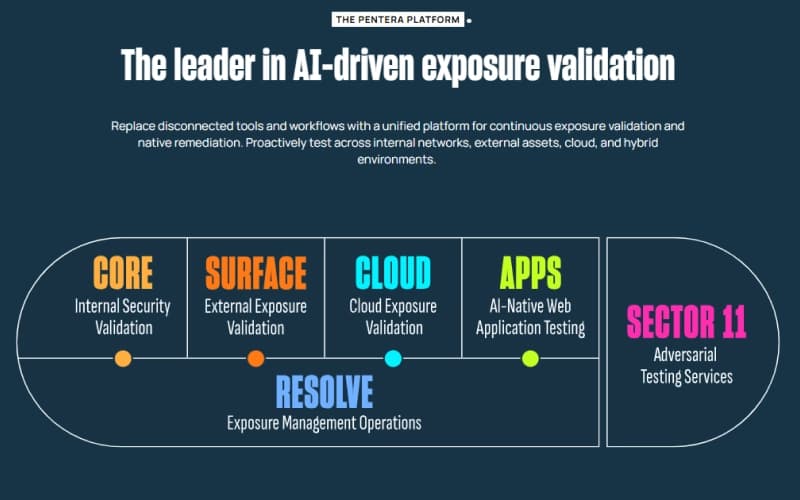
Pentera is a cybersecurity platform that helps security teams identify and validate exploitable risks across their IT environments. It uses adversarial testing to safely simulate attacker behavior across internal networks, external systems, cloud environments, and hybrid infrastructure. The platform includes Pentera Core for internal attack paths, Pentera Surface for external exposure, and Pentera Cloud for cloud-based risks. Pentera Peer adds an AI-based interface that gives teams more context when analyzing security findings.
Once risks are identified, Pentera helps teams decide which exposures need attention and move them into remediation workflows. Pentera Resolve can prioritize validated attack paths, assign fixes, and re-test the environment to confirm whether the exposure has been reduced.
What Is Pentera Best For?
The standout feature of Pentera is its 'AI-Powered Exposure Validation'. It lets security teams test their environments from an attacker’s perspective rather than relying only on theoretical vulnerabilities. This feature continuously tests internal networks, external attack surfaces, cloud environments, and web applications. It then uses the results to show which exposures are actually exploitable, how they can be chained, and which issues deserve attention first.
How Much Does Pentera Cost?
Pentera price is estimated to start at $35,000/year, based on industry benchmarks for similar cybersecurity platforms. The vendor offers quote-based pricing plans, which makes it suitable for different organizations.
In addition to the base subscription cost, buyers should budget for the following additional expenses:
- Implementation And Onboarding: $6,500 (one-time)
- Pentera Resolve (Remediation Module): $18,000/year — sold separately; adds SLA tracking, ownership assignment, retest workflows
- Asset Scope Expansion: $150–$300/additional 100 assets/year — for mid-contract environment growth
- Professional Services/Advisory: $12,000–$25,000 project-based — custom attack scenarios, compliance mapping, dedicated validation programs
Pentera’s pricing receives mixed feedback. Some reviewers consider the product expensive, while others feel the cost is justified by its value. Overall, pricing may be a consideration for organizations with tighter security budgets.
Disclaimer: Pricing references are based on publicly available third-party information and industry benchmarks. Actual costs may vary.
Pentera Integrations
Pentera integrates with several third-party apps, including:
How Does Pentera Work?
Follow the steps below to understand how Pentera typically works across the security validation and remediation process:
- Set up your environments by connecting internal networks, external assets, cloud environments, and web attack surfaces to the platform
- Configure testing by defining the environments, attack scenarios, and testing parameters that fit your security validation needs
- Run adversarial tests to simulate attacker behavior and identify ways security gaps could be exploited or chained across the environment
- Review validated exposures to understand how an attack progressed, what assets or data could be reached, and which risks require attention
- Prioritize remediation by assessing validated attack paths and focusing security teams on exposures with greater potential impact
- Assign and manage fixes by moving validated findings into remediation workflows and routing tasks to the appropriate teams
- Re-test the environment after remediation to check whether the identified exposure has been addressed and track changes in overall exposure
Schedule a free
Pentera demo to delve deeper into its functionality.
Who Is Pentera For?
The software suits different businesses across various industries and sectors, including:
- Manufacturing
- Retail
- Education
- Technology
- Telecommunications
Pentera Use Cases
Based on Pentera's features and user feedback, we have identified the following business scenarios where it is well suited:
Enterprise Security Teams Testing Large IT Environments
Security teams managing complex IT environments can use Pentera to test internal networks, internet-facing systems, cloud infrastructure, and web applications. This is useful for organizations where security exposure can span several environments at once. Teams can examine how an attacker could move through the environment and which assets may be reached along the way. Reviewers particularly appreciate its powerful automation capabilities, which makes it suitable for large IT environments.
Security Teams Deciding Which Risks to Fix First
Security teams often have large volumes of vulnerabilities and findings to review. Pentera can validate whether weaknesses are actually exploitable and show how they could be combined into attack paths. Teams can then use this context to focus remediation on exposures with demonstrated risk rather than relying only on static severity scores.
Cloud Security Teams Reviewing Exposure
Organizations with large cloud environments can use Pentera to see how compromised identities, permissions, or cloud weaknesses could expose sensitive resources. The platform includes dedicated cloud attack validation alongside testing for identities and access. This gives cloud security teams a way to examine how individual weaknesses may contribute to broader attack paths.
Regulated Organizations Validating Security Controls
The platform can be used by organizations operating under security and compliance frameworks to test controls against attack scenarios and document the results. Pentera lists support for frameworks including PCI DSS, ISO/IEC 27001, NIST, DORA, NIS2, and CIS Controls. Testing records, remediation activity, and revalidation results can provide supporting evidence for security and governance processes. This setup is particularly relevant to organizations that need documented evidence of how their controls perform in practice.
Is Pentera Right For You?
Pentera is best suited to organizations that need security validation to support a large or constantly changing environment. It is particularly relevant for enterprise security, red teams, vulnerability management, and security operations teams that need evidence they can use to make remediation decisions. Its customer base includes organizations such as DTCC, Casey’s, Telefónica, EDEKA, and ALDO Group.
Security may also be an important consideration for organizations evaluating Pentera. The vendor maintains SOC 2 Type II, SOC 3, ISO 27001:2022, and ISO 42001 certifications. Its ISO 42001 certification is particularly relevant to its use of AI, as the standard focuses on managing AI-related risks and establishing controls around responsible AI development and use.
A recent industry shift is the move toward continuous, threat-led security validation rather than relying on periodic assessments. In July 2026, Pentera partnered with Recorded Future to connect threat intelligence with exposure validation. The integration lets security teams check whether emerging threats are actually exploitable in their own environments and prioritize the exposures that matter. This makes Pentera a relevant option for organizations adopting a Continuous Threat Exposure Management (CTEM) approach.
Still doubtful if Pentera is the right fit for you? Connect with us at (661) 384-7070 for further guidance.