


Cerebro
Last Updated
Key Takeaways
Generated from the text of customer reviews
Cerebro is project management and collaboration software for visual production teams. It is used across VFX, animation, architecture, and marketing, with VFX and animation being particularly well suited to the platform. Users generally value its project organization and visual collaboration tools, although some complain that the software takes time to learn. Recent updates include the addition of custom color tags and favorites.
Our Verdict
Cerebro is a good fit for studios that manage detailed review cycles in VFX, animation, or architecture, where feedback needs to stay connected to specific assets. Its entry-level pricing is reasonable for this niche, although the move to the Studio plan can be a bigger expense for smaller teams. Overall, it is worth considering for visual production teams that want project management and review tools in one platform.
Overall Rating
Based on 2 users reviews
4
Rating Distribution
Positive
50%
Neutral
50%
Negative
0%
Starting Price
$9
per user per month
Cerebro Specifications
- Time Tracking
- Task Management
- Reporting
- Budget Management
What Is Cerebro Software?
Cerebro is collaborative working environment software that helps production teams manage a visual project from a single dashboard. Features like task assignment, file exchange, and progress tracking are all available at the same interface. Teams working with large media files, such as VFX renders or architectural drawings can get dedicated storage servers. The software features built-in reporting that brings project metrics and financial data into one view. It also connects directly with production software through plugins and APIs, so teams stay inside the tools they already use.
What Is Cerebro Best For?
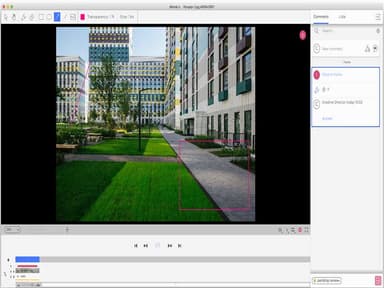
The platform’s built-in visual annotation system, Mirada, is one of its more distinctive features. Reviewers can mark up videos, images, and architectural drawings directly instead of explaining changes through separate messages. Text, voice, and graphic comments can be tied to a specific frame or area. This helps keep feedback alongside the part of the asset being discussed. This can make review rounds easier to follow when several people are working on detailed visual projects, particularly in VFX, animation, and architecture.
What Much Does Cerebro Cost?
Cerebro pricing starts at $9/user/month for the Team plan. This tier supports 1–10 users and includes 50 GB+ of cloud storage, visual annotations, free installation assistance, and integrations. A 30-day free trial is also available. Other plans include:
- Start: Free
- Studio: $29/user/month
- Factory: $59/user/month
Freelance accounts are available as well, with the following options:
- Mini (50 active days): $1,2/active day
- Midi (100 active days): $1,18/active day
- Maxi (200 active days): $1,1/active day
Beyond the base price, buyers should also factor in the following additional costs:
- Implementation And Setup: Initial setup can cost $500–$2,500 one time for configuring accounts, permissions, integrations, and project structures
- Training And Onboarding: Employee training may cost $200–$1,000 per team, particularly for larger teams adopting Cerebro’s visual review tools
- Data Migration: Moving existing project files and assets into Cerebro can cost $500–$5,000 one time for larger data volumes
- Premium Technical Support: Enhanced technical assistance may cost $500–$2,000/year for organizations with larger or more complex deployments
- Hardware Or Workstation Upgrades: Graphics-intensive projects may require $500–$2,000/user for higher-performance workstations and related equipment
Cerebro is generally considered a cost-effective option for teams that need project and file management alongside creative production tools. The free trial can also help businesses evaluate the platform before committing. However, organizations with larger teams may find the higher-tier plans less budget-friendly.
Disclaimer: The pricing is subject to change.
Cerebro Integrations
Cerebro can integrate with various third-party tools. Notable ones include:
- Unreal Engine
- DaVinci Resolve
- Amazon Web Services
- Dropbox
- Outlook Calendar
Users can also create custom integrations with Google Drive, 1C, Microsoft Excel, etc.
How Does Cerebro Work?
Getting started with Cerebro involves a few basic steps:
- Sign in with your credentials to open the main dashboard
- Go to Projects in the left-hand menu to create a project or open one that's already active
- Select a project to view its dashboard, including tasks, files, comments, and timelines
- From the Tasks tab, create a task, assign it to a team member, add a due date, and attach any relevant files
- Save the task and monitor its status as work moves forward
- Use the mobile app when you need to check project activity away from your computer
Who Is Cerebro For?
Cerebro is ideal for small and medium-sized businesses across various industries and sectors. These include:
- Visual effects and post-production
- Animation and 3D production
- Film and video production
- Architecture and visualization
- Advertising and creative agencies
- Art and design education
Cerebro Use Cases
Based on our analysis of user reviews and Cerebro features, we have identified key scenarios where this software is a good fit:
1. Growing Teams That Needs More Than Cloud-Only Storage
Cloud storage can become harder to manage as a creative team grows and its project files accumulate. Cerebro's Studio plan removes the user cap and allows companies to keep project files on their own server. They do not have to rely entirely on cloud storage. This can work well for studios dealing with increasing amounts of footage, renders, and other large assets.
2. Studios Working With Remote Artists And Freelancers
With web, desktop, and mobile access, along with file sharing and selective synchronization, Cerebro can support teams that regularly work with freelancers or outside contractors. They can share the files needed for a particular assignment without necessarily opening up the entire project to external contributors.
3. Architecture Firms Coordinating Designs And Construction Documentation
Architecture and visualization teams can use Cerebro to keep drawings, project files, tasks, and revisions together. Work can be assigned, dependencies tracked, and documents shared, while feedback can be added to files such as PDFs and DWG drawings. That gives teams a central place to follow design changes as a project develops.
4. Production Teams Working Across Different Creative Software
Creative teams often switch between applications depending on the work involved, from 3D modeling and animation to visual effects and video editing. Cerebro offers integrations and plugins for software such as Autodesk Maya, 3ds Max, Houdini, Blender, Cinema 4D, Nuke, and Adobe products. This can make it a practical option for teams that want project activity and file management to work alongside their existing creative tools.
Is Cerebro Right For You?
Cerebro is worth considering for teams that need more control over project access and security as they grow. Studios working with client footage, unreleased designs, or external contractors can use its permission groups to control what different users can access. Its support for custom encryption certificates may also suit companies with specific security policies.
Cerebro has also been used by Walt Disney Russia’s post-production team, along with visual effects and architecture firms, for CG production work. These examples point to its relevance for teams handling large, sensitive project files and working with multiple contributors.
Still doubtful if Cerebro is the right fit for you? Reach out to us at (661) 384-7070, and we will help you make an informed decision.
Cerebro Features
Task And Project Management
The software lets teams create projects and tasks, assign work to particular users, add deadlines, and group related activities. Project branches can be duplicated when needed, and templates make it easier to set up recurring project structures without starting from scratch each time.
Task Dependencies
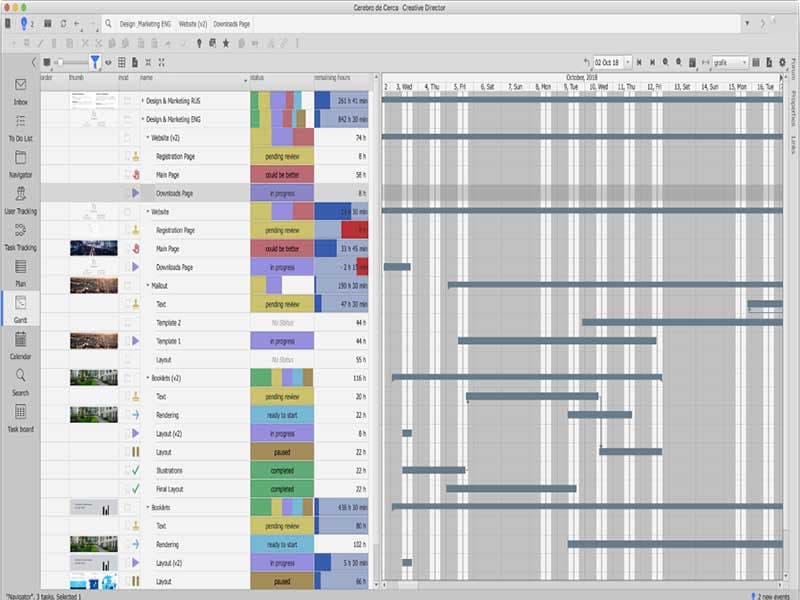
Using this Cerebro feature, related tasks and resources can be linked to show how different pieces of work affect one another. Cerebro displays these relationships in Gantt charts. Resources are not limited to people, either; teams can also account for equipment, locations, and other requirements tied to a project.
Budget And Time Tracking
Cerebro gives teams a way to set spending and time limits for individual tasks or resources, then record the time actually spent on the work. Estimates, costs, financial information, progress, and project reports are also available, giving teams a running view of how a project is tracking.
Selective Synchronization
When using Cerebro, users don't have to synchronize an entire project when only a few files need to be shared. It lets users select specific project files and synchronize them with external customers or contractors. This can be useful when working with outside parties who only need access to certain assets.
Collaboration
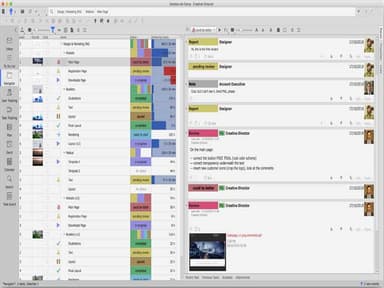
Cerebro also covers the everyday coordination that happens around a project. Users can maintain personal task lists, distribute work among team members, and exchange messages within a project. Someone working across several active jobs, for example, can check their assigned tasks in one place instead of searching through separate email threads.
File Storage
The software’s file handling is designed for different types of production workloads, whether a project involves a few large render files or thousands of smaller source files. Its dedicated servers and built-in file exchange module handle storage and sharing without requiring a separate service. Files can also sync across users, so teams don't have to keep passing assets back and forth by email.
Pros And Cons of Cerebro
Pros
Handles complex animation projects well
Keeps large project files organized
Tracks artist workloads across projects
Fits specialized VFX production processes
Keeps distributed teams on the same page
Cons
May take time to learn and configure
Small tasks can feel cumbersome to manage
Time tracking requires manual input
Cerebro Pricing
Start | Team | Studio | Factory |
|---|---|---|---|
Free | $9 per user per month | $29 per user per month | $59 per user per month |
|
|
|
|
Disclaimer: The pricing details were last updated on Sep 25, 2026 from the vendor's website. Please contact us for a tailored pricing list.
Cerebro Reviews
Total 2 reviews
4
All reviews are from verified customers
Rating Distribution
5
Stars50%
4
Stars0%
3
Stars50%
2
Stars0%
1
Stars0%
Share your experience
Small Business, 11-50 employees
“helpful modules and AP extractors”
Pros
Leadfwd has been especially valuable in helping me stay humble while being out in the congregation and that personal impact means a lot to me. On top of that, the modules and AP extractors are really useful features and have been some of the biggest benefits for me.
Cons
The biggest limitation at the moment is that it doesn't support multiple languages which creates a barrier.
Rating Distribution
Ease of use
7
Value for money
7
Customer Support
5
Functionality
5
Trucking Accounting, 51-100 employees
Less than 6 months
“Excellent service”
Pros
The software provides clear and daily data, making operations run smoothly. Also it's user-friendly and easy to navigate.
Cons
Initially, I found it confusing to understand the functions and layout.
Rating Distribution
Ease of use
10
Value for money
10
Customer Support
10
Functionality
10
Frequently Asked Questions
Does Cerebro offer an API?
Yes, API access is available.
What languages does Cerebro support?
It supports English and Russian.
What types of pricing plans does Cerebro offer?
Cerebro offers three paid plans beyond its free version: Team at $9/user/month, Studio at $29/user/month, and Factory at $59/user/month. Contact us for a personalized Cerebro price estimate.
Does it have a mobile app?
Yes, it has a mobile app for both Android and iOS devices.
What other apps does Cerebro integrate with?
It can integrate with several third-party tools, including Google Drive and Unreal Engine.
Who are the typical users of Cerebro?
Small and midsize organizations across several creative industries use Cerebro, including visual effects and post-production, animation and 3D production, film and video, and architecture.
What level of support does Cerebro offer?
Cerebro offers around-the-clock support to businesses and users through various channels like phone, chat, email, docs, and community forums.