


CAKE POS
Last Updated
Key Takeaways
Generated from the text of customer reviews
CAKE POS provides point-of-sale functionality designed for day-to-day restaurant operations. It works well for independent restaurants and quick-service businesses, as well as growing restaurant groups. Reviewers highlight its ease of use and quick and responsive customer support. Some users have also reported concerns about payment processing. A recent update lets restaurants set custom pre-authorization amounts in the Order Queue instead of using the previous fixed $1 charge.
Our Verdict
CAKE POS may suit independent restaurants and growing restaurant groups that value ease of use and responsive support. It is a practical fit for small to mid-sized teams that want a simple system for managing operations in different locations. Its no-monthly-POS-fee model may offer long-term value. Its online ordering and guest engagement tools suit restaurants that want to enhance customer experience from a single platform.
Overall Rating
Based on 46 users reviews
4.4
Rating Distribution
Positive
87%
Neutral
7%
Negative
7%
Starting Price
Custom Pricing
CAKE POS Specifications
- Sales Orders
- Sales Tracking
- Customer Management
- Online Help
What Is CAKE POS?
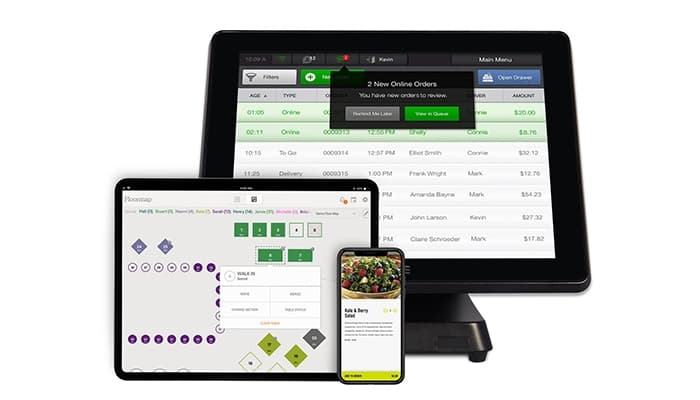
CAKE POS is a restaurant management software from CAKE Corporation. It brings point-of-sale transactions and restaurant ordering into the same system. Restaurants can take orders in-house or online, process payments, send orders to the kitchen, and review restaurant activity through reporting tools.
CAKE Corporation is a wholly owned subsidiary of Mad Mobile, Inc. Mad Mobile acquired CAKE to expand its restaurant technology offering. The system supports card payments along with checks and cash. Once an order is entered, staff can send the ticket to the kitchen and keep front-of-house and back-of-house operations connected.
CAKE supports several tools that restaurants can add to their setup. Self-service kiosks give customers another way to place orders. Restaurants can also use online ordering and customer-facing displays. Printer routing is available for directing orders to the appropriate printers.
What Is CAKE POS Best For?
CAKE POS software stands out with its Customer Touch Display (CTD). The customer-facing payment screen also serves as an in-house advertising channel. Restaurants can use it to show promotional content while guests complete their transactions. This gives restaurants another way to engage customers during payment. It can be particularly useful for independent restaurants and growing chains that want to promote offers or menu items at the point of payment.
How Much Does CAKE POS Cost?
CAKE POS pricing starts at $0–$500+/month/location. It uses a custom payment-processing rate, so the total cost depends on transaction volume and the terms offered to each restaurant. Its plans include the following options, with pricing customized rather than published as fixed monthly fees.
- Core
- Growth
- Scale
Final costs may depend on the following additional costs:
- Payment Processing: Custom rate based on card-processing volume. It is estimated at around 2.5%–3.5% + $0.10–$0.30/transaction, depending on the negotiated rate and card mix
- Inactivity Fee: $85/month/location when there is no card-processing activity for 60 consecutive days under a Pay-As-You-Please subscription
- Third-Party Integrations: Estimated $0–$200+/month, depending on the external service. CAKE supports integrations with accounting, delivery, marketing, and other restaurant applications
- Optional Professional Services: Estimated $100–$500+ one-time, depending on the service required
User reviews generally describe CAKE as affordable and offering good value. Some reviewers note that add-ons, equipment, and processing costs can raise the overall expense.
Disclaimer: Pricing references are based on publicly available third-party information and industry benchmarks. Actual costs may vary.
CAKE POS Integrations
CAKE software integrates with various popular third-party applications, including:
- DAVO
- Uber Eats
- QuickBooks
- Door Dash
- Xero accounting solution
- Checkmate
How Does CAKE POS Work?
Here's how restaurant teams can access CAKE POS and move from setup to daily order management:
- Log in to the CAKE Admin account to access restaurant settings and management tools
- Configure menu items, modifiers, prices, and availability for supported ordering channels
- Create dine-in, takeout, or delivery orders through the POS. CAKEpop handles tableside ordering
- Route orders to the Kitchen Display System and follow them through completion
- Process customer payments and show promotions, loyalty messages, gift cards, or QR codes at checkout
- Manage online and third-party orders through connected ordering channels
- Track sales and operations. Multi-location businesses can manage locations, menus, pricing, and reporting centrally
Who Is CAKE POS For?
CAKE POS serves the restaurant and foodservice industry, including:
- Quick-service and fast-casual restaurants
- Full-service restaurants
- Cafes and bakeries
- Bars and lounges
- Asian restaurants
- Indian restaurants
- Mexican restaurants
CAKE POS Use Cases
Based on CAKE POS’ capabilities, it is relevant to the following use cases:
Independent Restaurants Expanding Beyond Dine-In Service
CAKE POS can manage different order types within the same restaurant operation, which can help an independent restaurant handle takeout, delivery, or online orders alongside dine-in service. Adding these channels may require staff to change how they handle orders during busy periods. This is most relevant to restaurants expanding their service model while continuing to operate from a single location.
Quick-Service Restaurants Adapting To Higher Order Volumes
When order volumes increase, quick-service restaurants may need to rethink how customers place and collect orders. CAKE POS can support restaurants shifting part of the ordering process toward self-service, while staff continue handling the rest of the service operation. This applies to restaurants changing their service model as customer traffic or ordering demand grows.
Multi-Location Groups Reviewing Operations Across Sites
Managing several restaurants creates different oversight challenges than running a single location. Managers may need to compare sales and operating activity across sites while keeping track of individual locations. CAKE POS suits this type of multi-location environment, where management needs a shared view of restaurant operations instead of reviewing each site separately.
Franchise Brands Expanding Across Multiple Locations
CAKE POS can provide a common operating environment across franchise locations, which can help restaurant brands maintain consistent processes as they expand. Corporate and franchise teams may still need to manage their own daily activities, but a shared system can support greater consistency across locations. This makes the software relevant to brands growing through franchising.
Restaurants Incorporating Promotions Into The Checkout Process
Some restaurant operators use the transaction itself to engage customers, particularly when promoting loyalty programs, gift cards, or current offers. CAKE POS can support this type of checkout-based engagement through its customer-facing transaction experience. This applies to restaurants that already have promotional activities in place and want those interactions to become part of the customer’s visit.
Is CAKE POS Right For You?
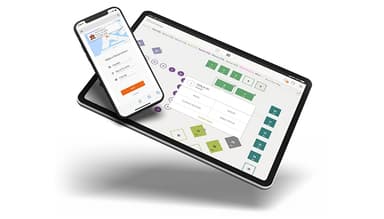
CAKE POS is worth considering for restaurants looking for a system that can support growth beyond a single location. Its plans follow that progression. Its multi-location system can support businesses with 3 to 100+ locations.
The software provides a way to manage different locations within the same setup. Its multi-location tools include centralized menu management, location-level pricing and item availability, and enterprise reporting. These controls can be useful for franchise and restaurant groups that are adding locations and need to keep administrative processes consistent across sites.
CAKE describes its payment processing as PCI-compliant, while its legal agreements reference PCI DSS requirements for payment-card security and POS equipment. This gives restaurants a specific security standard to review when assessing CAKE's payment environment.
CAKE also connects with other systems that restaurants may already use. The available connections are therefore worth reviewing alongside the rest of a restaurant's existing technology setup.
The software is used across different restaurant formats and larger restaurant groups. CAKE lists Toastique, Ike's Love and Sandwiches, and ATL Buffalo Wings on its multi-location page. Its POS also features 76 Steak & Potato as a long-term customer.
CAKE may not be the best fit for a business looking for a general retail POS rather than restaurant-specific workflows. For restaurants expecting to expand their ordering and payment setup, its plans provide a path from single-location operations to larger deployments.
Still doubtful if CAKE POS is the right fit for you? Get in touch at (661) 384-7070, and we will help you make an informed decision.
CAKE POS Features
Point Of Sale
CAKE POS features a point of sale tool that enters restaurant orders and process payments. It lets restaurant staff take orders, select menu items and modifiers, and manage dine-in and takeout orders from the register. Order details are kept together so staff can review the check and complete the transaction.
Online Ordering
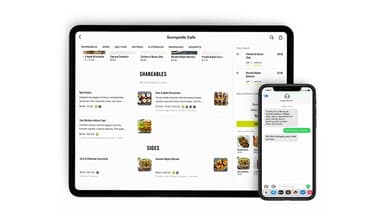
CAKE's online ordering system accepts pickup, delivery, and order-ahead orders. Orders placed through the system are sent to CAKE POS, where staff can view and manage them with other supported orders.
Kitchen Display System
CAKE's Kitchen Display System displays restaurant orders on digital kitchen screens. Orders from CAKE POS, online ordering, and self-service kiosks can be routed to the kitchen. Staff can view and update tickets as orders move through completion.
Menu Management
CAKE Admin is used to configure restaurant menus. Staff can add or modify menu items, prices, modifiers, and availability. The menu information can then be used across supported CAKE ordering channels as part of the restaurant's ordering setup.
Self-Service Kiosk
CAKE's self-service kiosk provides a customer-facing interface for browsing menus, selecting items and modifiers, and making payments. Orders placed through the kiosk connect with CAKE POS and enter the restaurant’s order workflow for processing.
Pros And Cons of CAKE POS
Pros
Easy interface helps new restaurant staff learn the system faster
Users praise support staff for quick responses and troubleshooting
Online ordering works well for restaurants using CAKE for digital orders
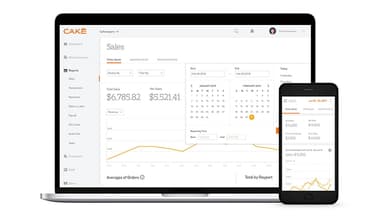
Custom reports cover sales, labor, and other operational data
Tile-based menus make items easy for staff to find and select
Cons
Bulk editing multiple menu items and modifiers is not easy
Time-clock settings may lack mandatory break enforcement options
Reporting lacks flexibility for comparing specific weekdays across years
CAKE POS Pricing
Core | Growth | Scale |
|---|---|---|
Custom Pricing | Custom Pricing | Custom Pricing |
|
|
|
Disclaimer: The pricing details were last updated on Oct 12, 2026 from the vendor's website. Please contact us for a tailored pricing list.
CAKE POS Reviews
Total 46 reviews
4.4
All reviews are from verified customers
Rating Distribution
5
Stars72%
4
Stars15%
3
Stars2%
2
Stars4%
1
Stars7%
Share your experience
Small Business, 11-50 employees
Less than a year
“Sometimes hard to use, sometimes not”
Pros
Most of the time, the customer service people are extremely helpful with whatever I need.
Cons
Sometimes, it gets extremely confusing when a problem arises, and I am unsure about the steps to take. It would also be helpful if it had timing features for different stations on the line.
Rating Distribution
Ease of use
6
Value for money
6
Customer Support
10
Functionality
6
Product, 1-10 employees
Less than 6 months
“Mama Monse's Review”
Pros
Learning this system was not at all an issue, and it is highly user friendly. The customer service is excellent as well.
Cons
It's unfortunate that there is no availability of SIM cards for "on the go" or mobile businesses. Additionally, it's not compatible with most hotspots due to Ethernet requirements.
Rating Distribution
Ease of use
10
Value for money
10
Customer Support
10
Functionality
10
Small Business, 11-50 employees
Less than 6 months
“Customer Service is Next Level Awsome!”
Pros
I recently started using CAKE, and I must say, setting up the system was a lot easy then I expected. Despite being 61 years old, I was able to set up our store with minimal instruction. Whenever I needed help, the customer service was consistently outstanding. With 36 years of business experience, I can honestly say that CAKE's customer service is the best I have ever encountered!
Cons
I do have a few desires for the system, such as receiving notifications when a customer arrives for curbside pickup.
Rating Distribution
Ease of use
10
Value for money
10
Customer Support
10
Functionality
9
Frequently Asked Questions
Does CAKE POS offer an API?
Yes. CAKE offers API capabilities for connecting third-party applications and partners.
What language does CAKE POS support?
CAKE POS is primarily available in English.
What other apps does CAKE POS integrate with?
CAKE integrates with apps including QuickBooks, Xero, Uber Eats, DoorDash, 7shifts, Olo, Checkmate, Paytronix, and Restaurant365.
Does CAKE POS have a mobile app?
No, CAKE POS does not offer a dedicated mobile app.
What types of pricing plans does CAKE POS offer?
CAKE POS pricing starts at $0–$500+/month/location, with Core, Growth, and Scale plans priced through a custom payment-processing rate rather than fixed monthly fees. You can also request a personalized CAKE POS cost quote for your business today.
Who are the typical users of CAKE POS?
CAKE POS serves the restaurant and foodservice industry, including quick-service and fast-casual restaurants, full-service restaurants, cafes and bakeries, bars and lounges, as well as Asian, Indian, and Mexican restaurants.
What level of support does CAKE POS offer?
CAKE offers support through phone calls, email, and support forms.