Last Updated
Overview
MedClarity offers medical billing and claims management tools that support healthcare providers in handling revenue cycle tasks such as insurance verification, claims processing, and payment tracking. While some users report occasional integration issues with external systems, its reporting and billing workflows support structured financial operations in clinical settings.
Overall Rating
Based on 8 users reviews
4.6
Rating Distribution
Positive
100%
Neutral
0%
Negative
0%
Starting Price
Custom
MedClarity Specifications
- e-Prescriptions
- Mobile App
- Patient Portal
- Customizable Forms
What Is MedClarity?
MedClarity, developed by Medusind, is cloud-based practice management and revenue cycle management software used by medical practices to handle appointment scheduling, billing, and patient record tracking. It includes a rules-based claims engine, real-time insurance eligibility checks, and a scheduler with copay visibility. These features help reduce claim errors and payment delays while supporting daily administrative tasks in clinics with high patient volumes, including mid-sized and large practices as well as specialty clinics.
What Is MedClarity Best For?
MedClarity is best known for its proprietary claims aging algorithm used in medical revenue cycle management. It helps prioritize unpaid claims by age and urgency, runs real‑time insurance eligibility checks, and surfaces copay information directly within the scheduling workflow. The software is a strong fit for practices managing high patient volumes and those moving away from fragmented billing and scheduling tools, since keeping claims follow‑up, eligibility verification, and appointment management in one place reduces revenue leakage.
How Much Does MedClarity Cost?
The pricing of MedClarity is estimated to fall between $300 and $1,200/provider/month, based on industry benchmarks for similar practice management and revenue cycle management software solutions. This range is intended for general budgeting purposes, as actual costs may vary depending on practice size, claims volume, EHR integrations, enabled modules, and whether it is bundled with Medusind’s RCM services. In addition to the base subscription costs, organizations should also account for the following expenses:
- Implementation And Onboarding: Typically ranges from $500–$2,500, covering system setup, workflow configuration, and onboarding support for providers and staff
- Data Migration: Usually falls between $500–$3,000 for moving patient records, billing history, and scheduling data from existing systems
- Training: Generally estimated between $300–$1,500, depending on practice size and the level of role-based training needed for front desk, billing, and clinical teams
- Integrations (API/EHR): Typically costs between $500–$2,000 for custom or semi-custom connections beyond standard EHR integrations
- Customization And Configuration: Usually ranges from $500–$2,500 for setting up workflows, claim rules, and automation based on practice needs
- Premium Support: Generally priced around $100–$500/month for priority support or dedicated account management in addition to standard service levels
Disclaimer: Pricing references are based on publicly available third-party information and industry benchmarks. Actual costs may vary.
MedClarity Integrations
MedClarity EHR integrates with more than 30 EHR systems. However, the vendor has not disclosed the names of any third-party applications.
How Does MedClarity Work?
Users can log in to MedClarity and follow the steps below to manage scheduling, billing, and revenue cycle tasks:
- Set up practice details by adding provider information, clinic locations, and basic configuration settings in the system
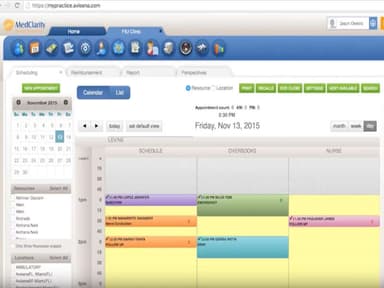
- Create appointments by booking patient visits and updating scheduling details through the calendar view
- Check insurance eligibility by reviewing patient coverage information before appointments or during intake
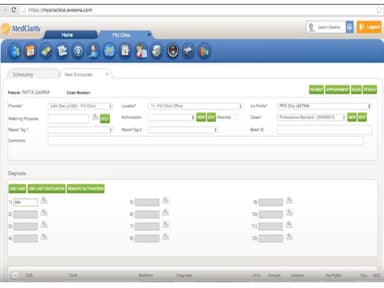
- Submit claims by entering billing details and sending claims through the system for processing
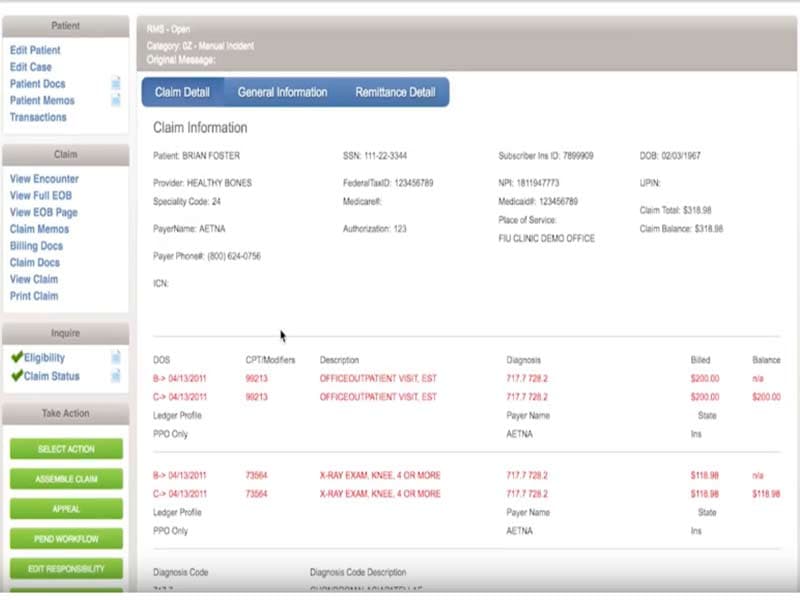
- Track claim status by viewing updates, denials, and payment progress in the billing dashboard
- Follow up on unpaid claims by reviewing aged balances and prioritizing overdue items for review
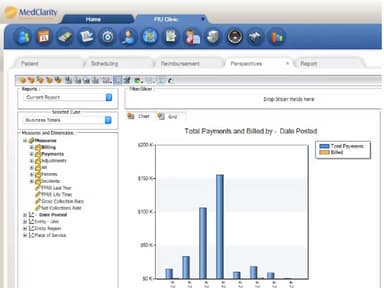
- View reports to check billing activity, collections, and overall revenue cycle status from available dashboards
Who Is MedClarity For?
MedClarity EMR is a scalable software that can accommodate the needs of growing medical practices across various specialties, including dental, radiology, and pathology. Clinics across the following specialties also use it:
- Cardiology
- Dermatology
- Chiropractic
- Nephrology
- Osteopathic
- Podiatry
- Oncology
MedClarity Use Cases
Based on our analysis of user reviews and MedClarity’s current capabilities, we have identified key scenarios where this software is a strong fit for medical practices, physician groups, and healthcare organizations seeking to streamline practice management and revenue cycle operations:
Practices Seeking Faster And More Predictable Claims Reimbursement
Billing teams often measure software value by how quickly claims get paid. When reimbursement timelines are slow or unpredictable, the cause is usually found upstream in eligibility gaps, submission errors, or limited visibility into claim status. MedClarity may suit practices where reimbursement velocity directly affects cash flow and billing staff need a more reliable path from submission to payment.
Practices Needing Consolidated Reporting Across Payers, Physicians, And Locations
Practices generating billing and financial data from multiple providers and insurance relationships rarely have one place to review it all. Preparing reports manually for these categories takes time administrative teams do not have. MedClarity may fit organizations needing flexible, on-demand reporting covering payers, physicians, and reporting periods without relying on staff to pull figures from separate sources.
Specialty Practices Managing Eligibility Verification And EMR Integration
In specialty settings like orthopedics, eligibility accuracy at the point of scheduling directly affects denial rates. When verification and clinical documentation run through separate systems, reconciliation errors between billing and clinical teams are common. MedClarity could play an important role for specialty practices that need eligibility and EMR workflows operating in closer alignment to reduce those gaps.
Multi-Location Practices With Fragmented Billing And Financial Oversight
Practices across several locations often struggle to maintain consistent billing procedures and a consolidated view of financial performance. Cash flow problems in these environments are frequently a visibility issue rather than an isolated operational failure. MedClarity may be worth considering for multi-site physician groups where unified tracking of billing activity and financial reporting across locations is a priority.
Practices Prioritizing Fast Staff Onboarding And Workflow Consistency
Small administrative teams and frequent staff turnover create ongoing risk of workflow inconsistency, particularly when software requires significant training to use properly. When new hires take too long to become productive, billing accuracy and scheduling reliability tend to suffer. MedClarity may suit practice managers who need staff operational quickly and day-to-day consistency maintained without heavy onboarding support.
Is MedClarity Right For You?
Are you looking for a comprehensive practice management solution that offers powerful analytics? MedClarity might be the perfect fit for your healthcare practice. It is HIPAA compliant and protects patient data to the highest standards. Moreover, the software is highly scalable and can cater to the needs of growing healthcare organizations.
Still have questions about MedClarity? Call our customer support representative at (661) 384-7070, and we'll answer all your questions and help you make the best decision.
MedClarity Features
Patient Records Management
MedClarity stores patient records within the same system as scheduling and billing, rather than in a separate tool. Staff can access clinical and administrative information during routine tasks without leaving the platform, keeping relevant data available across the different operational areas the software covers.
Claims Aging Algorithm
The platform includes a proprietary algorithm that organizes unpaid claims by how long they have been outstanding. The algorithm structures the claims follow-up queue based on time elapsed, giving billing teams a consistent method for working through unresolved items in the AR workflow.
Rules-Based Claims Engine
The software runs claims through an automation and rules engine before they are submitted to payers. The engine applies predefined rules during the scrubbing process, reviewing each claim for issues that would otherwise require correction after the fact. Billing teams work through flagged items while the claim is still in-house, before it moves further in the submission workflow.
Smart Scheduler
This functionality helps make daily front-desk work easier by bringing everything related to appointments into one place. It tracks appointment status in real time, verifies insurance eligibility ahead of visits, and clearly shows copay information so staff know what to expect.
Real-Time Eligibility Verification
MedClarity’s real-time insurance eligibility verification makes it easier for healthcare providers to quickly check a patient’s coverage and benefits directly within the platform, without having to switch between different systems. It pulls up-to-date information from insurance databases, helping reduce claim denials caused by inactive or expired coverage.
Pros And Cons of MedClarity
Pros
Keeps scheduling, billing, and records within one system
Gives staff access to real-time insurance eligibility information
Reduces claim errors before submission to insurance payers
Helps teams prioritize unpaid claims based on aging
Supports billing operations in high-volume medical practices
Cons
Initial setup may require configuring billing workflow rules
Some workflows may depend on external EHR compatibility
MedClarity Reviews
Total 8 reviews
4.6
All reviews are from verified customers
Rating Distribution
5
Stars63%
4
Stars38%
3
Stars0%
2
Stars0%
1
Stars0%
Share your experience
lynn
Health, Wellness and Fitness, 101-500 employees
“Good software”
Pros
MedClarity is praised for its ease of use, cloud-based accessibility, and efficient patient tracking features.
Cons
Similarly, I didn't find anything in particular that I disliked.
Rating Distribution
Ease of use
8
Value for money
8
Customer Support
10
Functionality
8
Jennifer
Medical Practice, 1-10 employees
More than a year
“User friendly medical practice management software”
Pros
MedClarity offers user-friendly features with a built-in 'help' button guiding users to the online manual, simplifying training for new employees. Users can customize schedules, appointment types, and more, while the reporting function allows for comprehensive data retrieval tailored to specific needs.
Cons
I don't have any complaints. The software meets all our needs perfectly.
Rating Distribution
Ease of use
10
Value for money
10
Customer Support
9
Functionality
10
Shelby
Financial Services, 1-10 employees
Less than 6 months
“Fast pay!”
Pros
This software stands out for its ability to expedite claim payments compared to other billing software options.
Cons
I can't find a single fault with Medclarity! It's incredibly user-friendly, and I would recommend it to anyone.
Rating Distribution
Ease of use
10
Value for money
10
Customer Support
10
Functionality
10
Frequently Asked Questions
Does MedClarity have an app?
No, MedClarity does not have a dedicated app.
Who are the typical users of MedClarity?
Typical users of MedClarity EHR include chiropractic, neurology, dermatology, podiatry, osteopathic, cardiology, and oncology departments.
What languages does MedClarity support?
MedClarity supports the English language.
Does MedClarity support mobile devices?
Yes, MedClarity can be accessed on mobile devices through a web browser.
What level of support does MedClarity offer?
MedClarity offers support through several options, including 24/7 customer support, phone, email, live chat, and an online contact form.
How much does MedClarity cost?
MedClarity pricing is estimated at $300–$1,200/provider/month, varying based on practice size, usage, integrations, and service bundling. Get a detailed MedClarity cost breakdown to make an informed decision.
Is MedClarity free?
No, MedClarity is not free.
What other apps does MedClarity integrate with?
MedClarity offers integration with 30+ EHR platforms. However, the vendor has not publicly disclosed its third-party integrations.
Does MedClarity offer an API?
No, MedClarity does not offer an API.
What type of pricing plans does MedClarity offer?
MedClarity offers customized pricing plans based on the specific requirements of medical practice.
Is MedClarity a technology-only solution for practice management?
Yes, MedClarity is a technology-only solution designed to improve practice management through advanced analytics, billing processes, and scheduling tools.