



Last Updated
Key Takeaways
Generated from the text of customer reviews
Our Verdict
Overall Rating
Based on 180 users reviews
4.1
Rating Distribution
Positive
79%
Neutral
15%
Negative
6%
Starting Price
$229
per month
Fishbowl Specifications
- Production Planning
- Inventory Management
- Supply Chain Management
- Work Order Management
Fishbowl Features
Cost Management
The feature enables manufacturers to track labor, estimated, and actual costs with precision to provide visibility into production expenses. Labor hours can be linked to individual production stages and work orders and manufacturing costs can be connected to the accounting systems. This enables manufacturers to trace costs linked with raw materials, labor, and finished products.
Capacity Planning
The platform provides capacity planning tools to help manufacturers allocate production resources based on demand. Users can get automated capacity projections, which help identify bottlenecks within manufacturing workflows so they can strategize to counter them as needed. By considering resources alongside production requirements, manufacturers can plan workloads, adjust schedules, and coordinate production capacity as demand or workflow requirements change.
Traceability
Fishbowl tracks parts, batches, and serial numbers through their inventory lifecycle. The Audit Trail plugin records changes made to records, while the Lot History report shows the work orders, purchase orders, and sales orders associated with a specific lot. This gives businesses a way to review item history when investigating inventory activity or preparing an audit.
Asset Management
The platform tracks business equipment in addition to inventory. Businesses can record the location and availability of assets such as tools, forklifts, and vehicles. Managers can use these records to check where equipment is located and whether it is available before assigning it to a job or emplboyee.
Vendor Management
Fishbowl stores vendor information alongside purchasing records. Businesses can assign default vendors to parts and maintain vendor-specific contract and payment terms. This gives purchasing teams access to supplier information when creating orders and reviewing previous purchasing activities.
Point Of Sale
Fishbowl Payments allows businesses to process card and ACH payments through the platform. Payment information is handled according to Payment Card Industry Data Security Standard (PCI DSS) requirements. Meanwhile, transactions are recorded alongside inventory and accounting activity. This allows sales and payment records to remain connected with the related inventory transactions.
Warehouse Inventory Management
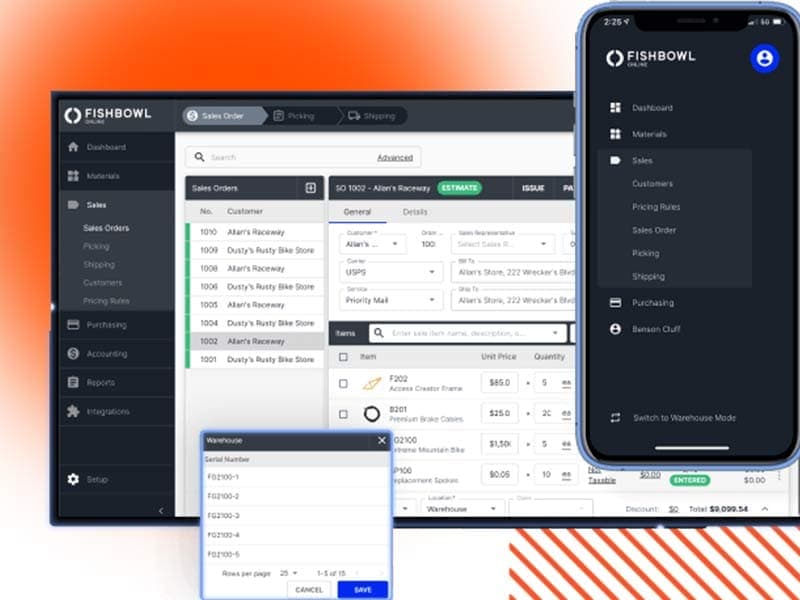
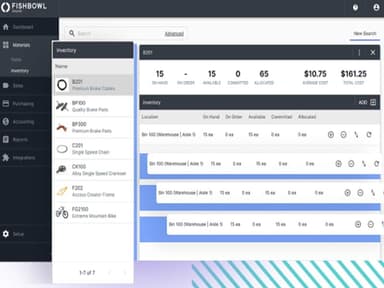
The platform supports inventory management across physical warehouses, mobile inventory operations, third-party logistics, and drop-shipping workflows. Businesses can manage purchasing and order fulfillment from the same inventory records. Receiving and shipping transactions update stock levels as inventory moves through the warehouse.
Pros And Cons of Fishbowl
Pros
Handles inventory across multiple locations efficiently
Makes kitting flexible for complex product combinations
Supports barcode scanning and warehouse scanners
Accommodates high-mix, low-volume operations and custom builds
Supports batch numbers during bulk uploads
Cons
Provides rigid report filters and limited options for adding fields
Limited drill-down capabilities for detailed cost analysis
Lacks configurable low-stock email notifications
Fishbowl Pricing
Essentials | Growth | Scale | Advanced Manufacturing | Advanced Warehouse |
|---|---|---|---|---|
$229 per month | $429 per month | $729 per month | $675 per month | $595 per month |
|
|
|
|
|
Disclaimer: The pricing details were last updated on Sep 07, 2026 from the vendor's website. Please contact us for a tailored pricing list.
Fishbowl Reviews
Total 180 reviews
4.1
All reviews are from verified customers
Rating Distribution
5
Stars48%
4
Stars31%
3
Stars11%
2
Stars4%
1
Stars6%
Share your experience
Christopher
Retail, 11-50 employees
Less than a year
“Software that's 70% complete”
Pros
I appreciate the interface's simplicity and seamless integration with Quickbooks.
Cons
This software has the potential to be fairly decent, but numerous peculiarities prevent it from truly being a powerful tool. A prime example is when moving inventory from one location to another. If you've had the item in your warehouse for six months and you move it from row 1 to row 2, the aged date resets to zero. Consequently, tracking aged inventory becomes effectively impossible. Additionally, when searching for a part that is not in stock, you must go through an advanced search, select the option for non-inventory items, and then search for the product. This process needs to be repeated for every consecutive product, resulting in unnecessary repetition.
Rating Distribution
Ease of use
3
Value for money
4
Customer Support
3
Functionality
2
Jeff
Electrical/Electronic Manufacturing, 11-50 employees
Less than 6 months
“Will Fishbowl Survive in the coming years?”
Pros
The onboarding process was smooth and the team provided responsive and helpful support. However, be prepared to handle the workload independently. Despite the initial challenge of starting from scratch and excluding Quickbooks inventory, it is ultimately worth it.
Cons
Once your system is up and running, customer support becomes a distant concern. Seeking assistance often entails spending thousands of dollars, even for the simplest requests, and getting a response can be a lengthy process, sometimes spanning up to two weeks for scheduling a resolution.
Rating Distribution
Ease of use
4
Value for money
4
Customer Support
4
Functionality
4
Joshua
Recreational Facilities and Services, 1-10 employees
Less than a year
“Good Software”
Pros
Fishbowl is user-friendly and effectively maintains our shop's inventory.
Cons
Fishbowl failed to establish a connection with shipping software like UPS Worldship, pirateship, etc., resulting in an unsatisfactory user experience.
Rating Distribution
Ease of use
8
Value for money
7
Customer Support
7
Functionality
7
Frequently Asked Questions
What type of pricing plans does Fishbowl offer?
Fishbowl Inventory offers three published monthly plans, Essentials at $229/month, Growth at $429/month, and Scale at $729/month. Fishbowl’s warehouse and manufacturing software pricing starts at $595/month and $675/month, billed annually. Contact us for a custom Fishbowl cost estimate.
Who are the typical users of Fishbowl?
Fishbowl is best suited for small to mid-sized manufacturers and distributors across industries like aerospace, automotive, chemicals, construction, consumer goods, food and beverage, and healthcare.
What languages does Fishbowl support?
Fishbowl primarily supports English.
Does Fishbowl offer an API?
Yes. The platform offers an API.
What other apps does Fishbowl integrate with?
Fishbowl integrates with QuickBooks (Online, Desktop, and Enterprise), Xero, Shopify software, Magento, ShipStation, Amazon, BigCommerce, WooCommerce, and CRMs including HubSpot, Salesforce, and Zoho.
What level of support does Fishbowl offer?
Fishbowl provides support through phone from an in-house customer success team, along with dedicated implementation specialists and the MyFishbowl community portal.
Does Fishbowl have a mobile app?
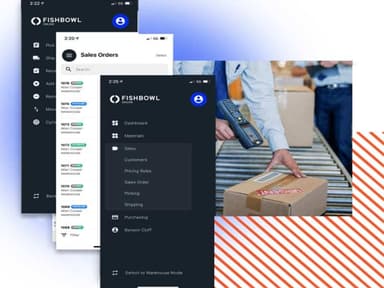
Yes. Fishbowl GO is a dedicated mobile app available on both iOS and Android.