


Simio
Last Updated
Key Takeaways
Generated from the text of customer reviews
Simio is digital twin simulation software for engineers, operations teams, and process analysts. It is widely used in manufacturing, supply chain, healthcare, and transportation. It's easy model configuration and simulation capabilities are consistently appreciated, whereas others report limited documentation and slower performance with complex models. Simio recently added Linux container support for Simio Portal to support cloud and DevOps deployments.
Our Verdict
Simio is well suited to mid-sized and large organizations that need to model complex operations and evaluate changes before implementation. Commercial pricing may be less practical for smaller teams, though the free version provides an accessible way to explore simulation modeling. We recommend Simio for organizations where detailed operational analysis and informed planning can justify the investment.
Simio Specifications
- Production Planning
- Inventory Management
- Supply Chain Management
- Real-Time Monitoring
What Is Simio?
Simio is a Digital Twin Simulation software that helps organizations model, analyze, and improve complex operational processes. It creates virtual representations of real-world systems, allowing teams to test changes before implementation. Organizations can use it for capacity planning, process optimization, risk analysis, resource allocation, production scheduling, and operational planning.
The platform uses object-oriented, data-generated, and data-driven simulation models to show how people, equipment, materials, and processes interact. Teams can run what-if scenarios to identify bottlenecks, evaluate layouts, understand system constraints, and assess operational changes. Simio also supports planning with live data, allowing organizations to adjust production plans and schedules as operating conditions change.
What Is Simio Best For?
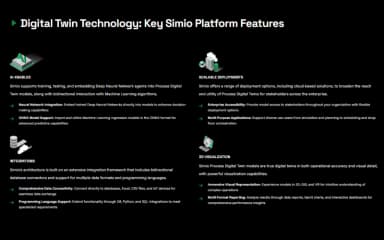
Simio is best known for its “AI Optimization” capabilities that improve decision-making and operational performance. Its simulation engine includes native neural network support, allowing teams to apply AI-based optimization without coding or separate applications. Organizations can generate synthetic training data, train neural networks using TensorFlow, and import third-party AI models through ONNX for predictive analysis and operational planning.
How Much Does Simio Cost?
Simio pricing is estimated to range from $500 to $3,000+/user/month. This range is intended for general budgeting purposes, as actual costs may vary depending on the license type, deployment, number of users, and required capabilities.
In addition to the base subscription cost, organizations should account for the following estimated expenses:
- Implementation and Setup: $10,000 to $75,000+
- Integration Setup: $10,000 to $50,000+
- Data Preparation: $5,000 to $25,000+
- Training and Consulting: $2,000 to $25,000+
- Customization and Digital Twin Development: $25,000 to $250,000+
Disclaimer: Pricing references are based on publicly available third-party information and industry benchmarks. Actual costs may vary.
Simio Integrations
The software integrates with multiple platforms, including:
- SAP S/4HANA software
- Microsoft Dynamics
- Kinaxis
- OMP
- Oracle ERP
- AVEVA MES
How Does Simio Work?
Here's how organizations can use Simio to model and analyze their operational processes:
- Log in to Simio or sign up for an account to access the platform
- Create a virtual representation of an existing or planned operational system
- Add workers, machines, materials, transportation systems, and other resources to the model
- Define process rules, schedules, constraints, and operational dependencies
- Connect existing operational data to make the model reflect real-world conditions
- Run simulations to understand how processes behave under different circumstances
- Create what-if scenarios for proposed staffing, equipment, layout, or production changes
- Compare scenarios based on throughput, capacity, resource utilization, and other operational measures
- Identify bottlenecks and areas where resources may be underused
- Test proposed operational changes before implementing them in the physical environment
- Use simulation findings to support planning, scheduling, and operational decisions
Who Is Simio For?
Simio software is suitable for businesses and organizations operating in the following industries:
- Healthcare
- Manufacturing
- Consumer services
- Automotive
- Supply chain
Simio Use Cases
We have compiled a list of scenarios, based on our analysis of Simio features, where this platform can be a good match:
Healthcare Organizations Managing Emergency Department Capacity
Emergency departments experiencing rising patient volumes can struggle with patient flow, staffing, and resource allocation. In this regard, it helps emergency departments test different patient volumes and staffing scenarios without disrupting actual care. The simulation facilitates the identification of potential hazards and evaluates staffing and resource changes. This results in more informed capacity planning and operational decisions.
Construction Teams Managing Complex Project Operations
Construction teams managing complex projects can rely on Simio. They can evaluate equipment movement, resource allocation, and operational workflows before making changes on-site. Moreover, its discrete-event simulation feature allows teams to model real-world constraints, test different routing and scheduling scenarios, and identify bottlenecks. This way, they can determine how proposed operational changes could affect productivity and safety.
Food Manufacturers Operating Multiple Continuous Production Lines
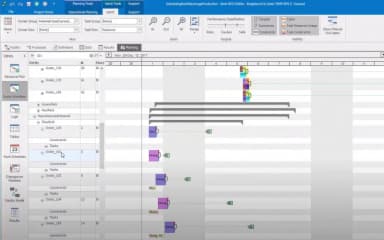
Manufacturers managing complex production lines can struggle when schedules depend on spreadsheets, manual data updates, and planner knowledge. Its advanced planning and scheduling (APS) capability allows teams to build production schedules around resource availability, material requirements, business rules, and operational constraints. Planners can also test different scenarios and adjust schedules when production conditions change. It reduces reliance on manual scheduling and supports faster operational decisions.
Transportation Companies Planning Fleet Growth
Transportation companies expanding their fleets can face capacity problems involving parking spaces, service bays, technicians, and maintenance resources. The capacity planning capabilities allow teams to model these constraints and test different growth scenarios before making physical changes. They can compare options like adding shifts, expanding service areas, or adjusting staffing. It enables them to determine when additional capacity may be needed and plan investments with less operational risk.
Is Simio Right For You?
Simio is reliable for organizations that need to evaluate complex operational decisions before putting them into practice. Its Process Digital Twin technology allows teams to test different production capacities, facility layouts, staffing plans, schedules, resource allocations, and capital investments. This gives teams a clearer picture of potential problems and trade-offs before making costly decisions.
Also, it has been certified by the Demand Driven Institute (DDI) for all three levels of software compliance, including DDMRP, DDOM, and DDS&OP. Moreover, the platform provides security guidance addressing regulatory and security frameworks like AICPA SOC. Simio is trusted by thousands of users worldwide, including organizations like Boeing, Northwell Health, and McDonald’s.
Still unsure whether Simio software is a good choice? Call our expert staff at (661) 384-7070 for guidance.
Simio Features
Process Digital Twin
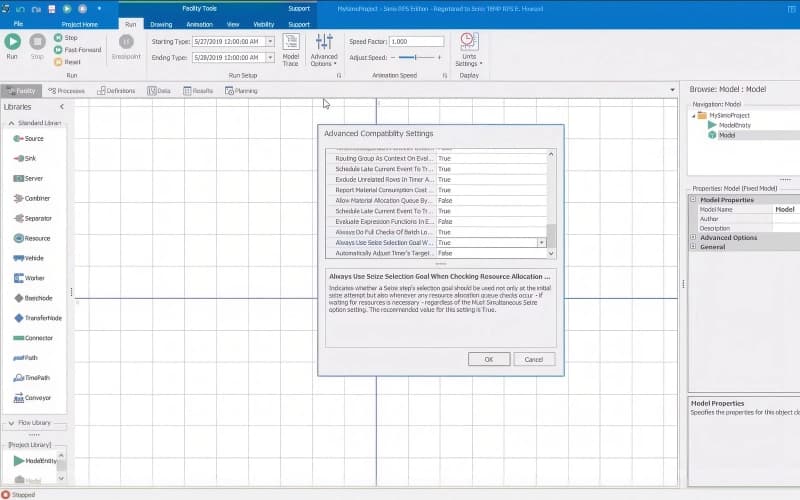
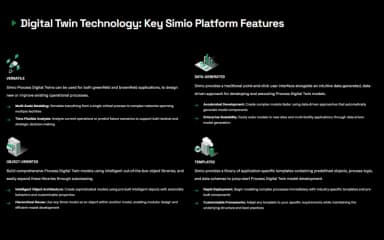
Simio enables users to create digital representations of physical operational processes. These virtual models can reflect workers, machines, materials, resources, and process dependencies. Organizations can use them to understand current operations and evaluate proposed changes without disrupting the physical environment.
Discrete Event Simulation
The software models operations as sequences of events that occur at specific points in time. It can incorporate variability and uncertainty to represent real-world operating conditions. This allows teams to analyze how interactions between resources and processes affect overall system performance.
3D Visualization
Simio provides 3D, GIS, and VR visualization to show operational processes during simulations. Users can import CAD and 3D graphics, create dynamic dashboards, define custom viewpoints, and record simulations. It also supports NVIDIA Omniverse integration and a large library of 3D symbols.
Glass Box Analysis
Simio’s Glass Box approach helps users identify constraints and delays related to materials or resource availability. Teams can adjust scenario parameters without coding and compare different configurations against business KPIs to understand what is affecting performance and select suitable operational changes.
Advanced Simulation Analytics
Simio turns simulation data into actionable insights for operational improvement. Its performance optimization capabilities allow complex digital twin models to run efficiently. This helps teams analyze results and support real-time decision-making.
Pros And Cons of Simio
Pros
Users frequently find model elements easy to access and configure
Models support both basic and detailed operational scenarios
The visual modeling approach facilitates the understanding of simulations
Its ability to identify process bottlenecks is considered useful
The ability to assign intelligence entities and nodes when modeling socio-technical systems
Cons
Slower performance noted for large or complex simulation models
Advanced features can require considerable time to fully learn
Limited documentation for more complicated situations
Simio Reviews
Total 25 reviews
4.6
All reviews are from verified customers
Rating Distribution
5
Stars64%
4
Stars32%
3
Stars4%
2
Stars0%
1
Stars0%
Share your experience
Nonprofit, 500+ employees
More than a year
“Simulation using Simio”
Pros
I can start building a simple model right away and visualize its operation from entity arrivals to the exit point. I can make modifications on the go and add more complex modes of operation. I love being able to see entity movement and the structure layout of the simio object library. Dragging and dropping objects and modeling as I progress is pretty easy too.
Cons
One issue I encountered with Simio, or perhaps I haven't figured out how to implement it, is the absence of a real-time scanning feature to check if a traveling path is occupied. It would be beneficial to have the ability to pause incoming entities from transferring to the path until it becomes free.
Rating Distribution
Ease of use
10
Value for money
8
Customer Support
8
Functionality
8
Auto Dealership, Automation, 1-10 employees
More than a year
“Simio let you focus on value-add work”
Pros
Thanks to its unique 'visual programming' technology resembling a process chart, I have more time to focus on valuable work in my simulation projects. You won't find the same level of user-friendliness in competing products.
Cons
The 3D effect still lacks the level of sophistication I was hoping for. It falls short when it comes to highly detailed motion modeling.
Rating Distribution
Ease of use
10
Value for money
10
Customer Support
10
Functionality
10
Product, 51-100 employees
“For industry”
Pros
Simio is very easy to use which makes it perfect for simulations. Even the free version provides clear instructions and tools that improve usability. The customer care is also commendable.
Cons
The paid version is quite expensive, and unfortunately, there is no version available for Mac. Additionally, the software tends to slow down when handling complex simulations. Apart from these aspects, I haven't come across any other disadvantages.
Rating Distribution
Ease of use
10
Value for money
10
Customer Support
10
Functionality
10
Frequently Asked Questions
What types of pricing plans does Simio offer?
Simio pricing is estimated to range from $500 to $3,000+/user/month. Get a personalized Simio price estimate.
Who are the typical users of Simio?
Simio is typically used across a range of industries, such as healthcare, manufacturing, consumer services, automotive, and supply chain.
What languages does Simio support?
Simio supports English, German, Spanish, French, Portuguese, and Simplified Chinese.
What other apps does Simio integrate with?
Simio integrates with various platforms, such as Microsoft Excel, SAP S/4HANA, Microsoft Dynamics, and Kinaxis.
Does Simio support mobile devices?
No, Simio does not offer a dedicated iOS or Android app.
What level of support does Simio offer?
Simio offers support via email, phone, contact form, and Simio University.
Does Simio offer an API?
Yes, Simio does offer an API.