Last Updated
Key Takeaways
Generated from the text of customer reviews
Polarion ALM, by Siemens, is an application lifecycle management platform used by engineering and development teams. It is widely adopted in regulated industries such as automotive, aerospace, and medical devices. Users often highlight its traceability and requirements management. However, some reviewers feel the document editing experience is less flexible than other tools. Recently, the platform introduced new AI features with ‘Polarion Copilot’ and expanded Test Management in Collections.
Our Verdict
The platform is well-suited for mid-sized and large organizations handling complex development work. It works especially well for teams that need tighter control over processes and documentation. Pricing can be difficult for smaller companies to justify, but larger businesses are more likely to see lasting value from the investment. We recommend it for enterprises managing regulated projects or large-scale product development.
Overall Rating
Based on 17 users reviews
4.3
Rating Distribution
Positive
94%
Neutral
0%
Negative
6%
Starting Price
$1,788
/user/year
Polarion ALM Specifications
- Task Management
- Reporting
- Project Scheduling
- Dashboard
What Is Polarion?
Siemens’ Polarion ALM is a cloud-based Application Lifecycle Management (ALM) solution catering to software development teams across various industries. As a unified ALM platform, it enables development teams to manage all aspects of the software development process.
The platform can be used for requirements management, quality assurance, version control, and project management on a single collaborative platform. This way, the solution supports compliance and traceability. Moreover, Polarion covers the entire application lifecycle from ideation to development, testing, deployment, and maintenance in the cloud.
What Is Polarion Best For?
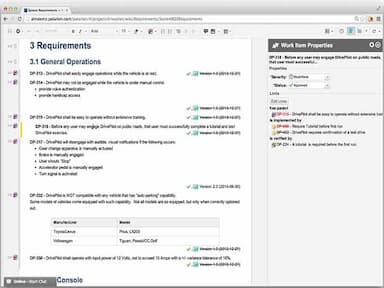
The software is known for its strong requirements management capabilities. Its requirements tracing functionality allows engineers to establish links between requirements, code components, and test cases. Polarion ALM also supports concurrent collaboration on specification documents through ‘Polarion LiveDocs,’ where each paragraph remains uniquely identifiable and traceable. Teams can share requirement documents across stakeholders for review and approval, while built-in electronic signatures help support controlled release processes. Overall, Polarion ALM helps ensure compliance and improves change impact analysis throughout a project's lifecycle.
How Much Does Polarion Cost?
The software’s pricing is estimated to start at $1,788/user/year. This is an estimated figure and actual price may vary based on the number of users, features selected, and more.
Additionally, organizations may also incur extra costs, including estimated expenses such as:
- Implementation And Deployment Services: $10,000–$150,000+
- Data Migration (legacy tools like DOORS/Excel/Word): $5,000–$80,000
- Training (end users + admins): Typically, $2,000–$25,000
- Custom Configuration And Workflow Setup: $5,000–$100,000
- Custom Integration: $5,000–$120,000+
- Ongoing Support And Maintenance (on-prem): 20% of the license cost annually
- Infrastructure (on-prem servers, hosting, cloud setup): $1,000–$50,000+
Additional User Licenses (scale-up expansion): $1,500–$8,000/user (one-time or annual depending on model)
Users generally view Polarion pricing as on the higher side, especially when implementation, migration, support, and integration costs are included. While the per-user license may seem reasonable at first, total ownership costs can escalate quickly for complex deployments overall.
Disclaimer: Pricing references are based on publicly available third-party information and industry benchmarks. Actual costs may vary.
Polarion Integrations
The software integrates with third-party applications, including:
- Jira software
- HP Quality Center or HP ALM
- MATLAB Simulink
- Azure DevOps
How Does Polarion Work?
Here is how to start with the software:
- Log in to the software using your credentials
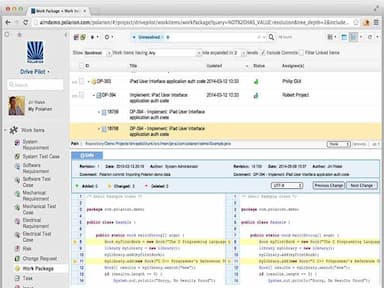
- Navigate to the Polarion Portal for an overview of your workspace
- Use the search function to find specific work items or documents
- Create a new work item such as a requirement, test case, or defect
- Retrieve a list of work items that meet certain criteria using a query
- Update the status or other attributes of a work item
- Upload attachments to a work item
Who Is Polarion For?
Polarion Software is designed for many businesses, from small teams to large enterprises. The software is used across various sectors and industries including:
- Aerospace
- Automotive
- Electronics
- Information Technology
- Medical Devices
- Healthcare
- Academic
Polarion Use Cases
Based on our analysis of user reviews and Polarion ALM capabilities, we have identified key scenarios where this platform is a strong fit:
Regulated Product Development With Strict Audit Needs
This software is often used in industries where compliance is not optional. Teams in these settings work under detailed documentation and review expectations that span long development cycles. The platform is typically chosen when organizations need a consistent record of how requirements evolve over time. It supports environments where every change must be accounted for during internal and external audits.
Large Engineering Teams Working Across Locations
Many organizations adopt Polarion when engineering work is split across sites or countries. In these setups, it becomes difficult to keep everyone aligned on what is being built and why. The tool is used to keep development discussions and updates in one place so teams are not relying on scattered communication. This is especially useful when coordination between departments needs to stay steady even when teams are not in the same office.
Companies Moving Away From Disconnected Legacy Systems
Some organizations turn to this platform when their existing setup has become difficult to manage. Requirements and testing data are often stored in separate tools or documents, which slows down decision-making. In these cases, teams look for a more consistent environment where project information is not split across multiple systems. The transition is usually driven by the need to reduce confusion during development rather than add new processes.
Complex Products That Combine Software And Hardware
Polarion is also used in programs where software and physical components are developed together. These projects often involve teams that depend on each other’s progress, even if they work in different engineering areas. The platform helps maintain clarity on how changes in one part of the system affect others. This becomes important in environments where small design updates can have wider technical consequences.
Is Polarion Right For You?
Are you looking for a unified solution to manage the lifecycle of your software products? Do you need a platform that provides end-to-end traceability and proof of compliance? If so, Polarion might be the perfect fit for you. The solution connects teams and projects, bringing requirements, coding, testing, and release into a single unified environment to improve application development processes.
The software is designed with security and scalability in mind. It provides a secure environment for teams to collaborate on shared assets. The software can serve small teams or scale up to support thousands of users across various industries.
Still unsure if the software is right for you? Contact us at (661) 384-7070, who will help you make the best decision.
Polarion ALM Features
Real-Time Collaboration
Foster seamless communication among team members using the centralized platform. Stakeholders can access, review, and collaborate on project data in real-time, ensuring the team stays aligned.
Agile Project Tracking
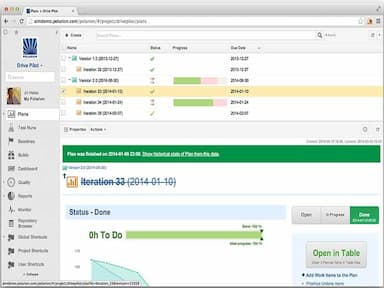
Its kanban-style boards provide visibility into sprint workflow and work item status. This helps teams adopt iterative processes and track progress on a shared backlog. The platform also enables drag-and-drop prioritization or multilevel prioritization with automatic calculation from sub-levels using change hooks.
Requirements Management
Polarion allows teams to author, link, trace and manage requirements. As a result, it ensures all work items like code and test cases can be traced back to the originating product requirements for compliance. The software also supports export for offline collaboration with seamless re-import of changes, and includes built-in ReqIF for lossless exchange of requirements and test case specifications.
Role-based Access Control
The software offers granular access control, ensuring users only have access to the information and functionalities relevant to their roles and responsibilities. That helps maintain security and protect the integrity of data.
Reuse And Branch Management
Polarion ALM enables reuse and branching of project data for sequential or product line development. It reduces manual duplication by supporting shared regulatory requirements and structured branching, while allowing controlled distribution of updates from master specifications to related branches.
Failure Tracking And Risk Mitigation
Failures and test issues are captured automatically across manual, automated, and third-party test runs, with immediate issue creation at the point of detection. The software also handles assignment based on classification like severity or component. Requirements analysis and FMEA-based templates further help identify risks early and support structured mitigation planning.
Pros And Cons of Polarion ALM
Pros
Single unified system for managing entire lifecycle
Traceability is maintained across every development stage
Interface feels simple and easy to work with
Integrates well with commonly used engineering tools
Supports controlled updates to source code changes
Cons
The initial setup is complex for new users
Reporting capabilities could improve
Customer service can be improved
Polarion ALM Reviews
Total 17 reviews
4.3
All reviews are from verified customers
Rating Distribution
5
Stars47%
4
Stars47%
3
Stars0%
2
Stars0%
1
Stars6%
Share your experience
Viktor
Information Technology and Services, 500+ employees
More than a year
“Good tool for application lifecycle management
Pros
I find Polarion ALM to be quite a complex tool with a wide range of functionality. For example, I can create functional test times, measure the time of the test during execution, and make testing more effective.
Cons
I find the design to be older and confusing. It is quite complex, so there are times when I struggle to understand how it works. Additionally, I miss having a dark mode.
Rating Distribution
Ease of use
8
Value for money
8
Customer Support
7
Functionality
8
Mario
Medical Devices, 500+ employees
More than a year
“Head Programmable Systems R&D
Pros
Polarion ALM provides full traceability. It gives me the ability to configure all elements, such as work items, documents, and widget pages, which allows a high degree of adaptation to internal processes. The integrated electronic signature and document workflow ease document release, and it offers a wide range of functionality to cover all software development-related process elements.
Cons
I feel that the document editing capabilities are not state-of-the-art.
Rating Distribution
Ease of use
10
Value for money
10
Customer Support
8
Functionality
10
Anonymous
Not Specified, 500+ employees
More than a year
“Best Technical Management Software for V Cycle Development
Pros
For me, requirement management is one of the most useful features of Polarion ALM. It also provides a well-integrated solution for change management and source code management.
Cons
I believe integrations with third-party tools and automation using scripts should be added.
Rating Distribution
Ease of use
8
Value for money
10
Customer Support
8
Functionality
10
Frequently Asked Questions
Does Polarion offer an API?
Yes, the software has an API available for use.
What language does Polarion support?
The software supports the English language.
What other apps does Polarion integrate with?
Polarion integrates with Jira, HP Quality Center or HP ALM, MATLAB Simulink, and Azure DevOps.
Does Polarion support mobile devices?
Yes, the software is compatible with mobile devices, though it does not offer standalone mobile applications.
What are some Polarion ALM pricing plans?
The vendor offers an approximate starting price of $1,788/user/year. Final cost quote is determined by number of users, features selected, services availed, and more. Get a personalized Polarion cost quote today.
Who are the typical users of Polarion?
Polarion ALM project management software is designed for businesses across sectors such as information technology, medical devices, aerospace, automotive, electronics, healthcare, and academia.
What level of support does Polarion offer?
Support options for Polarion ALM include assistance via phone and contact form.
How does Polarion help with configuration management?
Polarion's automatic change control features enable robust version control and traceability throughout development. It seamlessly integrates with source code repositories, delivers project transparency and facilitates regulatory inspection via automated audit trails.
Can it support our legacy software development environments?
Polarion is compatible with legacy environments. As a hosted Polarion solution, it can integrate within your existing tools and modernize your ALM approach without disrupting workflows. Pre-built box project templates also help streamline onboarding.
How does it ease regulatory compliance burdens?
Comprehensive requirements and change management allow traceability from initial requirements all the way through to the final delivered software.
What immediate benefits can we expect from using Polarion?
Teams report streamlined processes and improved transparency right away. Polarion also delivers immediate value through features like built-in reports for executives and automated test scheduling to handle even complex test conditions.
How does Polarion facilitate regulatory inspections of source code modifications?
Polarion's requirement and change management capabilities make it easy to link any source code modifications back to the original requirements or change requests that triggered them.