


ProjectLibre
Last Updated
Key Takeaways
Generated from the text of customer reviews
ProjectLibre is an enterprise project management software used by project managers in engineering, construction, and other project-based fields. Users like how closely it matches Microsoft Project’s features, though the interface is a recurring complaint, and many users find it outdated. ProjectLibre released Cloud AI 2.0 on September 10, 2026, adding portfolio and resource management, risk analysis, collaboration tools, and AI-assisted project management.
Our Verdict
The platform works well for teams transitioning from Microsoft Project or Project Online and handling several complex, schedule-driven projects at once. The software pricing is generally deemed reasonable, and users value the professional project-planning capabilities available via its free desktop version. We recommend it for mid-to-large teams that have outgrown single-project planning and need to manage a full portfolio with AI-assisted planning and advanced scheduling capabilities.
Overall Rating
Based on 36 users reviews
4.4
Rating Distribution
Positive
86%
Neutral
14%
Negative
0%
Starting Price
$9.99
per user per month
ProjectLibre Specifications
- Task Management
- Reporting
- Budget Management
- Resource Allocation
What Is ProjectLibre?
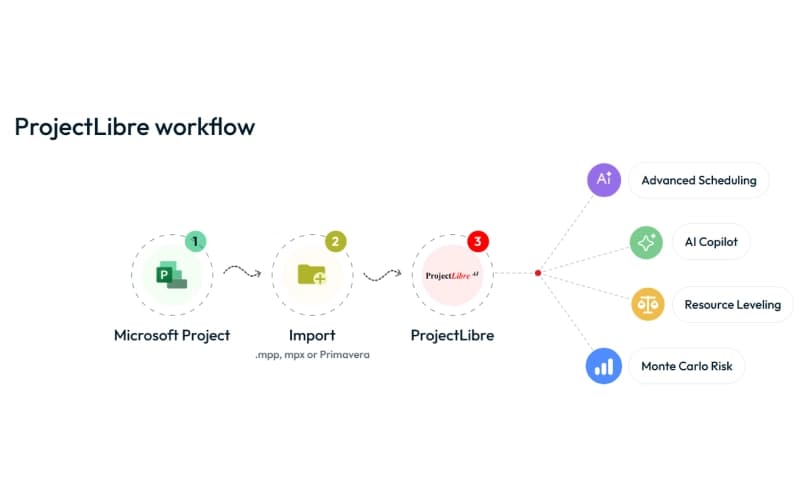
ProjectLibre is a project management platform built as an alternative to Microsoft Project. It is available as an open-source desktop application or a subscription-based AI-powered cloud service. The platform is used by enterprise project managers who need to migrate from Microsoft Project. It opens .MPP and .XML files, so teams can bring over project files they already have instead of rebuilding them from scratch. It also includes critical path scheduling and resource leveling, which take task dependencies and team capacity into account. These tools help cut down on setup time and reduce the rework that usually comes with switching planning tools.
What Is ProjectLibre Best For?
ProjectLibre is particularly useful for its 'Monte Carlo Risk Analysis' for project managers. It runs simulations of possible project outcomes and estimates the chances that a project finishes on time. Running these simulations gives a clearer picture before locking in a schedule. That makes it useful for people managing complex schedules, tasks with uncertain durations, or projects with many dependencies.
How Much Does ProjectLibre Cost?
The pricing for ProjectLibre starts at $9.99/user/month (billed annually). This plan, known as ProjectLibre Core, includes basic and expert UX modes, AI Copilot, portfolio management, and more. There is also a desktop version called ProjectLibre Desktop, which is free and open source with no subscription fee. A 7-day free trial is also available.
In addition to the base subscription costs, organizations should keep the following potential costs in mind based on the industry benchmarks:
- Implementation: $2,000–$15,000
- Data Migration: $1,500–$10,000
- Training And Onboarding: $500–$5,000
- Integrations: $1,000–$8,000
- Customization And Configuration: $1,000–$6,000
Users describe ProjectLibre's pricing as very affordable. Many mention that it is free and point out how much you get without paying anything. Several reviewers say it covers most of what a paid project management tool would offer.
Disclaimer: The pricing is subject to change.
ProjectLibre Integrations
The software supports integration with Microsoft Project.
How Does ProjectLibre Work?
Log in to your ProjectLibre account, then follow the steps below to use its features:
- Create a project to set up its structure and schedule
- Define the work by adding tasks, durations, milestones, and dependencies between them
- Build the schedule with Gantt charts, calendars, constraints, and critical path scheduling
- Give tasks the right resources and keep an eye on availability, cost, and workload
- Update task completion and actual data as the project moves forward
- Check performance by looking at cost, schedule, earned value, and resource use
- Collaborate in ProjectLibre Cloud by managing team members, roles, access, and project work
Who Is ProjectLibre For?
ProjectLibre is suitable for organizations, sectors, and professionals, including:
- Small businesses
- Non-profits
- Educational institutions
- Project managers
- Consultants
- Engineers
- Contractors
ProjectLibre Use Cases
Based on our analysis of user reviews and ProjectLibre’s current capabilities, we have identified key scenarios where this software is a good fit for project management teams:
Organizations Migrating Off Microsoft Project Online
Microsoft is retiring Project Online on September 30, 2026, and that leaves organizations holding years of .mpp files with nowhere to put them. ProjectLibre opens these files directly. Scheduling teams keep their existing baselines and dependencies rather than rebuilding project history by hand, which matters most for PMOs with long-running programs that can't afford to start over.
Nonprofits And Grant-Funded Programs Tracking Deliverables
ProjectLibre's earned value metrics and cost tracking give program managers a way to compare what was planned against what actually happened. Grant funders usually want proof that work is on schedule and within budget, not just a written update. With this data, managers can back up their progress and spending claims with numbers.
Enterprises Managing Multiple Concurrent Projects
Staff and equipment shared across several projects tend to get double-booked, and schedules start colliding. ProjectLibre's enterprise resource pools and cross-project leveling flag where that overbooking is happening. Administrators can then rebalance workloads across the whole portfolio, rather than fixing each project's schedule in isolation.
Construction And Contracting Firms Coordinating With Complex Project Schedules
Construction projects tend to face delays, and one late activity can affect several other parts of the project and can even lead to new scheduling conflicts. The ProjectLibre platform gives construction teams Gantt charts, dependencies, network diagrams, critical path scheduling, and resource management tools to keep track of changes. It enables teams to view how schedule changes affect related work and adjust the plan as the project moves forward.
Teams Building New Project Plans From Scratch
Setting up a schedule with nothing to build from takes a lot of manual work. ProjectLibre's AI Copilot reads a plain language description of the project and generates tasks, durations, dependencies, and milestones from it. From there, teams refine the schedule with the platform's regular tools, so they're editing something rather than staring at a blank page.
Is ProjectLibre Right For You?
If you are part of a project management team moving off Microsoft Project, growing your portfolio, or looking for a tool that holds up at enterprise scale, then ProjectLibre could be worth considering. It has won InfoWorld's Best of Open Source Software award and was included in Opensource.com's list of the Top 10 open source projects. Cisco, Abbott, and Medtronic are among its clients, alongside other Fortune 500 companies.
Its Cloud platform keeps data in secure centers based in the right regions for each customer, and it scales from small teams to large global enterprises. ProjectLibre Desktop version is available for Windows, macOS, and Linux, and has passed 8.7 million downloads across 193 countries.
As more companies adopt AI tools, they are asking questions about what happens to their data, particularly whether it gets used to train the underlying models. ProjectLibre answers this by stating that it uses prompts only to build the project you asked for. It does not keep that data or use it for training, and it is not shared outside the platform.
Still unsure about ProjectLibre? Contact us at (661) 384-7070 for more information.
ProjectLibre Features
Advanced Scheduling
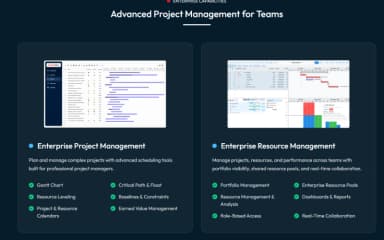
ProjectLibre's scheduling tools cover task dependencies, calendars, baselines, float, and critical paths. Tasks can recur on a set interval or split into separate segments. Effort-driven scheduling recalculates work automatically as assignments change, and working time can be modeled separately for the project and for individual resources. Resource pools, availability tracking, and workload analysis by project, team, or organizational group are part of the same toolset.
Advanced Modeling And Analytics
Monte Carlo risk analysis, DCMA schedule audits, earned value management, resource graphs, and WBS, RBS, and OBS modeling all run inside the project schedule itself. Schedule Performance Index, Cost Performance Index, and To Complete Performance Index can be tracked over time. Rate schedules can be set separately for internal, government, customer, and overtime costs.
Professional Visualizations
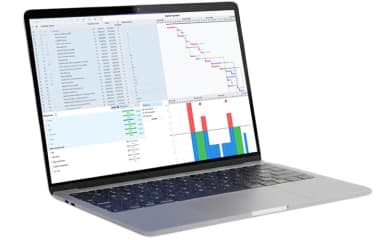
Several views are available for looking at a project, including Gantt charts, network diagrams, WBS charts, and resource graphs. Gantt views lay out timelines, tasks, dependencies, and critical paths. Network diagrams show project logic and how tasks relate to one another. WBS charts break project scope into a hierarchy. Resource graphs display demand, capacity, utilization, over-allocation, and project flow.
Usability And Collaboration
ProjectLibre Cloud synchronizes in real time, so shared schedules stay current across a team. Guided setup, templates, drag-and-drop editing, undo and redo controls, color coding, and alerts are built into daily use, and the platform also runs as a progressive web app. Depending on their role, users can work in a basic or advanced interface.
AI-Powered Project Creation
Natural language input can be turned into a full project plan. A user describes the project in any language, and the AI fills in tasks, milestones, dependencies, and overall structure based on that description. From there, the plan can be reviewed and refined using the platform's standard scheduling tools.
AI Automated Resource Assignments
AI assigns project resources by weighing priorities, available capacity, and performance trends. Assignments shift as conditions change, and the resource model shows current workload and any over-allocation as it happens. Priority levels, capacity data, and performance history all feed into how people and other resources get allocated.
Predictive Cost Management
Cost monitoring and forecasting in ProjectLibre are built on earned value analysis and performance management. Cost variances, current performance, and the spending still needed to finish planned work can all be reviewed directly. Rate schedules and cost data live in the same project model used for scheduling and execution, rather than in a separate system.
Pros And Cons of ProjectLibre
Pros
Makes it easier to plan clear project schedules
Keeps every project task organized from start to finish
Gives you more control over how resources are used
Flags possible delays before they turn into problems
Simplifies overseeing multiple projects running at once
Cons
Import and export options are somewhat limited
User interface could be improved
Options for customizing project calendars are limited
ProjectLibre Pricing
ProjectLibre Core |
|---|
$9.99 per user per month (billed annually) |
|
Disclaimer: The pricing details were last updated on Oct 09, 2026 from the vendor's website. Please contact us for a tailored pricing list.
ProjectLibre Reviews
Total 36 reviews
4.4
All reviews are from verified customers
Rating Distribution
5
Stars50%
4
Stars36%
3
Stars14%
2
Stars0%
1
Stars0%
Share your experience
Chemicals, 500+ employees
More than a year
“Perfect for budget-conscious teams”
Pros
I am very pleased to find this free project management software. It offers most of the essential features and is easy to use and manage projects. There's even a portable version available.
Cons
Customizing the calendar is not possible at all, however on the other hand that option was available in the MS Project. Also the software doesn't perform well when dealing with a high number of tasks (more than 1000). The UI could be improved to enhance its aesthetic appeal. Additionally, I would like the addition of more features similar to MS Project.
Rating Distribution
Ease of use
10
Value for money
10
Customer Support
10
Functionality
8
Customer Service, 500+ employees
Less than 6 months
“Still has room to grow”
Pros
It delivers results similar to Microsoft Project, and it's an open-source product, nothing extraordinary though.
Cons
The software is not very well-designed, and the user experience isn't as easy as I expected.
Rating Distribution
Ease of use
4
Value for money
4
Customer Support
4
Functionality
6
IT, 1-10 employees
More than a year
“One of the best free project management software options out there!”
Pros
I really like the Gantt chart feature for scheduling work because it makes everything pretty easy for me.
Cons
When I am printing charts to PDF, there is no option or tool available to get an idea whether they fit properly on A4 pages.
Rating Distribution
Ease of use
10
Value for money
6
Customer Support
6
Functionality
8
Frequently Asked Questions
Does ProjectLibre offer an API?
Information about an API is currently unspecified by the vendor.
What language does ProjectLibre support?
ProjectLibre supports 31 languages in its desktop application. Its official documentation is available in English, Arabic, Dutch, French, German, Hindi, Italian, Japanese, Korean, Polish, Portuguese, and Spanish.
What other apps does ProjectLibre integrate with?
ProjectLibre integrates with Microsoft Project.
What types of pricing plans does ProjectLibre offer?
ProjectLibre pricing starts at $9.99/user/month, billed annually for the ProjectLibre Core plan. ProjectLibre Desktop is available for free. Get a detailed ProjectLibre cost breakdown to make an informed decision.
Who are the typical users of ProjectLibre?
ProjectLibre is typically used by project managers, consultants, engineers, and contractors.
What level of support does ProjectLibre offer?
ProjectLibre offers email support, multilingual help documentation, video tutorials, community forums, and product updates.
Does ProjectLibre support mobile devices?
ProjectLibre does not offer a dedicated mobile app for Android or iOS. Its Cloud version is browser-based and can be accessed from mobile devices.