


Workday Financial Management
Last Updated
Overview
Workday Financial Management helps organizations streamline accounting, procurement, reporting, and financial planning through a unified cloud-based platform. While some users feel the customization options could better align with company branding needs, its real-time insights, automation capabilities, and centralized financial tools make it a strong choice for improving efficiency and decision-making.
Workday Financial Management Specifications
- Time Tracking
- Task Management
- Reporting
- Budget Management
Workday Financial Management Features
Financial Planning
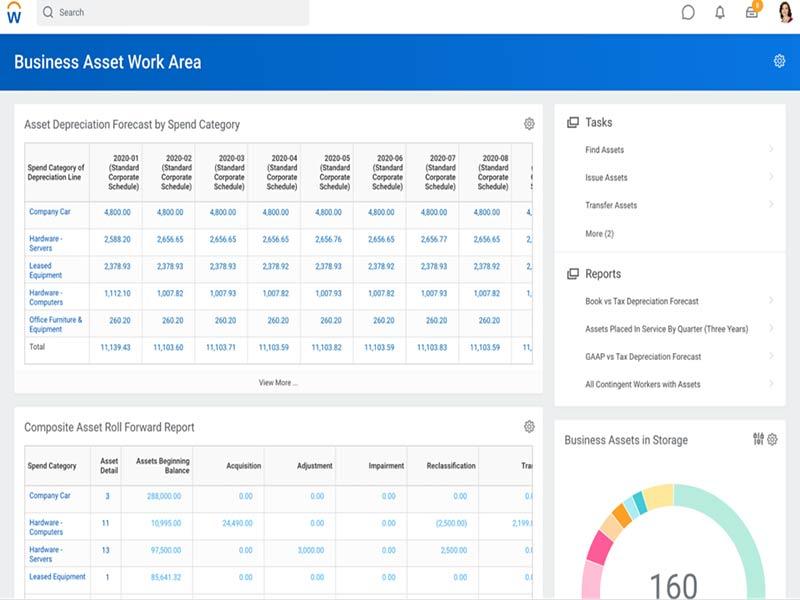
Workday Financial Management application offers data-driven insights to help users make informed decisions. Professionals can also leverage these insights to create strategic plans for budgeting expenses while responding quickly to changes. Moreover, the software provides a 360-degree view of an organization’s financial data through a shared platform.
Reporting And Analytics
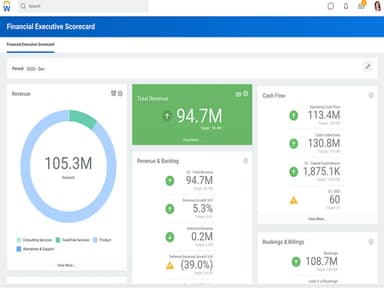
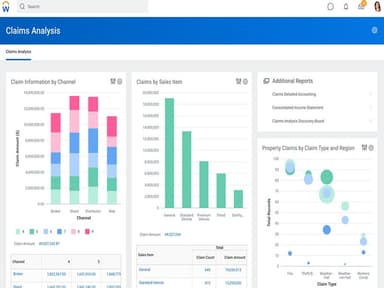
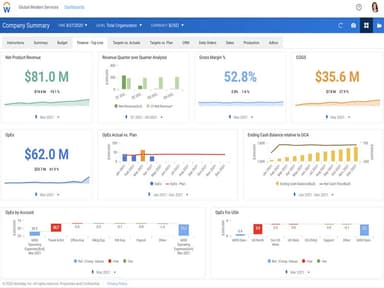
The digital finance system has a robust suite of analytical tools that enable users to create internal reports and external regulatory statements. Executives and managers can also use the program to view monetary, management, and operational visualizations for monitoring business performance.
Audits And Internal Control
Workday Financial Management system provides flexible audit tools to help businesses identify risks, ensure data security, and document information with audit and internal controls. Professionals can also set thresholds, adjust controls, prevent unauthorized transactions, and evaluate workflow using a centralized interface.
Instant Business Insights
The software offers immediate access to your financial performance and operational data. It lets you view live data, delve into specifics, and generate personalized reports and dashboards. This feature empowers you to make data-driven decisions.
Unified System And Consolidation Hub
The platform centralizes various financial processes like accounting, consolidation, procurement, projects, reporting, and analytics into a single system. It simplifies the management of all your financial operations. Additionally, it includes financial close and consolidation capabilities that support multicurrency reporting, intercompany eliminations, retained earnings calculations, and real-time account reconciliations, improving enterprise-wide financial visibility across multiple entities and systems.
General Ledger And Accounting
Workday Financial Management offers a centralized general ledger and accounting system designed to provide real-time financial visibility. It supports multidimensional reporting, enabling users to analyze budgets versus actuals, drill into transactions, and combine operational and financial data within a unified reporting environment.
Spend And Revenue Management
Workday helps organizations manage spending and revenue processes through connected financial workflows. Its revenue management functionality brings together contracts, billing, collections, and revenue recognition within a single AI-powered system, giving finance teams greater visibility into the full revenue lifecycle.
Pros And Cons of Workday Financial Management
Pros
Simplifies payroll processing through centralized automation
Provides a full financial picture and an accurate picture of business events to help companies stay ahead
Generates real-time reports with smooth navigation
Offers key capabilities, like tailored reports and flexible foundation, for effective human capital management
Cons
Limited customization on existing pages
The absence request process can be improved
Inbox or archive section can be confusing
Workday Financial Management Reviews
Total 11 reviews
4.4
All reviews are from verified customers
Rating Distribution
5
Stars55%
4
Stars27%
3
Stars18%
2
Stars0%
1
Stars0%
Share your experience
Not Specified, N/A employees
“powerful automation and insights”
Pros
Right away, the clean and simple interface made the software pleasant to use and the automation tools do a lot to cut down on manual work. The real-time reporting and analytics are especially useful when quick decisions need to be made. Another big plus is the cloud-based access which makes it possible to work from anywhere, along with strong integration options that connect well with other business systems.
Cons
Getting everything set up and implemented takes time and in some cases expert help may be needed. New users can also face a bit of a learning curve especially when it comes to the more advanced features. On top of that, the pricing may feel a little expensive for smaller businesses.
Rating Distribution
Ease of use
10
Value for money
9
Customer Support
10
Functionality
10
Not Specified, N/A employees
“all invoices in one place”
Pros
Handling received invoices and submitting payments through this has been really convenient. Everything lives in one place and it's helpful to be able to go back and review previous invoices and payments whenever needed.
Cons
It isn't the most easy system to navigate. I'm pretty comfortable with technology so I was able to pick it up quickly but others on our team had a harder time with it. Another frustration is when I'm submitting payments with multiple entries under different categories, I have to re-enter the same information again and again. It would be much better if that data could carry over automatically.
Rating Distribution
Ease of use
10
Value for money
10
Customer Support
10
Functionality
10
Not Specified, N/A employees
“Platform feels incomplete”
Pros
Being able to drill all the way down to the transaction level from within reports is my favorite part of the system. That level of detail is a really valuable feature.
Cons
One frustration is that, over the years, it seems like functionality has been released into production before it was fully ready. A lot of features feel only about 80-90% finished. Recurring journals are a perfect example. The concept is excellent but the lack of a BP for recurring journal templates kind of undermines the whole point of letting those journals post without approvals which I assume is what most customers want, including me. Another case is prepaid schedule amortization installments, customers have been asking for years to be able to schedule installments through a specific date rather than relying on 'Accounting Date Days Ahead.'
Rating Distribution
Ease of use
6
Value for money
6
Customer Support
6
Functionality
6
Frequently Asked Questions
Does Workday Financial Management offer an API?
Yes, Workday has an API available for use.
What language does Workday Financial Management support?
Workday Financial Management supports English, French, German, Italian, and Spanish.
What other apps does Workday Financial Management integrate with?
Workday has not publicly disclosed a dedicated integration list for Workday Financial Management specifically. However, the broader Workday platform supports integrations with various third-party applications across finance, CRM, analytics, and workforce management.
Does Workday Financial Management support mobile devices?
Yes, the software supports mobile devices.
What types of pricing plans does Workday Financial Management offer?
Workday Financial Management pricing is commonly estimated to range from around $10,000 to more than $500,000/year, based on industry benchmarks for enterprise ERP and financial management platforms. Request a custom Workday Financial Management price quote.
Who are the typical users of Workday Financial Management?
Workday Financial Management is designed for medium to large enterprises across industries like education, finance, healthcare, information technology, and retail.
What level of support does Workday Financial Management offer?
Workday provides several support options, including a knowledge base, email, a help desk, and phone assistance.
What is the financial impact of using Workday Financial Management software?
Workday Financial Management, a leader in the magic quadrant for cloud, positively impacts finances by providing an accurate picture of the company's financial health.