


Lectora
Last Updated
Key Takeaways
Generated from the text of customer reviews
Lectora is an eLearning authoring tool used by instructional designers, LMS administrators, and eLearning developers to build interactive online courses. Users consistently praise its customization and interactivity, while its occasional inaccurate translations receive criticism. It is a suitable platform for government and regulated industries who benefit from its compliance and accessibility controls.
Our Verdict
Lectora suits organizations with dedicated instructional design and L&D teams managing compliance-heavy, multi-author course production. Its pricing is reasonable for teams prioritizing governance at scale, but may be on the premium end for smaller teams. We recommend it for regulated industries and distributed teams.
Overall Rating
Based on 17 users reviews
4.6
Rating Distribution
Positive
88%
Neutral
12%
Negative
0%
Starting Price
$1,549
per year

Lectora Specifications
- Asynchronous Learning
- Activity Tracking
- Access Controls/Permissions
- Collaboration Tools
What Is Lectora?
Lectora is an e-learning authoring platform that helps instructional designers and training teams build interactive courses without being faced with rigid templates. With its AI Course Wizard, they can turn topics into preliminary course drafts. As a result, the blank-page problem that typically slows down content creation is avoided.
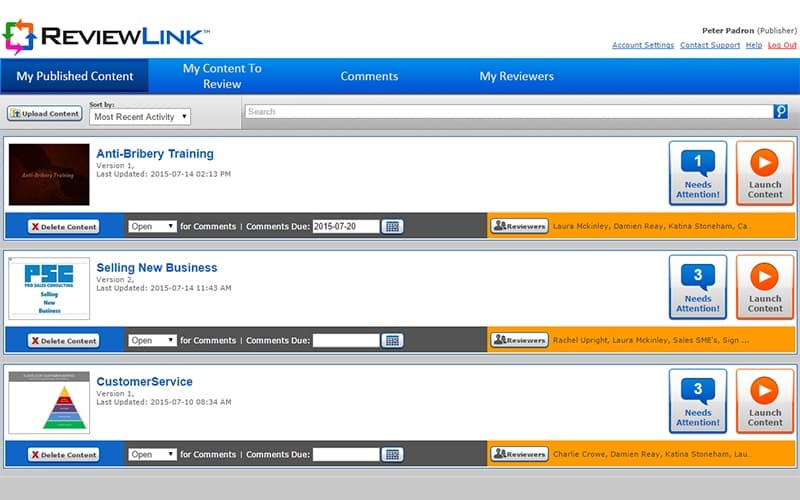
Teams can convert existing PowerPoint decks directly into published training, so that prior material does not have to be built from scratch. It also provides built-in tools like Review Link to allow stakeholders and SMEs to give feedback directly on a project. This prevents revisions from getting lost in email threads.
What Is Lectora Best For?
This software stands out its ‘Collaboration’ feature through which teams can author and review content. It allows distributed workforces to author courses from anywhere. Benefiting from this capability, designers, reviewers, and SMEs can work on a single project in parallel instead of passing files back and forth. It also lets teams assign author roles and projects, where each contributor works within a defined scope.
Lectora logs revisions and tracks version history, giving teams a clearer record of what changed and when without manually maintaining a changelog. It incorporates built-in notification and communication tools that keep teammates aligned on project status. This makes it suitable for larger instructional design teams or distributed organizations where multiple contributors need to work on the same course simultaneously.
How Much Does Lectora Cost?
Lectora price starts at $1,549/year for its Studio Gold Suite which includes the Micro Builder, Asset Library, and Review Link. Its Bundle and Save plan costs $10,547/year and offers more than 9 learning apps. There is also a 30-day free trial.
In addition to the base subscription cost, organizations should keep the following potential hidden costs in mind:
- Additional Authoring Seats: $1,500 to $8,000/year
- Custom Templates And Branding: $2,000 to $10,000
- LMS/SCORM And xAPI Integration Testing: $1,500 to $7,000/year
- Author Training And Onboarding: $1,000 to $5,000
Users consider Lectora a cost-effective solution for the depth of the features it provides in creating eLearning content. However, some point out that it can be costly when compared to other platforms in the same category.
Disclaimer: The pricing is subject to change.
Lectora Integrations
Lectora integrates with:
How Does Lectora Work?
Here’s how you can get started with Lectora after successful completion of the onboarding process:
- Log in to ‘The Studio’ account portal with the help of your registered credentials
- Access the ‘Applications Dashboard’, where every ELB learning product in your subscription appears as a separate launch tile
- Launch ‘Lectora Online’ directly from the dashboard to start authoring in the browser
- Open the ‘Members’ section to invite teammates and control who can create, edit, or review tiles
- Visit Settings to manage company details, subscription information, and account-level preferences
- Pull templates, character images, and other assets into a new tile from the connected Asset Library
- Share a draft through the Review Link to gather stakeholder feedback before publishing
Who Is Lectora For?
Lectora typically caters to:
- Instructional designers
- Training delivery specialists
- LMS administrators
- Learning Experience Designers (LXD)
- eLearning developers
Lectora Use Cases
Based on our analysis of Lectora features, user reviews, and marketing positioning, we identified some of its real-world use cases.
Instructional Design Teams Converting Legacy PowerPoint Training Into eLearning
Lectora can be used by organizations that are still relying on PowerPoint-based training material. The platform offers a PowerPoint import that allows teams to directly incorporate that content. This removes the need to layer in assessments and interactivity instead of rebuilding from scratch. For teams that want to modernize a training library on a tight timeline, this is particularly useful.
Experienced eLearning Developers Building Complex Branching Scenarios And Custom Interactions
Developers who want to build intricate interactions that involve conditional branching and variable-driven logic can find Lectora to be especially helpful. According to users, the platform offers powerful authoring tools with extensive customization capabilities while also supporting multimedia elements like videos, animations, and audio. This makes it an effective platform for creating highly interactive eLearning content.
Multinational Organizations Publishing Training Across Multiple Languages And LMS Platforms
Lectora helps global teams with its XLIFF-based translation workflow and native export to English, French, German, Spanish, Swedish, Mandarin, and Brazilian Portuguese. It is a suitable option for companies that want to roll out the same course to teams in different countries. When combined with direct publishing to platforms like Docebo, SABA, Healthstream, and SCORM, it fits organizations that need one authoring source to feed several regional LMS instances.
Distributed Teams Managing Multi-Author Course Development And Stakeholder Review
Multiple developers working on the same course can use Lectora software to collaborate on the course creation process. With its role-based permissions and revision logging, they can avoid overwriting each other’s work. This is reinforced by Review Link, through which SMEs and stakeholders can markup pages directly rather than sending feedback over email. It is a suitable option for organizations with training content that passes through several hands.
Is Lectora Right For You?
Lectora is worth considering for instructional designers and learning and development teams building interactive courses with control over how they work on different devices.
It also suits organizations that need to scale e-learning production across multiple teams, departments, and regions without losing control over compliance or governance. This is made possible through its role-based access, check-in/check-out version control, and automatic revision logging.
For teams that are increasingly prioritizing security as they grow and handle more sensitive information, the platform is a safe choice since it holds an SOC 2 Type 2 certification. With AI-based automation in drafting becoming increasingly important, Lectora helps organizations keep pace with its ‘AI Course Wizard’.
Still unsure about Lectora? Connect with us at (661) 384-7070 for further guidance!
Lectora Features
AI Course Wizard
Lectora lets teams leverage AI to generate a preliminary course from a specified topic. They can choose between 1-15 pages, select a theme, and generate responsive pages with text and content and image placeholders in about 60 seconds. With the generated course, authors get a starting structure that can be refined with organization-specific content, images, and objectives.
Asset Library
Users get access to a built-in library of over 120 million assets to add visual and multimedia content to courses. It provides stock images, audio, video, cutout people, icons, and medical assets, along with eLearning and PowerPoint templates. Teams can also use ready-made assets for customizing course visuals without sourcing materials separately.
Interactive Templates
This function provides over 3,500 pre-designed eLearning templates for building courses without creating layouts or interactions from scratch. With its course starter packs, teams can access matching layouts, scenarios, games, process flows, click-to-reversals, drag-and-drops, quizzes, timelines, and knowledge checks. These templates also support mobile learning, xAPI data tracking, and accessibility features.
Pros And Cons of Lectora
Pros
Offers extensive customization and design flexibility
Automates course creation through its broad library
Extends its capabilities to external graphics, audio and video
Supports personalized learning through its adaptive courses
Provides a single source of truth for global teams
Cons
German translation can be inaccurate
Interface may make some features difficult to locate
Browser rendering can be inconsistent
Lectora Reviews
Total 17 reviews
4.6
All reviews are from verified customers
Rating Distribution
5
Stars76%
4
Stars12%
3
Stars6%
2
Stars6%
1
Stars0%
Share your experience
Higher Education, 51-100 employees
More than a year
“powerful but buggy”
Pros
When a project needs complex interactivity or a larger build, Lectora works well. It offers a lot of customization and can produce perfect and professional-looking results.
Cons
One thing that gets annoying with this tool is that it can be buggy at times which breaks up the workflow and slows progress on projects. The learning curve is also fairly steep especially once you get into the more advanced features so it can feel overwhelming now and then. And while the responsive design tools are useful, converting older courses that were built for fixed page sizes into something truly mobile-friendly is not very easy. Because of that, updating legacy content ends up being more difficult than it should be.
Rating Distribution
Ease of use
5
Value for money
6
Customer Support
5
Functionality
5
Professional Training & Coaching, 1-10 employees
More than a year
“Great features and integration”
Pros
One thing that really works well with is its powerful set of features while still being simple to use. The pricing is also a plus and it integrates nicely with other products.
Cons
That said, it still offers only about three quarters of the feature set you get from the biggest players like Captivate and 360.
Rating Distribution
Ease of use
9
Value for money
8
Customer Support
8
Functionality
9
Education, E-Learning, 1-10 employees
More than a year
“Easiest Tool to Meet Current and Future eLearning (Accessible & Responsive)”
Pros
The standout feature of Lectora is its unwavering commitment to accessibility. It effortlessly helps meet DHS Trusted Tester requirements. I also love the option to develop truly responsive courses, rather than just having a responsive player that shrinks content, as that wouldn't be accessible.
Cons
The new interface's QuickLaunch Toolbar can be challenging to navigate as it has a very dark color that blends in.
Rating Distribution
Ease of use
10
Value for money
10
Customer Support
10
Functionality
10
Frequently Asked Questions
What types of pricing plans does Lectora offer?
Lectora has a starting price of $1,549/year for its Studio Gold and $10,547/year for its Bundle and Save plan. There is also a 30-day free trial. Request a Lectora price quote today!
Who are the typical users of Lectora?
It is typically used by instructional designers, training delivery specialists, LMS administrators, Learning Experience Designers (LXD), and eLearning developers.
What language does Lectora support?
The platform supports multiple languages, including English, German, French, and Brazilian Portuguese.
Does Lectora have a mobile app?
No, Lectora does not offer a mobile app.
Does Lectora offer an API?
Yes, Lectora offer an API.
What other apps does Lectora integrate with?
Lectora integrates with third-party software like SABA, HealthStream, Docebo, and SCORM.
What level of support does Lectora offer?
Lectora offers support through its community, phone, and knowledge base.