


GBD Compass

Claimed
Last Updated
Overview
GBD Compass helps brand managers identify potentially unfavorable descriptions of their business in AI-generated answers. However, sentiment scores still require interpretation alongside individual responses. Captured answers and platform comparisons show the wording behind those scores, helping teams track changes in brand perception over time.
Be the first one to leave a review!
No review found

Starting Price
Custom
GBD Compass Specifications
- Analytics and Reporting
- Brand Management
- Competitor Analysis
- SEO Management
What Is GBD Compass?
GBD Compass is a search intelligence platform from GrowByData for enterprise marketing and e-commerce teams. It brings paid search, organic results, shopping, and AI search visibility into one reporting environment. Teams use it to understand their brand’s presence relative to competitors.
The software offers Holistic Share of Voice, Leaders by SERP Feature, Regional and Category Insights, and Domain and Advertiser Comparison. Its focus goes beyond organic rankings. It shows where competitors appear in search results and where a brand has gaps in coverage.
Marketing teams can use GBD Compass to assess whether visibility gaps affect specific markets or product categories. This gives them a clearer basis for setting priorities. Rather than relying on company-wide totals, teams can focus their search marketing efforts on the segments that need attention.
What Is GBD Compass Best For?
The software is best known for its Above-the-Fold (ATF) visibility analysis, which measures brand presence in search placements visible before scrolling. Within Holistic Share of Voice, users can view ATF visibility alongside total domain visibility and changes over time. Side-by-side domain comparisons include ATF contribution and share-of-voice distribution. Filters narrow the data by category, region, device, and keyword grouping. This helps search teams distinguish brands appearing prominently on a results page from those visible only farther down.
How Much Does GBD Compass Cost?
GBD Compass pricing is estimated to start from $1,000 – $5,000 per organization per month, based on similar enterprise marketing intelligence platforms combining search monitoring, competitive analysis, and AI visibility reporting.
This range is intended for general budgeting purposes. The actual costs may vary based on monitored keywords, prompts, locations, platforms, and selected modules.
Apart from the base subscription pricing, organizations may need to budget for the following estimated additional costs that are typically associated with similar software solutions:
- Monitoring Setup: Typically, around $500 – $3,000 one-time for configuring keyword groups, AI prompts, competitor domains, and regional reporting
- Expanded Search And AI Monitoring: Generally, around $200 – $1,500/month, for additional keywords, prompts, locations, or platforms beyond the agreed allowance
- Custom Data Connections: Often between $1,000 – $5,000/project, for connecting reporting feeds to business intelligence tools or internal dashboards
- Specialist Analysis: Usually around $500 – $2,000/month, for analyst-led visibility audits, citation investigations, and competitive reporting beyond the standard support
Disclaimer: Pricing references are based on publicly available third-party information and industry benchmarks. Actual costs may vary.
GBD Compass Integrations
GBD Compass supports connections with the following third-party platforms:
- ChatGPT
- Microsoft Copilot Studio
How Does GBD Compass Work?
You can start by reviewing where your brand appears in search results and AI answers. The steps below explain how to compare competitors and examine changes in GBD Compass:
- Log in to GBD Compass and open the Holistic Share of Voice report
- Select a date range and filter results by location, device, category, or keyword group
- Compare your domain’s visibility with competitors and review changes over time
- Open Leaders by SERP feature to examine organic, paid, shopping, and AI overview placements
- Review Regional and Category Insights to compare visibility between markets and product segments
- Examine LLM reports for brand mentions, citation share, and sentiment on tracked AI platforms
- Use the LLM Screenshot Finder to inspect captured responses for specific prompts and dates
- Review ChatGBD summaries, then save filters or share the report with eligible team members
Who Is GBD Compass For?
GBD Compass software serves marketing teams working in sectors covered by GrowByData’s search intelligence, including:
- Automotive
- Retail
- Healthcare
- Financial services
- High tech
- Travel
- Software
GBD Compass Use Cases
Based on our analysis of GBD Compass features and documented capabilities we have identified the following marketing scenarios where its reports can support investigation and planning:
1. Retailers Investigating Weak Search Presence In Specific Cities
A retailer’s national search figures may look healthy while its brand receives little exposure in certain cities. That makes regional planning difficult. Marketing teams need to know whether the weakness affects an entire market or only particular product categories.
Regional and Category Insights let teams examine those locations separately and compare their share of voice with competing domains. A retailer could investigate whether its clothing category has weaker visibility in one city while other categories maintain their presence. The team can then focus its investigation on the affected segment instead of revising the national strategy. This suits businesses whose product lines face different competitors depending on the market.
2. Content Teams Finding Out Why AI Answers Cite Competitors
Publishing content on a buyer’s question does not mean an AI platform will cite it. When competing websites repeatedly appear instead, writers need more than a count of missing mentions. They need to see the question, the answer, and the source behind the citation.
GBD Compass’s LLM reports show prompts where competitors appear and identify the pages cited in those responses. Writers can use the LLM Screenshot Finder to inspect the captured answer and understand how the source appears in context. They can then compare the cited page with their own material to investigate missing information or differences in how the topic is explained. After revising or publishing content, the team can monitor whether its citation presence changes on the tracked prompts.
3. Marketing Leaders Reconciling Different Channel Results
SEO, paid search, and e-commerce teams may each report progress without showing what is happening elsewhere on the search page. A brand might gain AI citations while losing Shopping visibility for the same topic. Reviewing those results separately leaves marketing leaders with conflicting accounts of performance.
Holistic Share of Voice places these channels within the same competitive view. Leaders can examine whether gains in one area coincide with losses in another, using the tracked keyword set as a common reference. ChatGBD summaries highlight changes that warrant further review. This gives channel owners specific movements to discuss when planning their next actions, rather than relying on separate headline figures.
4. Brand Managers Examining Negative Descriptions In AI Answers
A brand can appear frequently in AI answers yet receive descriptions that concern its marketing team. Some answers may emphasize drawbacks, while others present the brand positively. A single overall visibility figure will not explain that difference.
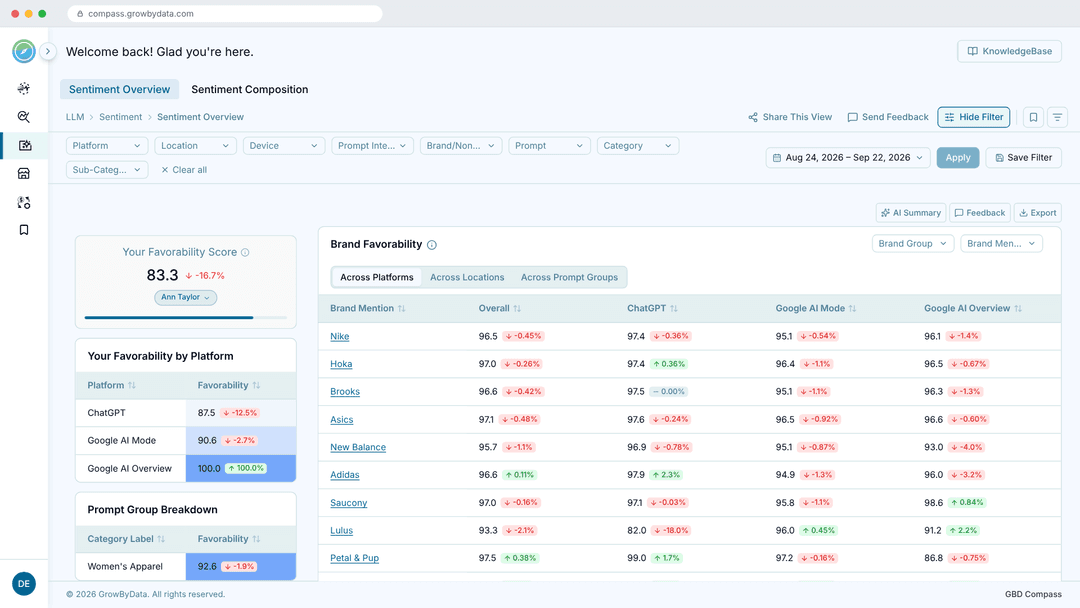
Brand managers can begin with Sentiment Composition to examine the balance of positive, neutral, and negative responses. The Favorability Score shows how that pattern changes over time, while platform and topic breakdowns narrow the investigation. Captured responses let the team review the actual wording rather than relying on the score alone. Managers can use that evidence to identify subjects requiring closer review and assess whether their published brand information addresses them accurately.
5. Search Teams Assessing An Emerging Competitor
A domain that rarely appeared on important searches may begin gaining visibility. The search team needs to establish where that growth is happening before treating it as a wider competitive threat. An advertiser gaining text ad exposure presents a different situation from a retailer gaining product listings.
Domain and Advertiser Comparison lets analysts examine the domain’s keyword coverage and visibility distribution. Leaders by SERP Feature separates the result types where it appears, so the team can investigate its paid, organic, or Shopping presence. Comparing changes over time reveals whether the movement extends beyond a few searches. That gives analysts a more specific starting point for reviewing the competitor’s activity and identifying the parts of their own search strategy affected.
Is GBD Compass Right For You?
Are you struggling to reconcile search reports or explain why competitors appear where your brand does not? GBD Compass suits enterprise marketing and e-commerce teams investigating those gaps. Its shared reporting connects paid, organic, Shopping, and AI visibility, while regional analysis narrows the investigation to specific markets.
For teams that manage broader portfolios, category and product-line filters support analysis of different business segments. Secure report sharing limits shared views to eligible Compass users.
GrowByData, the company behind GBD Compass, holds ISO 27001:2022 certification and uses GDPR-aligned handling for international search monitoring. Its search intelligence work has received Forrester recognition and a 2023 Global Business Tech Awards shortlisting.
As AI-generated answers become another channel for brand discovery, marketing teams need to examine mentions alongside website citations. Compass addresses this shift by tracking both and comparing AI presence with conventional search visibility. Its 2026 ChatGPT connection also lets users question their existing Compass data conversationally.
Still not sure if GBD Compass is right for you? Contact our customer support team at (661) 384-7070 to discuss your requirements.
GBD Compass Features
Holistic Share Of Voice
A combined view compares domains by total share of voice and tracks changes over time. Percentage changes show which competitors are gaining or losing visibility. Reporting covers more than 20 search result types, including text ads, Shopping, images, organic results, AI Overviews, and Maps. Users can examine how domain presence changes within the tracked search results.
Leaders By SERP Feature
Individual leaderboards show which brands lead within each search result type. Organic reporting covers nonpaid visibility, while Shopping and Merchant Listings reporting tracks product grid presence. Text Ads measures paid share, and AI Overview reporting tracks citations and brand mentions. Filters narrow each module by category, region, device, keyword grouping, and branded versus nonbranded searches.
Regional And Category Insights
Regional comparisons break down share of voice by key U.S. cities. Category analysis covers more than 25 retail categories, with additional views for product lines and segments. Users can compare a brand’s presence between selected markets and examine differences within its product portfolio. These reports show where visibility is stronger or weaker within the locations and categories analyzed.
Domain And Advertiser Comparison
GBD Compass provides side-by-side domain comparisons covering individual search result types. The reporting displays the percentage of keywords where each domain has visibility, alongside its share-of-voice distribution. Users can compare feature-level share within Shopping, Text Ads, Organic, Images, and AI Overviews. Each view shows how visibility divides among the domains included in the comparison.
ChatGBD: AI-Driven Recommendations
Embedded AI generates summaries of charts and tables within supported reports. ChatGBD flags competitors gaining ground and highlights coverage gaps between branded and nonbranded queries. It also provides next-step recommendations for paid, organic, Shopping, and AI search activity. Within LLM reports, its summaries adjust to the selected filters and describe the data shown in that view.
Pros And Cons of GBD Compass
Pros
Provides clearer channel comparisons with combined visibility reports
Supports focused market planning with city-level visibility comparisons
Guides content priorities with prompt-level competitor citation data
Speeds report interpretation with ChatGBD’s chart and table summaries
Reduces repeated report setup with saved filters and bookmarks
Cons
Limits visibility findings to the keywords and prompts tracked
Requires response-level context when interpreting sentiment scores
Requires teams to implement content changes outside the platform
GBD Compass Reviews

No reviews yet!
Be the first to review this product
Frequently Asked Questions
What information does GBD Compass show about its AI monitoring coverage?
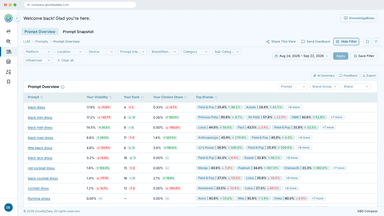
The LLM Scan Parameters page displays the number of prompts, days analyzed, locations, and platforms covered. Its detailed prompt table also distinguishes branded and nonbranded terms.
Can users export GBD Compass data as CSV files?
Yes, GBD Compass supports CSV exports. Exported filenames reflect the date range selected in the report.
Does a brand name inside a citation count as a brand mention?
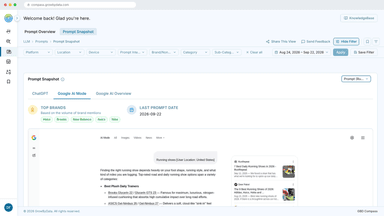
No, the Prompt Snapshot excludes brand mentions within citations from its brand mention calculation. This separates mentions in the answer from brand names appearing within citation references.
How does GBD Compass calculate brand visibility and citation share?
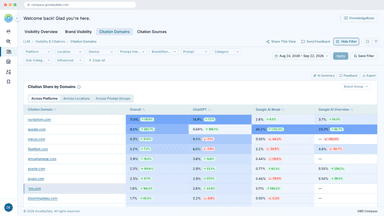
Brand visibility is the percentage of tracked queries in which a brand appears. Citation share is a domain’s percentage of all citation links collected under the selected filters and date range. For example, 20 links from a domain among 100 collected citations represent a 20% citation share.
Does GBD Compass require customer-installed scripts for AI monitoring?
No, customers provide their domain, competitors, and relevant topics during setup. GrowByData runs the recurring tracking, and customers review the results in their Compass dashboard.
Which AI platforms does GBD Compass monitor?
GBD Compass monitors ChatGPT, Perplexity, Google AI Overviews, and Google AI Mode. GrowByData’s October 2026 coverage statement excludes Gemini and Microsoft Copilot. Its Microsoft Copilot Studio connection provides access to Compass data rather than tracking Copilot answers.
Can GBD Compass identify keywords where a brand has no visibility?
Yes, the Non-Coverage Keywords report identifies keywords where a brand has no visibility within tracked results. The Keyword Visibility report also includes an Overall Coverage column.
Can GBD Compass suggest prompts for AI monitoring?
Yes, customers subscribed to LLM Reports can access the Prompt Suggestion Tool directly within Compass. It generates prompts for reporting and analysis.