Last Updated
Key Takeaways
Generated from the text of customer reviews
Accounting Seed is a Salesforce-native accounting platform used by accounting and finance teams at SMBs and mid-market organizations, particularly in professional services, construction, legal, and nonprofit sectors. Users frequently cite recurring billing automation as a benefit, while Salesforce-related complexity is a common concern. Its Winter ’26 release introduced Financial Reports Hub and AI Accounting Agents.
Our Verdict
Accounting Seed is best suited for growing organizations needing alignment between financial processes and broader business operations. It works well for teams managing accounting across sales, billing, and operations. Pricing and onboarding may be high for smaller businesses. Recommended for scaling organizations outgrowing basic accounting software and requiring team coordination.
Overall Rating
Based on 40 users reviews
4.5
Rating Distribution
Positive
95%
Neutral
5%
Negative
0%
Starting Price
Custom
Accounting Seed Specifications
- Financial Reporting
- Invoice Management
- Expense Tracking
- Budgeting and Forecasting
What Is Accounting Seed?
Accounting Seed is a cloud-based financial management system tailored for businesses seeking a comprehensive accounting solution. Specifically designed for small to medium-sized companies across various industries, the software integrates smoothly within the Salesforce ecosystem, providing a unified platform to manage financial data, reporting, and compliance requirements. It effectively addresses common pain points in financial operations, such as fragmented data management and limited process automation, streamlining accounting tasks for enhanced efficiency and accuracy. Known as a flexible and user-friendly tool, Accounting Seed is among the preferred choices in office accounting technology, and it is appreciated for its adaptability and customizable approach to financial workflows.
What Is Accounting Seed Best Known For?
Accounting Seed is built around its native Automated Quote-to-Cash Workflow Engine, which is designed for mid-sized organizations already operating within the Salesforce CRM ecosystem. This feature automatically inherits closed-won sales data to generate financial ledger invoices instantly. By eliminating the manual data re-entry and frequent sync failures common with traditional, external accounting tools, it helps departments automate invoicing and live revenue recognition pathing.
How Much Does Accounting Seed Cost?
Accounting Seed pricing typically starts at approximately $750/company/month for entry-level configurations. It follows custom quote-based pricing plans rather than fixed public tiers, with costs scaling based on users, complexity, and implementation scope.
Other commonly observed cost components include industry-reported implementation and service estimates (based on Salesforce consulting benchmarks and third-party implementation partner ranges, not official vendor pricing):
- Implementation And Setup: ~$5,000–$25,000 depending on business complexity and data migration requirements
- Salesforce Consulting/Partner Onboarding: ~$2,500–$20,000 based on customization and configuration depth
- Training And Configuration Support: ~$150–$250/hour for onboarding and workflow setup
- Data Migration Services: ~$1,000–$10,000 depending on legacy system volume and structure
- Ongoing Support/Optimization: ~$500–$2,000/month for managed support or system optimization
Total cost varies significantly depending on organization size, accounting complexity, and Salesforce environment maturity.
Users of Accounting Seed generally perceive it as a higher-cost accounting platform but praise its native Salesforce integration. Many view it as a pro that eliminates middleware expenses, while others consider high implementation fees and scaling user licenses a con.
Disclaimer: Pricing references are based on publicly available third-party information and industry benchmarks. Actual costs may vary.
Accounting Seed Integrations
Currently, Accounting Seed integrates natively with Salesforce Engage software, allowing seamless management of both CRM and accounting data.
How Does Accounting Seed Work?
Here’s how you can navigate the software after logging in:
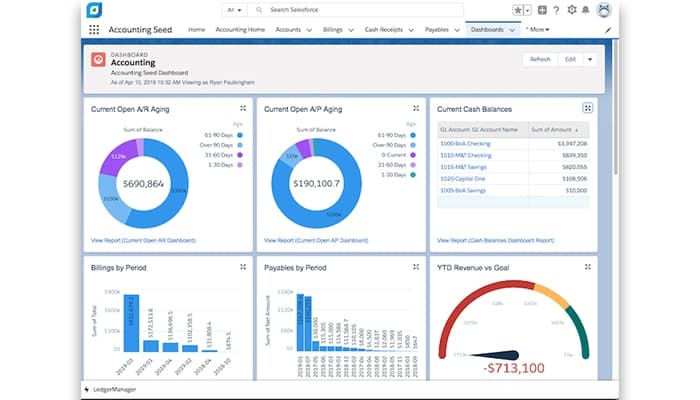
- Access the Accounting Seed dashboard to gain a full view of financial metrics and key data
- Customize the dashboard layout to prioritize essential widgets for quick access to accounting data ready at a glance
- Review real-time financial data for up-to-date insights, ensuring financial health across accounts
- Utilize the ‘Salesforce’ integration for streamlined CRM and financial data access within a single platform
- Navigate to the 'General Ledger' for back-office accounting tasks like account reconciliation
- Open the 'Reporting' section to generate customized financial reports based on specific business needs
- Access user management tools to assign roles and permissions, ensuring secure access across your team
Who Is Accounting Seed For?
Accounting Seed is designed to serve all sorts of businesses, from small to medium sized enterprises (SMEs) to large companies. It caters to various industries such as:
- Automotive
- Construction and maintenance
- Consumer goods
- Education
- Energy and utilities
- Financial services
- Healthcare and life sciences
Accounting Seed Use Cases
Based on analysis of user feedback and Accounting Seed’s capabilities, the following are key scenarios where the platform is a strong operational fit:
Sales-Led Organizations Consolidating Customer And Financial Workflows
Businesses already structured around Salesforce often adopt Accounting Seed to reduce separation between customer management and financial operations. Sales and finance teams typically work from different systems, which leads to duplicated effort and delayed visibility into customer status. In this setup, organizations use a single environment to manage both commercial activity and financial records. This is particularly relevant for companies scaling beyond basic accounting tools but not yet adopting full enterprise ERP systems.
Professional Services Firms Managing Client And Project-Based Revenue
Consulting firms, legal practices, and similar service-based organizations use the tool to manage client-driven financial workflows tied to ongoing engagements. Finance teams often need visibility into how time, expenses, and billing align across different client accounts. The platform is commonly used in environments where project profitability and client-level financial tracking are central to decision-making. This helps firms maintain structured financial oversight across multiple active engagements.
Subscription And Retainer-Based Businesses Handling Recurring Revenue Cycles
Service providers operating on subscription or retainer models use Accounting Seed to manage repeat billing cycles that occur on fixed schedules. Prior to adopting the system, many teams rely on manual invoicing processes that become difficult to maintain as client volume increases. Businesses in this category typically value having a consistent financial workflow that reduces administrative overhead across monthly or quarterly billing cycles. This use case is most common in agencies, managed service providers, and B2B service firms.
Multi-Entity Businesses Managing Consolidated Financial Operations
Organizations operating across multiple business units or legal entities use the tool to centralize financial visibility across their structure. Finance teams often struggle with fragmented reporting when each entity operates in isolation. In these environments, companies require consolidated oversight of financial performance while still maintaining separation between individual books. This setup is typically relevant for growing companies expanding across regions or operating multiple subsidiaries.
Finance Teams Replacing Disconnected Accounting Systems With A Single Platform
Finance departments transitioning away from separate accounting and operational tools use Accounting Seed to reduce fragmented data management. Before adoption, teams often deal with inconsistencies between financial records and operational activity stored in different systems. In this scenario, organizations prioritize bringing financial workflows into one environment to improve coordination between accounting, operations, and reporting teams. This is most relevant for mid-market companies that have outgrown entry-level accounting tools.
Is Accounting Seed Right For You?
Are you seeking a comprehensive, Salesforce-native accounting solution that integrates CRM and financial management? With Accounting Seed, you gain a tool that eliminates data silos and simplifies financial workflows, addressing the complexity of manual data entry and fragmented systems.
Designed for both security and scalability, Accounting Seed is built on the Salesforce platform, ensuring robust data protection and compliance with industry standards. Its scalable architecture allows businesses of any size to expand functionality as needs evolve, making it suitable for growing companies and complex organizations alike.
Still not sure if Accounting Seed is right for you? Contact our customer support team at (661) 384-7070 for further assistance.
Accounting Seed Features
Customizable General Ledger
This feature enables users to manage all financial transactions with ease, from journal entries to account reconciliation. This customization-friendly feature allows businesses to tailor financial data management to fit specific reporting needs, enhancing financial oversight and control.
Project Accounting
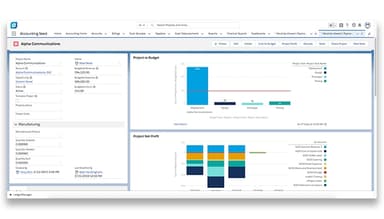
The project accounting feature simplifies project-based financial tracking, allowing users to assign and manage budgets, track expenses, and analyze project profitability. This functionality is ideal for service-oriented businesses that need visibility into project-specific financial performance.
Automated Billing And Invoicing
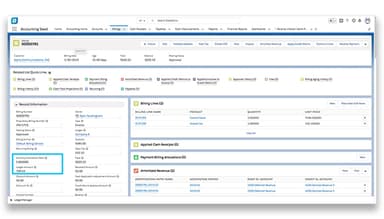
The platform simplifies the invoicing process through automated billing and invoicing, enabling recurring billing schedules and customized invoice creation. This feature minimizes manual tasks and enhances accounting automation for improved financial management.
Multi-Currency Management
Accounting Seed’s multi-currency management feature allows users to handle transactions in multiple currencies, making it ideal for companies with international clients or vendors. This functionality automatically converts currencies based on real-time exchange rates, simplifying global transactions and ensuring accurate financial reporting across different markets.
Reporting And Analytics
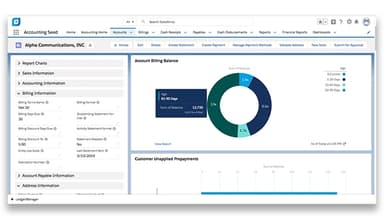
With robust reporting and analytical tools, Accounting Seed delivers detailed financial insights through customizable reports and dashboards. This feature empowers decision-makers with accurate, real-time data to support strategic planning and improve financial forecasting.
Pros And Cons of Accounting Seed
Pros
Seamless integration with Salesforce enhances data management
Robust reporting capabilities for detailed financial insights
Automated billing streamlines invoicing processes efficiently
Project accounting feature simplifies tracking project finances
Cons
Cash application process can be time-consuming
Financial reports may require additional formatting efforts
Certain features necessitate third-party applications for full functionality
Accounting Seed Reviews
Total 40 reviews
4.5
All reviews are from verified customers
Rating Distribution
5
Stars55%
4
Stars40%
3
Stars3%
2
Stars3%
1
Stars0%
Share your experience
Rit
IT, 11-50 employees
More than a year
“Flexible and powerful accounting software in Salesforce platform”
Pros
It can be customized to fit with existing Salesforce business processes and it offers powerful reporting and dashboard features.
Cons
The user interface is tied to Salesforce design, which makes it a bit click-heavy.
Rating Distribution
Ease of use
10
Value for money
10
Customer Support
10
Functionality
10
Andrea
Insurance, 11-50 employees
Less than a year
“Honest take on this software”
Pros
Features like Bank Connect and the option to replicate payable lines and journal entries stand out to me. Those are some of the best features available for sure.
Cons
Payment processing in Accounts Payable is a bit limited since all payable components like vendors, insurance companies and producers share the same general ledger account.
Rating Distribution
Ease of use
10
Value for money
10
Customer Support
10
Functionality
10
Christi
Social Media, Advertising, Marketing, 51-100 employees
Less than a year
“New to Accounting Seed, not new to accounting.”
Pros
it is ok however I am quite new to Accounting Seed so it is s a bit tricky when it comes to posting entries. You really need a solid understanding of accounting to understand it properly.
Cons
Well it is difficult to link reports to Salesforce data.
Rating Distribution
Ease of use
7
Value for money
7
Customer Support
3
Functionality
7
Frequently Asked Questions
Does Accounting Seed offer an API?
Yes, Accounting Seed offers an extended Salesforce API.
What language does Accounting Seed support?
Currently, Accounting Seed comes with the Translation Workbench and can be translated into any language from the user interface perspective. However, their error messages, support, and technical documentation are still in English only.
Does Accounting Seed support mobile devices?
No, Accounting Seed does not offer any app for any mobile device.
Who are the typical users of Accounting Seed?
Accounting Seed features can be used by small-to-medium-sized businesses to manage financial operations.
What level of support does Accounting Seed offer?
The software offers in-app AI assistance, FAQ, online support, email, phone, and a knowledge base.
What other apps does Accounting Seed integrate with?
The official website only lists Salesforce as a native integration.
How much does Accounting Seed cost?
Accounting Seed pricing starts at $750/company/month for entry-level configurations. It can be customized based on user needs. You can request a personalized Accounting Seed cost quote from our website.