Last Updated
Key Takeaways
Generated from the text of customer reviews
Our Verdict
Moodle Specifications
- Activity Dashboard
- Asynchronous Learning
- Activity Tracking
- Access Controls/Permissions
What Is Moodle?
Moodle is an open-source Learning Management System (LMS) built for schools, universities, and workplace training programs. The platform was officially launched in 2001 by Martin Dougiamas and holds Certified B Corporation status.
Moodle offers various key capabilities, such as assessment, communication tools, and course creation. It includes accessibility support that meets WCAG 2.2 AA standards. Additionally, it integrates with third-party tools, including video conferencing tools, and authentication systems. Furthermore, its mobile app allows learners to study offline and online from anywhere across supported devices.
What Is Moodle Best For?
A standout capability of Moodle is its branding and theme customization offering. Teams can personalize the software’s interface, including adjusting colors, layout, and logos to match a brand’s specific guidelines. This branding work goes beyond visuals, since organizations can also point learners to a custom domain instead of a generic Moodle web address.
How Much Does Moodle Cost?
Moodle is an open-source software that organizations can download and customize for free, with no licensing costs for self-hosted deployments.
For organizations seeking managed hosting, MoodleCloud pricing starts at $170/year (50 users) for the Starter plan. Further plans include:
- Mini - $280/year for 100 users
- Small - $510/year for 200 users
- Medium - $1,230/year for 500 users
- Standard - $2,160/year for 750 users
Other than the base subscription, organizations should also keep the following estimated additional costs in mind:
- Implementation And Setup: Can range from $1,000 to $5,000+, depending on installation, configuration, testing, migration, and training requirements
- Course Design And Content Migration: May cost $1,000–$10,000+, depending on the volume of courses, learning materials, and instructional design work required
- Integrations And Custom Development: Estimated at $2,000–$15,000+, depending on the number and complexity of external system integrations or custom plugins
- Hosting And Infrastructure: Self-hosted deployments may require $500–$5,000+ per year for hosting, server resources, backups, and related infrastructure
- Training And Consulting: Can range from $500–$3,000+, depending on the number of administrators, educators, and staff requiring training
- Support And Maintenance: Organizations using paid partner support may budget $1,000–$10,000+ annually for technical support, upgrades, troubleshooting, and ongoing maintenance
Most users find Moodle’s pricing flexible and affordable due to its open-source model. Some users note that costs can rise when organizations require managed hosting, greater user capacity, additional storage, or paid technical support.
Disclaimer: The pricing is subject to change.
Moodle Integrations
The tool connects with various third-party applications and tools, including:
- Quilgo
- Poodll
- MathType
- Kortext IQ
- EduGears AI
- Kialo Edu
How Does Moodle Work?
Here is how you can get started with Moodle:
- Log in to the platform using the user credentials or administrator to set up during installation
- Complete the initial site setup through ‘Site Administration’, covering the site name, language, time zone, and default course settings
- Add users one at a time, or upload them in bulk, through the ‘Accounts’ section under ‘Site Administration’
- Create a new course and pick a format, such as ‘Topics’ or ‘Weekly’, based on how the content should be structured
- Add activities and resources to each course, including quizzes, assignments, forums, and uploaded files
- Assign roles to learner, teacher, or admin, so each person only sees what applies to their part in the course
Who Is Moodle For?
The software is used across various industries and sectors, such as:
- Education
- Government
- Real estate
- Healthcare
- Hospitality
- Finance
- Information technology
Moodle Use Cases
Based on our evaluations of user feedback and Moodle's current capabilities, we have identified a few scenarios where this platform can be a suitable choice:
Universities Supporting Bilingual Learning Programs
Universities serving students across different language groups struggle to keep learning consistent. It is difficult to manage course delivery across departments due to separate language need. Moodle supports institutions where bilingual education is part of the regular academic workflow. It builds multi-language content directly into courses and displays materials based on each user’s preferred language. This helps organizations maintain a common learning environment across language groups.
Organizations Training Employees Across Different Roles
Businesses with varied teams require training that reflect different job responsibilities. A single learning approach may not suit technical, administrative, sales, and compliance teams equally. Moodle helps address this by providing role-specific learning paths and letting L&D teams control access to different training content. This helps each group receive materials aligned with its responsibilities within the same LMS.
Global Non-Profits Educating Teams Across Regions
International non-profits can struggle to keep learning consistent across countries while responding to local needs. Moodle Workplace uses multi-tenancy to help organizations manage different country-level groups within one platform. It also supports multilingual training and mandatory or on-demand courses. As a result, regional teams can access relevant learning while organizations maintain a consistent training structure.
Social Care Organizations Training Adult Professionals
Social care providers often need to prepare workers through structured training while accommodating learners with different levels of digital experience. Moodle Workplace supports structured progression through automated learning pathways. Whereas visual dashboards help learners follow their training. Integrated certification also helps organizations document completed professional education. This is particularly relevant when training must remain accessible while meeting professional development requirements.
Is Moodle Right For You?
If you run an educational institution or business that needs to deliver structured, personalized training to large groups, Moodle is worth considering. As an open-source platform, it helps organizations shape and host the LMS according to their requirements.
Moodle currently supports 500+ million users worldwide, with courses available in 42 languages. Moodle LMS, Moodle Workplace, and the Moodle App have achieved WCAG 2.2 Level AA accreditation. Moodle US also maintains SOC 2 Type 2 compliance, supporting data security and privacy for its U.S. operations.
Still not sure if the software is the right fit for your team? Contact us at (661) 384‑7070 for further assistance.
Moodle Features
Multi-Tenancy
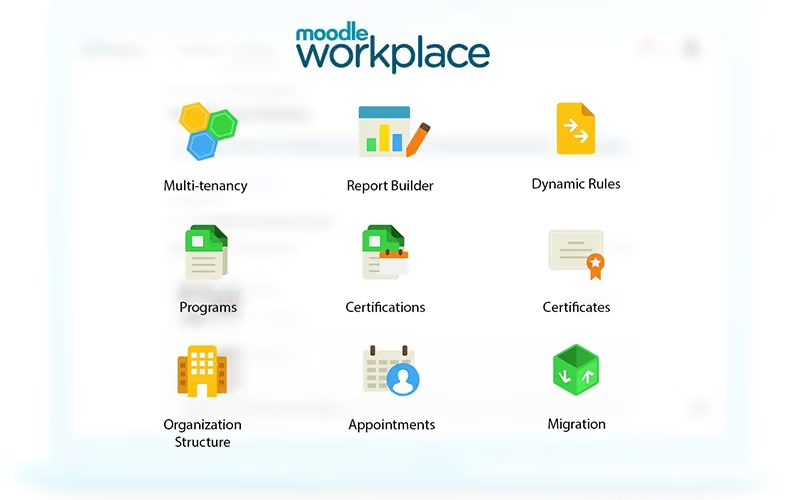
Moodle Workplace supports multi-tenancy that helps organizations create separate learning environments for different departments, business units, or clients. Each tenant can have its own users, branding, and learning content. This helps organizations serve distinct learning audiences while managing them within the same platform.
Workforce Development
The software supports workforce development through structured learning pathways and progress tracking. Universities can use this capability to organize ongoing training for staff and faculty and monitor their advancement through assigned courses.
Moodle AI Subsystem
The platform allows organizations to choose from providers such as OpenAI, Azure AI, local models, or their own infrastructure. Administrators can control AI use by site, course, activity, or role. This helps organizations manage AI costs and data ownership without being tied to one provider.
Blended Learning
Moodle features blended learning that combines online and in-person education. It allows educators to use communication tools and create flexible learning paths to support interaction. As a result, institutions can accommodate different approaches to teaching and learning within the same platform.
Pros And Cons of Moodle
Pros
Highly customizable to fit different educational workflows
Strong community support helps users find answers and resources
Well-supported with frequent updates to improve the platform
Cons
The interface may be difficult to navigate for first-time users
Mobile app functionality may be a bit limited compared with the web version
Moodle Reviews
Total 532 reviews
4.5
All reviews are from verified customers
Rating Distribution
5
Stars55%
4
Stars37%
3
Stars7%
2
Stars1%
1
Stars0%
Share your experience
Heather J.
Construction, 500+ employees
“Highly flexible LMS”
Pros
What makes this LMS exceptional is its perfect balance of cost, flexibility and scalability. It's free, supports extensive plug-ins and handles large online classes effortlessly, ideal for institutions looking to grow!
Cons
I found the platform difficult to master, its interface feels dated and I needed a lot of help from my IT team.
Rating Distribution
Ease of use
7
Value for money
10
Customer Support
10
Functionality
6
Kristin G.
Higher Education, 500+ employees
“Effective for communication”
Pros
I still rely on it as an effective tool for communicating with students and delivering asynchronous course content. It also complies with required accessibility standards and connects directly with our campus technology, Ellucian.
Cons
Sometimes videos take a long time to buffer despite a solid internet connection something I've noticed frequently. Also, customizing the learning environment to our needs can be frustratingly difficult.
Rating Distribution
Ease of use
7
Value for money
8
Customer Support
7
Functionality
6
Teresa S.
Construction, 1-10 employees
“Didn't meet my expectations”
Pros
Gave it a trial run to determine whether it could serve for onboarding customers, helping communicate clearly what they should expect when they sign up with our company.
Cons
It didn't meet my expectations though I suspect that's more about it not being the appropriate tool for this job. I can, however, envision advantages in other areas.
Rating Distribution
Ease of use
6
Value for money
6
Customer Support
6
Functionality
5
Frequently Asked Questions
Does Moodle offer an API?
Yes, Moodle offers an API.
What languages does Moodle support?
Moodle supports multiple languages, including German, Spanish, English, French, Italian, and Brazilian Portuguese.
What other apps does Moodle integrate with?
Moodle connects with third-party tools and applications, including Quilgo, Poodll, Kialo Edu, EduGears AI, Kortext, MathType, and more.
Does Moodle offer a mobile app?
Yes, the platform offers a dedicated mobile app for Android and iOS devices.
What types of pricing plans does Moodle offer?
Moodle is an open-source platform that organizations can download for free. It has no licensing costs for self-hosted deployments. MoodleCloud pricing plans include Starter ($170/year for 50 users), Mini ($280/year for 100 users), Small ($510/year for 200 users), Medium ($1,220/year for 500 users), and Standard ($2,160/year for 750 users). Contact us for a personalized Moodle pricing quote.
Who are the typical users of Moodle?
The software is used by professionals working across education, government, finance, real estate, healthcare, hospitality, and information technology.
What level of support does Moodle offer?
Moodle offers support through a ticket system, live chat, FAQs, and a help center.