


ESO Scheduling
Last Updated

Key Takeaways
Generated from the text of customer reviews
ESO Scheduling is a web-based workforce scheduling platform for EMS and fire department teams. User reviews commonly praise scheduling ease, certification tracking, and payroll support, while setup, customization, reporting, and interface consistency receive mixed feedback. Recent updates include the introduction of the ‘Auto-Generated Narrative’ feature.
Our Verdict
ESO Scheduling is a practical fit for EMS and fire departments that need dedicated workforce scheduling without adopting a broader generic workforce platform. With a starting price that is relatively accessible for smaller and mid-sized agencies, it can provide reasonable value for teams with easy scheduling needs. We recommend it for emergency-service teams prioritizing workforce coordination and staffing visibility.
Overall Rating
Based on 20 users reviews
4.3
Rating Distribution
Positive
90%
Neutral
10%
Negative
0%
Starting Price
$795
per year

ESO Scheduling Specifications
- Employee Information Management
- Attendance And Time Tracking
- Workforce Analytics
- Recruitment and Applicant Tracking
What Is ESO Scheduling?
ESO Scheduling is a web-based employee scheduling platform designed for emergency medical services (EMS) agencies. It helps managers automatically generate schedules, manage sick calls, and fill open shifts from any location. The software also brings certification tracking, time and attendance management, and payroll reporting into the same system. Collectively, these capabilities allow agencies to maintain records of employee licenses and certifications to help ensure staff credentials are up to date.
What Is ESO Scheduling Best For?
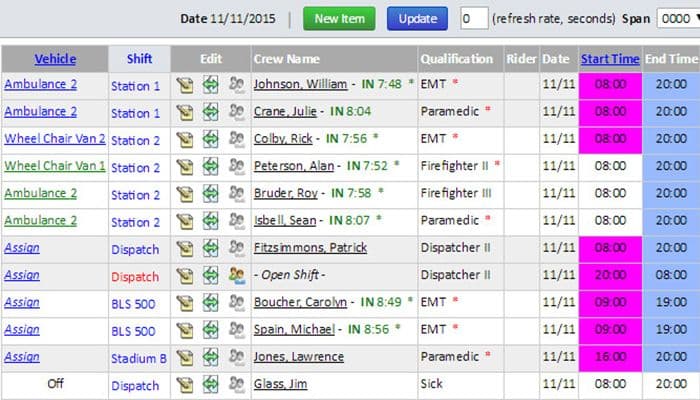
ESO Scheduling stands out for automating the process of keeping shifts staffed when schedules change. Its system can generate schedules, identify and fill open shifts, manage sick calls, time-off requests, swaps, and shift bids. This helps supervisors respond to staffing gaps without rebuilding schedules manually. Its scheduling workflows are designed around the coverage requirements of emergency-service teams.
How Much Does ESO Scheduling Cost?
ESO Scheduling cost is estimated to start at $795/year. It may vary depending upon the personalization requests.
Besides the base subscription cost, users should also account for additional charges to consider the total cost of ownership. It includes, but is not limited to, the following:
- Implementation And Configuration: $1,500–$4,000 (one-time)
- Data Migration: $500–$2,000 (one-time)
- Staff Training: $500–$1,500 (one-time)
Disclaimer: Pricing references are based on publicly available third-party information and industry benchmarks. Actual costs may vary.
ESO Scheduling Integrations
The vendor has not disclosed any third-party integrations.
How Does ESO Scheduling Work?
Once you have logged into the ESO Scheduling software, here’s how you can utilize its features:
- Create and populate employee schedules automatically to maintain adequate shift coverage and reduce manual scheduling effort
- Fill open shifts quickly by reviewing staffing visibility across the team and assigning qualified personnel where needed
- Manage time-off requests, call-outs, and shift swaps to keep schedules accurate and operations running smoothly
- Track employee records, certifications, credentials, and training information from a centralized personnel management system
- Monitor workforce readiness by reviewing staffing, personnel, and operational data in a connected environment
- Document employee activities, daily tasks, and operational contributions to maintain complete workforce records
- Analyze workforce coverage and labor utilization to improve scheduling decisions, control labor costs, and support organizational performance
Who Is ESO Scheduling For?
ESO Scheduling is mainly designed for:
- EMS
- Healthcare
- Government
- Fire departments
ESO Scheduling Use Cases
Based on our assessment of ESO Scheduling features and user reviews, we have identified several situations where the platform is well suited for organizations:
EMS Managers Dealing With Last-Minute Coverage Gaps
EMS managers dealing with sick calls or unfilled shifts can use ESO Scheduling to update schedules, manage call-outs, and identify employees available for open shifts. Instead of rebuilding schedules manually, managers can use its scheduling tools to maintain coverage while accounting for employee availability and staffing requirements. Users particularly highlight its easy-to-use interface that lets them manage scheduling quickly.
Fire Department Supervisors Coordinating Shift Communications
When a sick call leaves a shift uncovered, supervisors can use ESO Scheduling’s message center to notify staff about the opening and communicate changes to the roster. Keeping these updates in one place helps employees follow staffing changes without supervisors having to contact each person separately. This is particularly useful when a last-minute absence affects several crew assignments.
EMS Agencies Tracking Expiring Licenses And Certifications
Agencies with employees holding multiple licenses and certifications may struggle to identify credentials that are nearing expiration. ESO Scheduling can maintain certification records, notify employees and supervisors about upcoming expirations, and incorporate certification requirements into shift assignment workflows. These capabilities help managers avoid assigning personnel who lack required credentials.
Scheduling Teams Struggling With Time Records
Scheduling and payroll teams can use ESO Scheduling to review employee hours, overtime, tardiness, absences, and timekeeping exceptions before payroll is processed. Managers can generate timekeeping and payroll reports from scheduling data. This way, they don’t have to reconcile information manually across separate records.
Is ESO Scheduling Right For You?
ESO Scheduling is suitable for fire departments and EMS agencies that need to manage shift coverage, call-outs, shift swaps, time-off requests, overtime, and payroll-related scheduling processes in one system.
Its functionality also connects scheduling with personnel records, credentials, EHR data, training, and operational activities, making it more suitable for emergency-response organizations than general-purpose employee scheduling teams. The platform is particularly relevant for organizations with changing coverage needs.
On the security side, ESO uses industry-standard security technologies and procedures to protect personal information from unauthorized access, use, or disclosure. Its legal documentation also provides a HIPAA Business Associate Agreement for applicable products and services. ESO maintains a responsible-disclosure program for reporting potential security vulnerabilities.
At Wave 2026, ESO highlighted the importance of rest and well-being for emergency responders. ESO Scheduling’s overtime alerts give managers visibility into overtime, which can help them review workloads when planning shift coverage.
Want to learn more about ESO Scheduling? Contact us at (661) 384-7070 for detailed guidance.
ESO Scheduling Features
Automated Shift Management
The platform offers tools to automatically generate and populate employee schedules while helping managers handle sick calls, open shifts, time-off requests, swaps, and shift bids online. This way, ESO Scheduling helps reduce the manual work involved in maintaining coverage and gives EMS and fire departments a central way to adjust staffing as availability changes.
Staff Communication
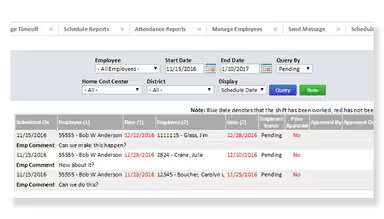
ESO Scheduling has a message center that gives managers and employees a shared place for operational updates and scheduling communication. Messages can be directed to individuals or groups, while schedule-change decisions and other notifications can be communicated through the system. By offering such capabilities, the staff communication tool allows teams to reduce back-and-forth when teams need to coordinate call-outs, PTO requests, or open shifts.
Automated Certification Tracking
The software provides users with integrated records for employee certifications and licenses, including expiration information. Managers can monitor credential status and receive notifications when certifications are approaching expiration, while ESO Scheduling can also use certification requirements when determining whether employees can work particular shifts. As a result, agencies can keep qualified personnel assigned to roles that require current credentials.
Time And Attendance Management
ESO Scheduling features time and attendance controls for tracking employee hours, tardiness, absences, and exceptions. The system can reconcile exceptions and provide reporting that helps managers review regular versus overtime hours. By connecting scheduling and timekeeping information, agencies can improve payroll preparation while gaining better visibility into labor usage and attendance patterns.
Payroll
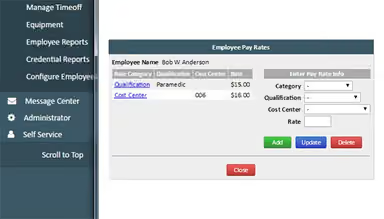
The platform helps generate payroll reports for manual or automated entry across a variety of payroll platforms. Users can create these reports with the click of a button. This way, ESO Scheduling's payroll feature helps agencies prepare payroll information without compiling reports manually each pay period.
Pros And Cons of ESO Scheduling
Pros
Helps users create and manage schedules with ease
Supports quick shift updates and changes
Helps users track employee certifications in one place
Provides access to schedules and reports from anywhere
Supports multiple shift patterns for diverse workforce needs
Cons
Initial configuration can be difficult
Occasional missing punches reported
Limited customization for complex scheduling requirements
ESO Scheduling Reviews
Total 20 reviews
4.3
All reviews are from verified customers
Rating Distribution
5
Stars45%
4
Stars45%
3
Stars10%
2
Stars0%
1
Stars0%
Share your experience
Healthcare, 11-50 employees
More than a year
“Delivers what it promises.”
Pros
Scheduling is a simple now and also it is very easy to use. Plus it even keeps track of certifications for employees. In short it's been an awesome tool for our company for 17 years, and we are looking forward to continuing to make the most of everything it has to offer.
Cons
Configuring certain areas of the software is not as easy as I expected.
Rating Distribution
Ease of use
8
Value for money
10
Customer Support
10
Functionality
8
Trucking Accounting, 101-500 employees
More than a year
“I like it!!!”
Pros
As per my experience, ESO is not only user friendly but is packed with a lot of useful features.
Cons
When the time is approved, the employee's name does not get removed from the daily sheet, which I truly dislike as it is quite annoying.
Rating Distribution
Ease of use
8
Value for money
9
Customer Support
9
Functionality
7
Public Sector, 101-500 employees
More than a year
“ESO is a complete package”
Pros
It's a complete package with an easy to use interface and the ability to filter data fields. I have been working with ePro scheduler for over 9 years now, starting from the basic user interface all the way to having full admin rights.
Cons
I have noticed a lack of communication between the functions within the software. Since this is an all in one system, the features should be able to work together and update each other instantly.
Rating Distribution
Ease of use
10
Value for money
10
Customer Support
8
Functionality
10
Frequently Asked Questions
What are the alternatives to ESO scheduling?
ESO Scheduling alternatives include Calamari HR software, Namely HR, and iCIMS software, among others. The right choice depends on whether an organization needs general workforce scheduling or specialized support for EMS and fire department operations.
Does ESO scheduling have a mobile app?
No, it doesn't offer a mobile app.
Which roles and teams benefit most from ESO Scheduling?
Operations and scheduling managers, public-safety supervisors, and HRIS and HR teams benefit the most from ESO Scheduling software.
Can managers monitor overtime before it becomes a budget concern?
ESO Scheduling provides in-app overtime alerts and visibility into overtime trends. Managers can use this information to review staffing decisions and labor spending.
Can agencies use ESO Scheduling with their existing payroll platform?
ESO Scheduling generates payroll reports for manual or automated entry across various payroll platforms. However, agencies should confirm compatibility with their specific payroll system.