

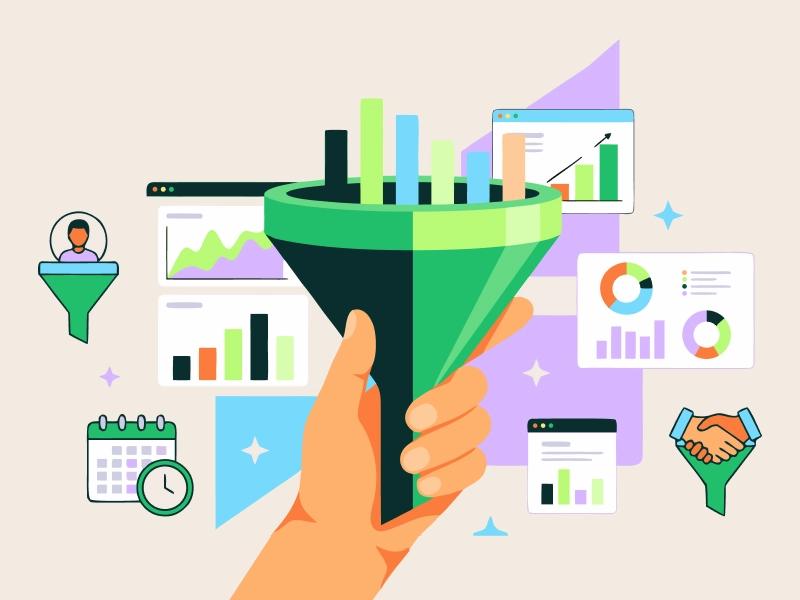



A recruitment funnel, sometimes also called a hiring funnel or talent funnel, is a structured workflow that maps every step a candidate takes from first hearing about your company to signing an offer letter. Like a traditional marketing funnel, it starts wide, with an area of maximum awareness, and narrows as candidates are evaluated, screened, and finally selected.
The concept builds the core of modern talent acquisition, where hiring is no longer just a one-off transaction; it is a repeatable, measurable system, optimized by the funnel. Each stage of the funnel has defined inputs, outputs, and key performance indicators that give HR teams the data they need to improve the candidate experience.
The recruiting landscape has shifted in the last few years. Average team sizes have dropped 14% in the past few years, while the average recruiter now manages 93% more open job applications and 40% more open jobs, meaning teams have gotten leaner, and funnels have gotten bigger, with more pressure than ever.
At the same time, candidate pass-through rates have dropped at every stage. This makes funnel visibility a competitive necessity for companies to survive and hire in a volatile job market. Companies that track and optimize each stage of their recruitment workflow are often more likely to improve hiring efficiency.
Add in AI adoption, as we know many companies now use AI for many HR tasks, and the funnel becomes the organizing structure that makes AI-augmented hiring coherent, auditable, and fair.
While organizations adapt the funnel to their context, the following seven stages form the industry-standard model used by HR professionals and talent acquisition leaders across the US.
Recruiting Funnel Stages: At A Glance
Stage | Purpose |
Awareness | Publicize the opening and reach the talent pool |
Attraction | Reach desirable candidates |
Interest | Market for specific skills |
Application | Have a mode of contact, or a portal, where candidates can apply |
Evaluation | Vet applications for the interview phase |
Interview | Interview vetted candidates |
Hire | Issue an offer letter to final selected candidates |
Stage 1: Awareness
At this stage of the funnel, candidates discover your organization and interact with your postings and openings. This is driven by employer branding campaigns, social media presence, Glassdoor reputation, and word of mouth. A large number of candidates consider employer brand before applying for a role. If your brand is invisible or negative, candidates might never enter the funnel at all.
What to do: Always make sure your Glassdoor profile, LinkedIn presence, and Google search results are up to date and trendy before launching any job posting. Fix perception gaps before you spend your budget on an attraction.
Stage 2: Attraction
At this stage, candidates see your specific open role. Job boards generate most of the applications that eventually come in, but employee referrals also add greatly to successful hiring. LinkedIn data shows that candidates are more likely to respond if a hiring manager, not a generic recruiter account, reaches out to them directly.
What to do: Combine programmatic advertising for volume with a structured referral bonus program for quality. Make sure job titles match what candidates are actually qualified for.
Stage 3: Interest
This is the stage where candidates investigate your company before committing to an application. In doing this, they can use multiple resources to research companies before deciding to apply, including company websites (31%), employer review sites (28%), and other channels. Your digital footprint is being read as a first interview — make it count.
What to do: Add FAQs covering your hiring process. Employee testimonial videos are particularly effective at converting interested visitors into applicants.
Stage 4: Application
Most candidates abandon applications before finishing the initial drafting. A lot of applications have a lower completion rate due to complexity. Companies that shorten their process can see open positions fill significantly faster as a result. Shorter and cleaner applications mean more completions and more qualified finalists.
What to do: Ask only what you cannot learn from a résumé or LinkedIn profile. Send a confirmation email as soon as you can with a clear timeline for the next steps. Make sure the application format is mobile-friendly, since a majority of applications are now started on mobile devices.
Stage 5: Evaluation
Resume review, ATS filtering, skills assessments, and pre-screening calls are all part of the candidate review process. AI screening tools are now standard for high-volume roles, handling initial resume parsing and skills matching. However, every automated screening tool must be regularly audited for bias.
What to do: Build a structured scoring rubric so every screener evaluates candidates against the same criteria. Consider take-home tasks or short assessments to surface candidates who may not interview well on paper but excel on the job.
Stage 6: Interviewing
Structured conversations to assess fit, capability, and culture alignment are all best practices for this part of the funnel. Recruiting teams now conduct 33% more interviews/hire than in 2021, which makes process efficiency critical. Too many rounds, more than three, and strong candidates drop out or accept competing offers.
What to do: Limit rounds to three as a baseline. Divide questions across interviewers so topics are covered efficiently. Provide candidates with prep materials in advance. Always give prompt post-interview feedback.
Stage 7: Offer And Hire
The average offer acceptance rate tends to remain higher across all company sizes due to the state of the job market. But top candidates often hold multiple competing offers simultaneously, and the best ones are typically off the market within a few days of starting their search. Speed matters as much as the offer itself.
What to do: Learn the candidate's motivations before constructing the offer, career growth, flexibility, mission, and compensation as they all factor differently for different people. Frame the offer around their specific goals, not just the salary number.
Building your company's recruitment funnel doesn't require a massive HR team or expensive software. It simply requires clarity, consistency, and a commitment to measuring what matters.
Step 1: Define Your Hiring Goals And Ideal Candidate Profile
Before structuring the funnel, clarify what success looks like for your organization. Build a scorecard with weighted criteria that covers skills, values alignment, and experience level, so that every evaluator uses the same standard from day one.
Step 2: Audit Your Employer Brand
Google your company name, read your own Glassdoor reviews, check LinkedIn follower trends, and review what your last three job posts looked like. Your brand is already saying something; find out what, and close the gap between perception and reality.
Step 3: Optimize Job Descriptions For Search And Clarity
Use the exact job titles that candidates on job boards are looking for. This can be done by having your team go over market trends. Keep responsibilities to the top 5–7 bullet points and remove jargon. Include salary ranges, as listings with ranges receive significantly more qualified applicants in US markets where pay transparency is increasingly expected or legally required.
Step 4: Shorten And Streamline Your Application
Target a small, few-minute application. Every additional field reduces the completion rate. Use an ATS with autofill to reduce friction and to make things easier for your team. Send an immediate confirmation email with a clear timeline.
Step 5: Design A Compelling Offer Strategy
Understand the candidate's career goals, growth priorities, and benefits preferences before extending an offer. This makes sure you don’t present a mismatched offer that wastes time. Frame the offer around their specific motivations and always remember it's not just the salary number.
Step 6: Instrument Every Stage With Recruiting Funnel Metrics
Set up dashboards tracking conversion rates between each stage, time-in-stage, source-of-hire, and offer acceptance rates, and make sure to review them weekly. Flag at any stage of the funnel where drop-off exceeds your baseline. The funnel only improves if you measure it consistently.
Important: Every touchpoint, from job post copy to the speed of your follow-up email, affects funnel conversion. In a market where candidates are frequently left without post-interview updates, consistent and transparent communication can serve as a distinct competitive advantage.
Technology doesn't replace the human judgment at the core of great hiring, but it does reduce the administrative time taken between stages. AI-driven tools are now reducing resume screening time and candidate sourcing time by a lot, which makes them a considerable alternative to constant manual screening.
Applicant Tracking Systems
A good applicant tracking system acts as the foundation of the recruitment funnel. It manages applications, automates sorting, tracks stage progression, and stores candidate data to make the whole process easier and centralized.
Talent Pipeline Tools
These solutions allow for more proactive sourcing and re-engagement of past candidates. They allow teams to monitor the existing talent pool and scan based on the types of skills they are looking for, making sure no qualified candidate slips below their radar.
Job Board And Programmatic Advertising
Jon Board platforms distribute job posts to a wide audience, making sure your opening reaches a wide range of qualified candidates out there looking for jobs. Programmatic tools optimize spending by targeting ideal candidates based on behavioral signals.
AI Screening Tools
AI-driven resume parsing, skills matching, and automated pre-screening questionnaires reduce time-in-stage at the evaluation phase. However, it is best for these tools to be audited with human supervision regularly for bias to remain equitable and legally defensible.
Video Interview Platforms
Video interviewing software, particularly async video tools, is also extremely useful when it comes to accelerating the interview stage without requiring calendar coordination, making them ideal for high-volume or globally distributed funnels.
Talent Acquisition Tools: At A Glance
Category | Primary Function | Top Software Options |
Applicant Tracking Systems (ATS) | Centralizes candidate data, manages workflows, and automates stage progression | |
Talent Pipeline Tool | Proactively sources passive talent and nurtures candidates for future roles | |
Job Boards and Programmatic Ads | Distributes job ads and uses algorithms to target specific candidates | LinkedIn Recruiter, Indeed, Appcast |
AI Screening Tools | Uses resume parsing and skills-based tests to rank candidates and reduce bias | HiPeople, TestGorilla, HackerRank |
Video Interview Platforms | Facilitates both live and asynchronous interviews to speed up screening | Spark Hire, HireVue, Modern Hire |
A talent acquisition funnel isn't just a hiring framework; it is the difference between a process that allows talent to slip through the cracks and one that consistently converts the right candidates. Every stage of the funnel is an opportunity to either win or lose qualified people for your company.
The budget is always part of the consideration, but teams that consistently manage to track and act on funnel data, regardless of resources, in most cases, have a higher chance of hiring better candidates.
You should start with an audit of your current candidate funnel, identifying where the drop-off is the highest along the process, and fixing one stage at a time. Small improvements over long periods of time can compound quickly into a meaningfully stronger hire rate for your organization.