
Article
Best 8 Effective Recruitment Strategies For A Competitive Talent Market
11 mins read
Last Updated


By Zainab Aamir and


Article
11 mins read
Last Updated
By Zainab Aamir and

Struggling to fill critical roles quickly or watching top candidates vanish mid-process? That’s where recruitment strategies come in. Organizations use various structured approaches to attract, engage, and hire talent efficiently, which help align sourcing, outreach, and selection with business priorities.
A clear strategy improves hire quality, cuts time-to-fill, and lowers cost-per-hire. Matching channels and workflows to each role helps companies move from last-minute hiring to a more structured, trackable process. Our guide comprehensively covers eight major strategies along with practical steps to implement them.

Recruitment strategies shape how organizations define roles and evaluate candidates. Here’s how exactly:
A structured recruitment strategy establishes expectations before candidates enter the pipeline. It defines role priorities, sourcing approaches, and assessment standards. When hiring managers and recruiters are on the same page, the quality of hires improves, turnover drops, and long-term stability is gained.
Hiring speed affects business operations. SHRM data indicates the median time to fill roles is around 44 days for nonexecutive positions. Longer hiring processes increase the risk of losing top candidates to competitors or other offers. Implementing a defined hiring process helps clearly map screening steps, interview stages, and decision-making, ensuring faster, more efficient hires.
Recruiting cost isn’t just job ads or agency fees. It also includes recruiter effort, interview time, and the cost of vacant roles. The same SHRM benchmarking reports also show that talent acquisition is a significant portion of Human Resources (HR) budgets. It also reports that executive hiring is around 7x costlier than nonexecutive hiring. This makes systematic hiring even more important, since it helps evaluate which sources result in quality hires and control per-hire expenses over time.
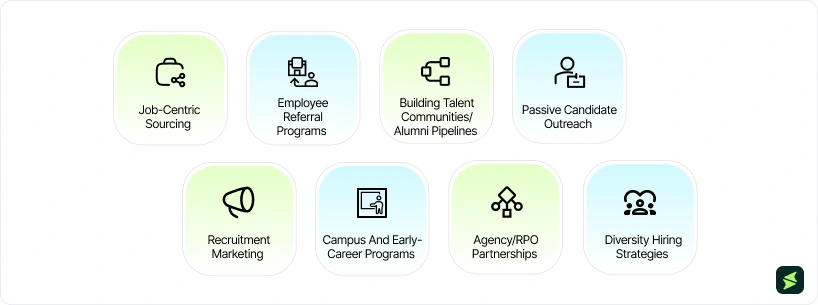
Good hiring depends on matching the approach to the role. These core strategies target the exact talent the company is missing.
Job-centric sourcing utilizes internal postings and public job boards like Indeed for Employers, LinkedIn, or Glassdoor. These help reach a wider range of candidates. HR leaders and Talent Acquisition (TA) managers create clear job descriptions and use these tools to match skills with open roles.
Posting internally first helps identify qualified employees, while moving to external boards benchmarks internal talent against the wider market.
Employee referral programs turn the workforce into a decentralized sourcing engine by incentivizing staff to recommend candidates from their professional networks. TA managers can formalize this by tracking referrals in the Applicant Tracking System (ATS) and offering tiered bonuses, such as payouts after a 90-day retention milestone.
This helps in avoiding the ‘cold start’ problem of traditional postings. This is because employees typically refer peers whose technical skills they can personally vouch for, protecting their own reputation.
Talent communities act as a proprietary bench of pre‑vetted professionals, including former employees and high-scoring candidates from past hiring cycles. TA managers maintain these pipelines by segmenting contacts into specific cohorts, such as 'Senior DevOps' or 'Product Leads', and sharing targeted updates on company products, tech stack changes, or upcoming projects.
This approach keeps top candidates engaged, prevents strong prospects from going cold, and opens the door for boomerang hires with prior institutional knowledge.
Passive candidate outreach focuses on connecting with top professionals who aren’t actively looking for a new job. TA managers identify them by reviewing Stack Overflow for Teams contributions, GitHub projects, or other evidence of expertise.
Rather than a generic job pitch, recruiters engage candidates in a meaningful conversation about leadership opportunities along with career growth that match their experience and skills. This requires careful, personalized communication to convince someone who is currently settled in their role.
Recruitment marketing is all about building a long-term Employer Value Proposition (EVP) rather than just filling roles. TA managers create and share targeted content - like 'day-in-the-life' videos, webinars, or white papers - through career pages, email campaigns, and Business-to-Business (B2B) channels. To see how people engage with content and what needs to change in the message, tools like Google Analytics.
SEO-optimized pages and remarketing keep the company visible to professionals exploring their next move. The goal is to make the organization a destination employer, highlighting culture, mission, and technical roadmaps while enhancing the candidate experience.
Campus programs create a direct connection between universities and the organization through career fairs, sponsored projects, and structured internship-to-hire programs. TA managers focus on target schools with courses – be it cybersecurity/data science - that match the company’s technical needs. Working closely with career centers and student organizations, firms can secure return-offer commitments from interns before they graduate.
A strong mentorship framework helps these junior hires hit billable or production targets within their first six months. This approach builds a scalable talent pipeline and reduces dependence on the competitive senior market.
Agency and Recruitment Process Outsourcing (RPO) partnerships let companies delegate candidate sourcing and vetting to external specialists. TA managers work with contingent agencies for hard-to-fill technical roles, paying only for successful placements, while RPO providers handle the entire hiring lifecycle, fully integrating with the company’s systems.
These partners bring advanced sourcing tools and deep, industry-specific networks that internal teams sometimes don’t have time to develop. By offloading the top-of-funnel work, HR leaders can focus on interviews and internal strategy. This keeps the talent pipeline strong even during rapid growth or hiring freezes.
Diversity hiring focuses on redesigning recruitment to attract talent from underrepresented groups, as it also helps in the reduction of unconscious bias. The process starts with anonymized resumes. Job descriptions are written in neutral language, and interviews follow clear guidelines reviewed by diverse panels.
HR leaders also partner with organizations like Women Who Code, National Society of Black Engineers (NSBE), or disability-focused networks to source outside the usual channels. This is all because companies now want to widen the candidate pool and prioritize ‘culture add’ over ‘culture fit’, building a workforce that reflects a global client base.
Hiring challenges differ across roles, and using the wrong approach can slow timelines, frustrate managers, and drive up costs. Selecting a strategy that aligns with specific needs enables HR leaders and TA managers to act decisively, fill positions faster, and maintain high-quality hires. The table below maps common hiring scenarios to the strategies that deliver the best results.
The Strategy Selection Matrix | ||
Hiring Challenge | Recommended Strategies | Why It Works |
High-Volume Hiring | Job-centric sourcing (internal postings, job boards), Employee referrals, Automated screening | Quickly fills pipelines with qualified candidates. Job postings and referrals drive volume, while screening tools filter for basic requirements |
Hard-to-Fill Or Niche Roles | Passive candidate outreach, Talent communities/alumni pipelines, Recruitment marketing | Engages passive or highly specialized candidates. Communities and branding keep talent warm until the right opportunity arises |
Urgent Hires/Critical Roles | Agency or RPO partnerships, High-touch direct outreach, Internal mobility | Outsourced partners or internal talent accelerate sourcing for urgent needs, maintaining quality under tight timelines |
Turning a talent strategy into a high-performing acquisition process requires moving from planning to repeatable action. HR leaders succeed by connecting strategy with the daily mechanics of the recruitment funnel. Here’s how to execute them effectively.
Before deploying resources, audit current hiring needs using an impact compared with effort. This ensures the recruitment manager isn't over-engineering simple hires or under-serving critical technical roles.
Implementation fails when the Ideal candidate profile is vague. Every search must begin with a Search Calibration Brief. This alignment document is created before sourcing and contains the role’s must-have skills, the tech stack, and success criteria. It also defines the 'Top 3 Deliverables' for the first 90 days to prevent mis-targeted sourcing.
Once the profile is locked, establish a multichannel outreach consistency. For passive talent, a single message is insufficient. Implement a standard three-touch workflow:
To secure elite talent, the initial application must be frictionless. Busy professionals may abandon processes that require manual data entry or account creation.
The strategy relies on the candidate’s perception of the brand at every stage. To stop candidates from entering a communication black hole, map experience touchpoints.
Implementation is incomplete without data-driven feedback loops. HR leaders should define clear North Star metrics, three to five key indicators that reveal whether the talent strategy is driving real business outcomes, not just activity. These may include time-to-fill for critical roles, candidate conversion rates at each stage of the hiring funnel, and retention rates for new hires.
Even the most sophisticated sourcing engine will fail if the internal process is riddled with operational friction. And the truth is that these mistakes don't just delay a hire; they stall product roadmaps and inflate the cost-per-acquisition. To protect the talent pipeline, we advise TA managers to eliminate some structural traps that include:
Nothing kills a high-quality pipeline faster than radio silence. Top-tier candidates, especially those engaged through passive outreach, are in active cycles with three or more competitors. And so, a delay of more than two business days in providing post-interview feedback signals organizational disarray. This, in turn, causes elite talent to disengage and move toward more responsive firms.
Posting generic descriptions that list 20+ mandatory skills without defining specific 90-day outcomes does nothing other than confuse the prospects. This lack of specificity attracts keyword-heavy resumes but fails to resonate with specialists. The result is a high volume of noise that forces the recruiters into endless, unproductive screening calls.
Leaning exclusively on a single platform, like LinkedIn, creates a strategic single point of failure. If that channel’s cost-per-click spikes or the algorithm changes, the talent flow evaporates. A resilient strategy requires a diversified mix of internal referrals, niche communities, and direct outreach to remain stable during market shifts.
Conducting unstructured 'coffee chat' interviews introduces significant unconscious bias and lacks predictive validity. Without a standardized rubric or a specific technical scoring system, hiring decisions become based on culture fit rather than competency. This inconsistency inevitably leads to poor hire quality and high turnover within the first six months.
Failing to survey candidates who decline offers or withdraw from the process leaves a massive blind spot. This data is the primary tool for identifying if the EVP is failing. It can also help figure if the salary is not competitive within the market anymore.
Expecting that a candidate should create a new username and password just to upload a resume for an initial touchpoint is a conversion killer. The best ATS software for recruitment agencies should minimize this friction with streamlined application flows that let candidates submit their details quickly and easily. High performers with limited time will abandon the process immediately, leaving the firm with a database of less-engaged applicants.

A hiring strategy defines priorities, but execution becomes difficult as volume and complexity increase. As referrals, direct sourcing, campus programs, and agencies run in parallel, manual coordination starts to break down. This is where recruitment software supports consistency and scale, without changing the strategy itself.
Rather than driving hiring decisions, software helps automate repeatable steps, centralize candidate data, and reduce handoffs. The goal is operational support, not tool-led hiring.
The table below shows how specific hiring goals align with the software used to support each strategy. Our table can help understand where technology fits once the approach is clear.
Strategy | Strategic Focus | Software Options | Why It Works |
Recruitment Marketing | Quality/Brand Equity | Helps employers build career sites, nurture talent pools, and manage candidate engagement | |
Campus/Early-Career | Future Talent | Handshake | Help companies engage with students and recent graduates via virtual career fairs, and more |
Agency/RPO | Niche/Speed | Helps with candidate sourcing and centralizes tracking to help agencies find and manage talent faster | |
Diversity Hiring | Bias Reduction | Helps remove bias in recruiting the language for job descriptions and inclusivity | |
Referral Programs | Retention | Tracks and incentivizes employee referrals, tying outcomes to retention‑focused hiring |
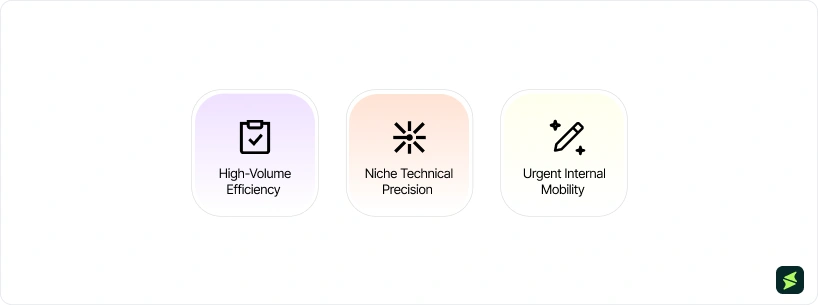
The sections below illustrate how some other tools can also be applied in real hiring scenarios, based on volume, urgency, and role complexity.
When the goal is moving hundreds of candidates through the funnel, the bottleneck is usually manual screening.
When hunting for specialized engineers, broad job boards are often ineffective.
The fastest hire for a critical gap is often an existing employee.
Ready to optimize your hiring? Every company’s needs are different. We, at Software Finder, can help identify recruiting software that matches your hiring volume and role requirements. Request personalized demos and find the tools that fit your workflow today!
Getting applicants but not the right ones - or losing top talent mid-process - is a common challenge. SHRM research has repeatedly shown that fragmented hiring processes and unclear role definitions can actually lead to longer time-to-fill and high turnover. Defined recruitment strategies help HR leaders and TA managers hire faster, improve fit, and control costs. Once your strategy is set, scale execution with top recruitment tools. Compare recruiting tool options and contact us to request demos and find the tools that perform the best for your hiring volume.